
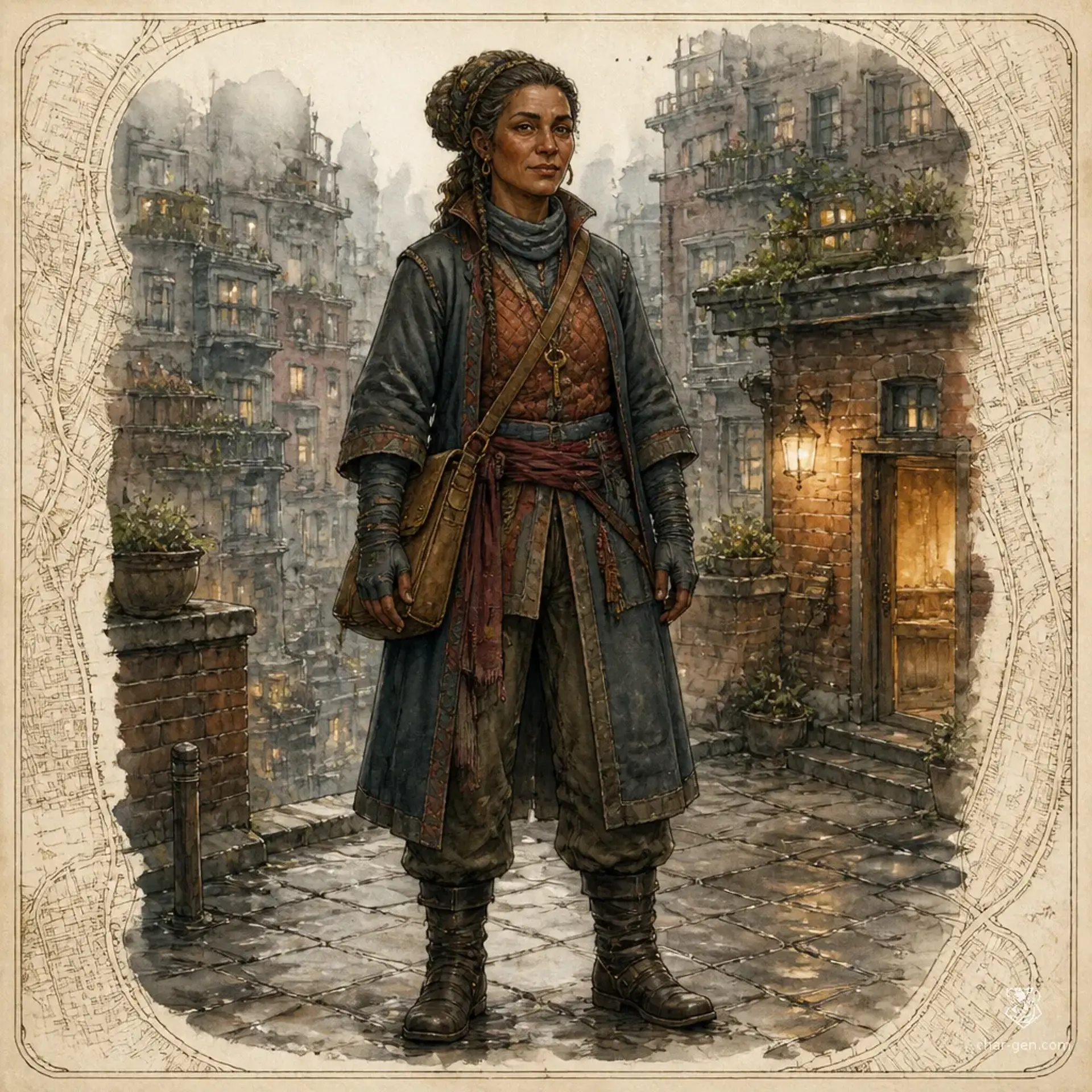
The Hearthbound are the people who know which baker leaves bread by the back door, which bridge groans before it collapses, and which landlord is lying about a vacant room. They are born into the crowded intimacy of city life, where survival depends less on solitude than on memory, cooperation, and knowing when to listen through a thin wall. A Hearthbound adventurer carries a neighborhood in their heart and can make a home almost anywhere, provided there is a roof, a kettle, and someone worth protecting.
Hearthbound ancestry is less a single appearance than a recognizable family of urban adaptations. They may be slight or broad, short or tall, with features recalling many humanoid peoples. Most have sturdy hands, flexible feet, keen peripheral awareness, and expressive faces shaped by generations of life in busy streets. Their complexions range from clay red and warm brown to slate, olive, copper, and pale gold. Hair is commonly worn in practical braids, wrapped coils, close cuts, or elaborate styles that identify neighborhood and family. Hearthbound eyes often seem unusually alert, as though constantly tracking movement at the edge of a crowd. Their clothing favors layered fabrics, hidden pockets, reinforced hems, and colors that remain respectable after a day of work.
Hearthbound culture is built from overlapping circles of belonging. A person may be claimed by a birth family, an apprenticeship, a street, a mutual-aid society, a temple, and a circle of lifelong friends, with each relationship carrying different duties. They are excellent at preserving practical knowledge, especially recipes, repair techniques, local routes, emergency signals, and oral histories. Privacy is respected inside the home, but public neglect is considered shameful. Hearthbound children are taught how to identify safe adults, read civic notices, share food fairly, and recognize the early signs of fire, flood, unrest, and famine. Their greatest social virtue is reliability. Their greatest social fear is becoming unnecessary.
Hearthbound religious practice is intimate and local. Many honor household spirits, civic saints, ancestral figures, road guardians, river powers, or deities of labor and hospitality. Even those who follow formal temples commonly keep a private shrine near the kitchen or front door. Their festivals commemorate rebuilt bridges, first harvests from rooftop gardens, the return of travelers, and the names of those who died without descendants. Hearthbound tend toward lawful or neutral outlooks because they value dependable obligations, but compassionate individualism and fierce rebellion are both respected when the community is being harmed.
The Hearthbound are found in old capitals, river ports, industrial boroughs, cliffside towns, and sprawling market cities. Their homes are rarely grand, but they are cleverly adapted to crowded conditions. A Hearthbound residence may occupy a narrow upper floor, a converted warehouse loft, a room above a shop, or a cluster of connected apartments joined by hidden stairways. They favor durable materials, foldaway furniture, shared courtyards, rooftop gardens, and small alcoves for household memorials. Their architecture assumes that neighbors will need one another, so doors, balconies, windows, and kitchens often open toward communal spaces rather than private gardens.
Hearthbound communities are woven into the larger populations of their cities. They often serve as clerks, craftspeople, innkeepers, messengers, negotiators, caretakers, investigators, and informal historians. Other peoples may mistake their neighborly habits for nosiness, or their practical generosity for an attempt to collect favors. In truth, Hearthbound culture treats trust as a shared infrastructure. They readily form friendships across ancestry lines, though they are wary of anyone who treats a city solely as a market, fortress, or stepping-stone. Rural communities may find them restless at first, while Hearthbound travelers often find open wilderness beautiful but socially exhausting.
A high-res, share-ready sheet you can post or print.