Medium or Small, chosen when you select this species
Rare
Construct
Construct·Medium or Small, chosen when you select this species
Prairieborn
Campus ferrum
Speed
30 ft.
Lifespan
Prairieborn do not age biologically, but their joints, memory cores, and animating matrices slowly degrade. With regular maintenance, they remain active for 150 to 300 years. Exceptional individuals can persist for many centuries through extensive restoration.
Darkvision
60 ft.
Habitat
Open plains, steppes, savannas, and other broad grasslands
construct
plains
guardian
ancient civilization
mobile society
monstrous ancestry
self-determination
field guide
SizeMedium or Small, chosen when you select this species
Speed30 ft.
LifespanPrairieborn do not age biologically, but their joints, memory cores, and animating matrices slowly degrade. With regular maintenance, they remain active for 150 to 300 years. Exceptional individuals can persist for many centuries through extensive restoration.
Creature TypeConstruct
Darkvision60 ft.
Across the endless grasslands walk the Prairieborn, ancient guardians built to defend a civilization that has vanished beneath the soil. They are not soldiers by nature, but every one of them carries a command, a memory, or a question from the age of their making. Some cross the world seeking purpose beyond obedience. Others travel as patient wardens, carrying water to the lost and judgment to those who despoil the open land. Wherever a Prairieborn stands beneath the sky, the old empires are not entirely dead.
Physical Description
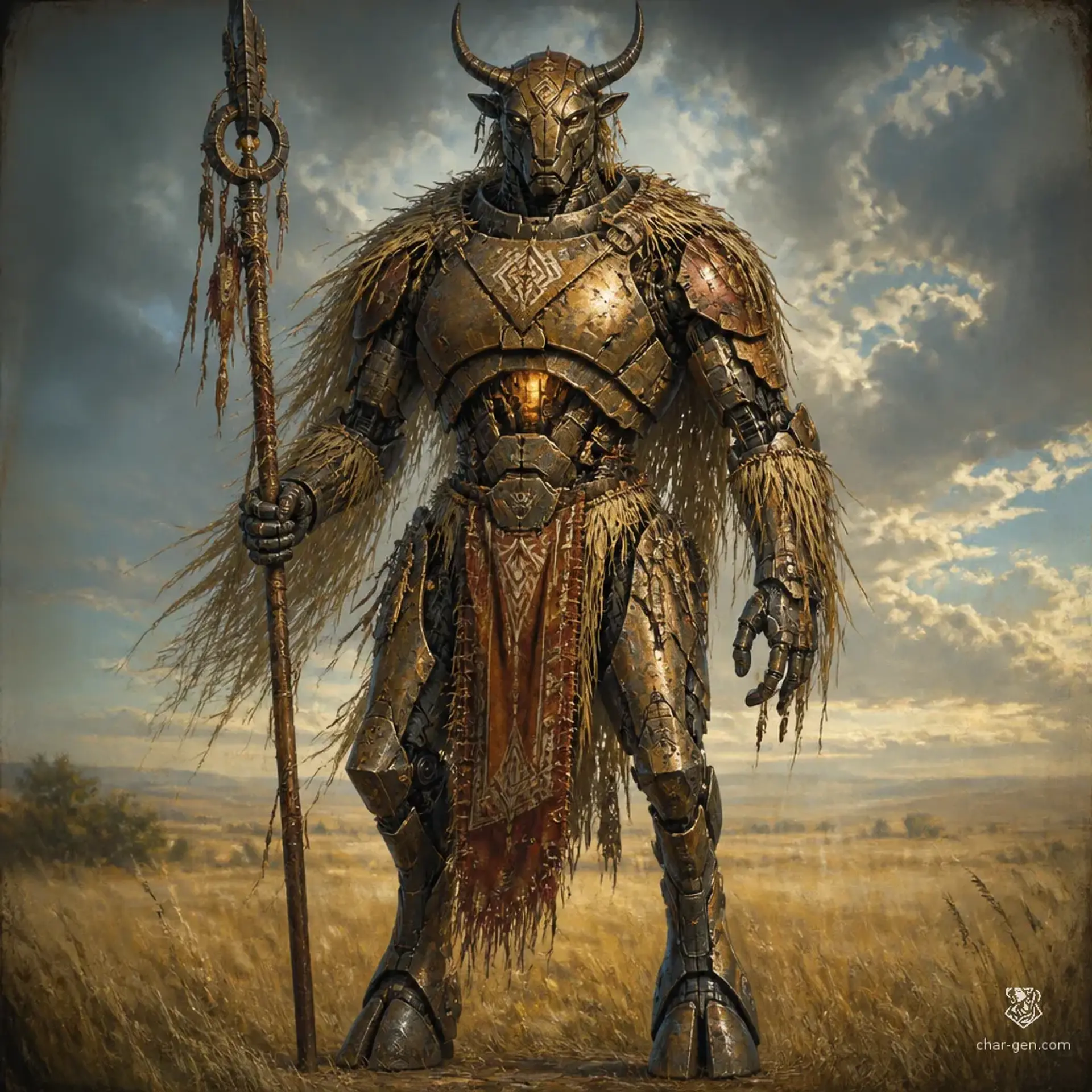
Prairieborn are tall, powerful constructs assembled from bronze, iron, ceramic, hardwood, and dense plates of sun-baked clay. Their bodies are usually humanoid in outline, though many possess digitigrade legs, broad hooflike feet, elongated arms, or heads modeled after antelope, horses, cranes, bison, and other plains animals. A Prairieborn's chest contains a resonant animating core known as a heart-forge. It glows faintly through vents or glass panels and produces a low vibration that can be felt more easily than heard. Their surfaces bear layered enamel, hammered clan symbols, and repairs accumulated over generations. They do not breathe, eat, or sleep in the mortal sense, but they must periodically enter a motionless maintenance trance. Most can mimic breath, speech rhythms, and body warmth well enough to pass briefly among living peoples, though their weight, precision, and unblinking gaze often reveal them.
Society & Culture
Prairieborn society is organized around herds, not by blood but by shared maintenance, mutual defense, and inherited memory. A herd may include several generations of constructs, living allies, adopted animals, and even a ruined machine kept as an honored ancestor. Each member is expected to contribute a useful function, but usefulness is not considered the same as worth. Their festivals mark seasonal changes, major repairs, the naming of newly awakened individuals, and the completion of long journeys. Music is central to Prairieborn identity. Drums, metal strings, rattling plates, and wind instruments preserve histories that cannot be stored in their damaged memory cores. Their most sacred custom is the First Refusal, a ceremony in which a newly awakened Prairieborn is offered a command and invited to decline it before choosing a personal name.
Religion & Alignment
Prairieborn do not share a single faith. Some honor the makers who first shaped them, while others worship storm spirits, ancestral landscapes, celestial cycles, or the mysterious force within every living thing. Many follow philosophies centered on chosen purpose rather than divine command. Their constructed nature does not dictate alignment. Lawful Prairieborn often preserve duties and agreements, neutral individuals prioritize practical stewardship, and chaotic members reject inherited commands in favor of self-determination. The most dangerous among them believe that all living beings are unfinished machines awaiting proper instructions.
Homelands & Architecture
Prairieborn settlements are low, mobile, and built to withstand relentless wind. Their oldest homelands are rings of stone and buried bronze foundries arranged around monumental signal towers. Newer communities travel with herds of ordinary animals, carrying collapsible shrines, repair forges, water casks, and weather vanes. Architecture favors rounded walls, sloped roofs, and underground chambers that remain cool during the day and warm at night. From a distance, a Prairieborn encampment resembles a herd of dark metal beasts grazing around a field of lanterns.
Relationships With Other Peoples
Living peoples often view Prairieborn as relics, weapons, omens, or curiosities before recognizing them as individuals. Plains communities generally respect them as guardians of roads, wells, and grazing grounds, while settled kingdoms may attempt to claim them as military assets. Prairieborn themselves vary widely. Some form deep attachments to biological families, some prefer the company of other constructs, and some fear that intimacy will reduce them to tools in another person's story. Their oldest diplomatic tradition is the Exchange of Repairs, in which two peoples publicly mend one another's damaged objects as a promise of mutual protection.
Visual sheet
Turn Prairieborn into a sheet
A high-res, share-ready sheet you can post or print.