Small or Medium, chosen when you select this species
Common
Humanoid
Humanoid·Small or Medium, chosen when you select this species
Hearthkin
*Hominis campestris*
Speed
30 ft.
Lifespan
Hearthkin mature at roughly 18 years and commonly live 75 to 90 years. Exceptional elders may reach a century, though few remain vigorous for all of it.
Habitat
Open plains, prairie, steppe, savanna, and gently rolling grasslands
humanoid
plains-dweller
mundane
communal
traveler
survivor
wayfinder
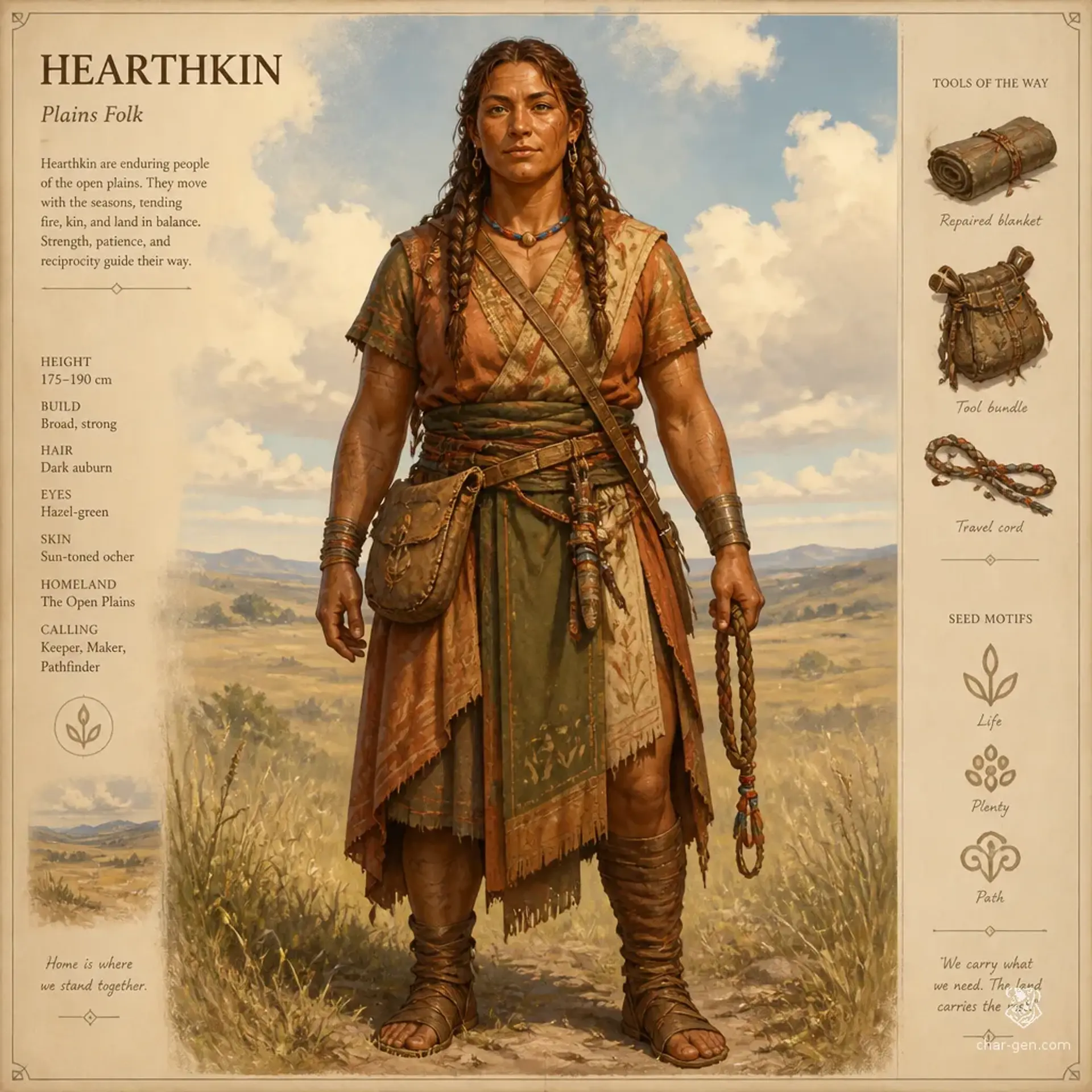
SizeSmall or Medium, chosen when you select this species
Speed30 ft.
LifespanHearthkin mature at roughly 18 years and commonly live 75 to 90 years. Exceptional elders may reach a century, though few remain vigorous for all of it.
Creature TypeHumanoid
The hearthkin are people of the long view, born beneath immense skies and raised to treat roads, wells, stories, and promises as things worth maintaining. They can cross a grassland without losing their way, make a shelter from almost nothing, and turn a tense gathering into a shared meal. Yet their calm is not passivity. When a route is threatened, a guest betrayed, or a community endangered, hearthkin patience becomes the steady force that outlasts louder powers.
Physical Description
Hearthkin are broad-ranging humanoids whose bodies vary considerably between clans and regions. Most stand somewhere between human and half-orc height, with sturdy frames shaped by walking, lifting, riding, and outdoor labor. Their skin ranges from sun-browned copper and russet to umber, olive, and warm ocher. Hair is commonly dark, auburn, tawny, or silver, often worn in practical braids decorated with beads, shells, or polished seeds. Their eyes are usually brown, hazel, gray, or green, and their faces tend to be expressive and weather-marked. Hearthkin clothing is layered and durable, designed to be repaired, wrapped against dust, or converted into carrying straps. Many wear a colored cord around the wrist or neck to indicate clan, profession, or a personal vow.
Society & Culture
Hearthkin society is organized around hearth-circles, extended households that may include blood relatives, sworn companions, apprentices, adopted children, and honored guests. Several hearth-circles form a clan, while clans cooperate through seasonal councils and market gatherings. Leadership is usually practical and temporary. A person may speak for the community because they understand water rights, settle disputes fairly, remember old agreements, or know how to survive a particular danger. Hearthkin children are taught that every skill has a social purpose. Hunting, weaving, cooking, mapping, horse care, masonry, storytelling, and even accounting are treated as forms of guardianship. Public boasting is considered embarrassing, but quiet competence earns lasting respect.
Religion & Alignment
Hearthkin religion centers on the Hearth-Memory, a collection of ancestral examples, seasonal rites, and local spirits associated with wind, water, soil, and fire. Most communities honor practical virtues rather than demanding exclusive devotion to a single deity. Ancestors are remembered through recited names, repaired tools, and repeated acts of kindness. Hearthkin often lean toward good or neutral alignments, valuing communal responsibility, but individual clans may be disciplined, fiercely independent, forgiving, or highly legalistic.
Homelands & Architecture
Hearthkin settlements are built low against the wind, with rounded homes of packed earth, sod, timber, and woven reed. Villages gather around a communal fire court or sheltered well. Larger towns are arranged along old roads and migration paths, with tall marker poles visible for miles. Their architecture favors repair, portability, and shared storage over ornament. Even permanent homes usually contain a collapsible shelter, a travel chest, and a wall reserved for family maps.
Relationships With Other Peoples
Hearthkin are accustomed to meeting outsiders on roads, at markets, and around seasonal gathering places. They often serve as guides, drovers, messengers, caravan guards, healers, and negotiators. They respect settled peoples who maintain their land responsibly and are wary of nobles or conquerors who treat open country as empty. Hearthkin usually welcome dwarf-like stoneworkers, goblin-kin traders, and elf-like wanderers, though relations vary by local history. They have little patience for raiders, slavers, and anyone who poisons wells or burns pasture without regard for those who depend on it.
Visual sheet
Turn Hearthkin into a sheet
A high-res, share-ready sheet you can post or print.