Ashbound do not age in the ordinary sense. Many remain vital for a century or more, and their true lifespan is shaped more by injury, dissolution, or ritual unraveling than by time. A well-kept Ashbound may endure for generations.
Darkvision
60 ft.
Habitat
Ashbound are found in grave districts, old battlefields, bone-dry marches, cathedral crypts, and borderlands where the dead are remembered more carefully than the living. They thrive anywhere ritual, recordkeeping, and duty can give shape to an otherwise fragile second life.
undead
oathbound
gravekeeper
battlefield revenant
funerary tradition
necrotic resistance
field guide
D&D 5E 2024
homebrew ancestry
SizeMedium
Speed30 ft.
LifespanAshbound do not age in the ordinary sense. Many remain vital for a century or more, and their true lifespan is shaped more by injury, dissolution, or ritual unraveling than by time. A well-kept Ashbound may endure for generations.
Creature TypeUndead
Darkvision60 ft.
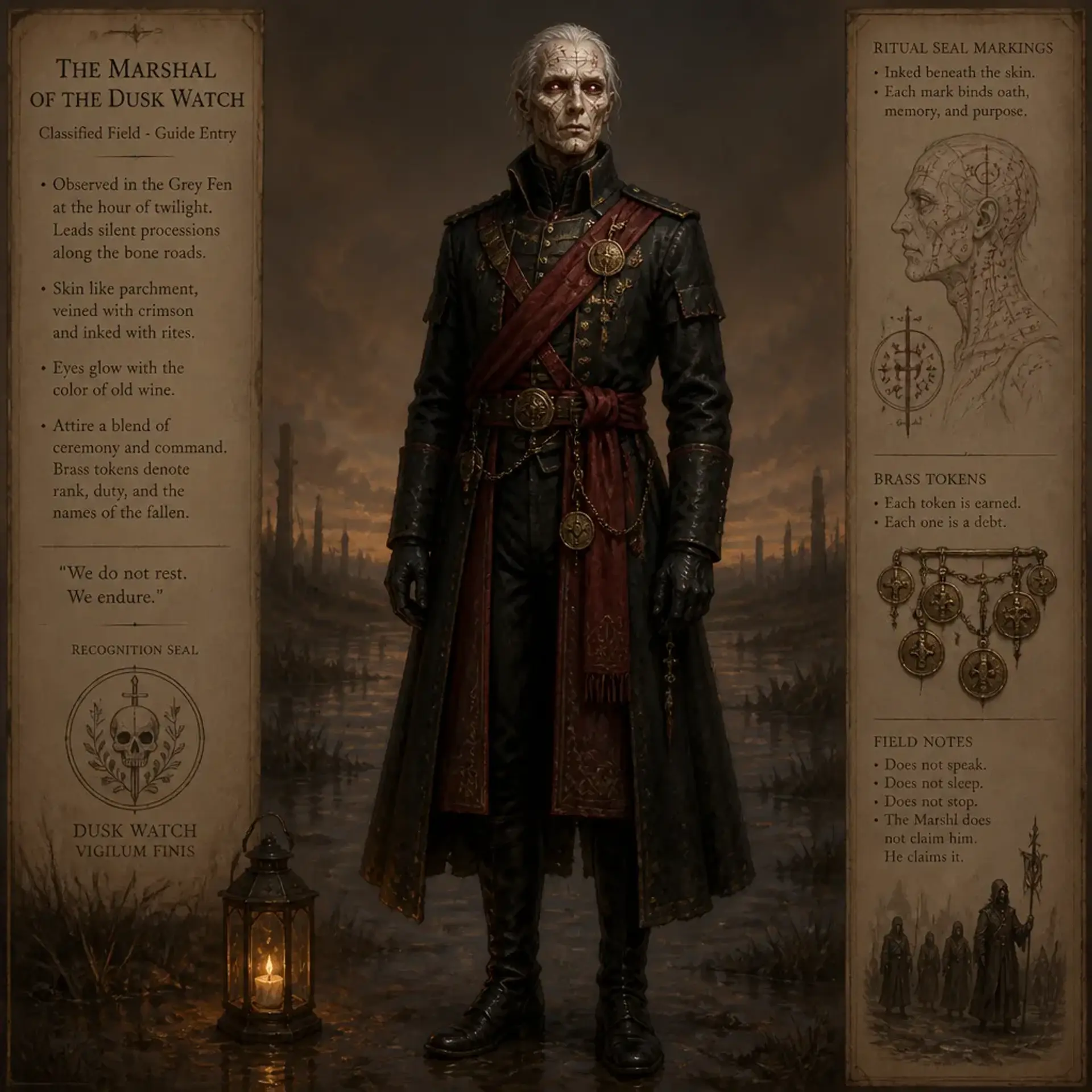
The Ashbound are the dead who refused to be finished. Raised by vow, burial rite, or battlefield miracle, they return with memory sharpened into purpose and with a body that feels more like a trusted relic than flesh. Some serve as guardians of tombs and treaties, some as mourners, magistrates, or soldiers who outlived their war, and some simply walk because no one ever taught them how to stay still. Wicke the Crimson Marshall belongs to the oldest tradition among them, where red insignia marks not conquest, but the solemn authority to command the living and dead alike when the line between them grows thin.
Physical Description
Ashbound are recognizable at a glance by the way death seems to have been curated rather than suffered. Their skin ranges from pale parchment to deep soot-gray, often marbled with faint crimson veins or old seal-like markings. Their eyes are usually ember-bright, wine-dark, or pale as candle flame. Hair may grow slowly, unusually fine or brittle, sometimes appearing silvered at birth of the second life. Many retain the posture of their former calling, whether soldier, priest, courtier, or undertaker. Their voices often carry a low resonance, as though spoken through a sealed chamber. They do not rot in the common sense, but they may dry, crack, or weather if neglected.
Society & Culture
Ashbound culture is built around continuity. They preserve names, records, funeral customs, and service oaths with an almost obsessive tenderness. Many households maintain a death ledger where important promises, debts, births, and burials are written side by side, because to the Ashbound these are all forms of lineage. They favor formal greetings, shared silence, and practical gifts such as oil, thread, seal wax, and well-made gloves. Celebration is not absent from their lives, but it is disciplined, often ritualized into toast, anthem, and memorial. A child is taught how to maintain a lantern before they are taught how to bargain, and an adult is judged less by how loudly they live than by how faithfully they endure.
Religion & Alignment
Most Ashbound are not bound to a single faith, though many keep to funerary traditions, ancestor rites, or oath-based cults. Their moral outlook is often shaped by the moment of their return, so they can be found among lawful guardians, compassionate caretakers, grim pragmatists, and, more rarely, fervent rebels against death's finality. They are rarely casual about ethics. To an Ashbound, alignment is less a label than a ledger of what one owes and what one has protected.
Homelands & Architecture
Their homelands are often built around ash cairns, mortuary avenues, and civic ossuaries that double as archives. Ashbound architecture favors thick walls, narrow light wells, red lacquer, iron hinges, and interior courtyards where lanterns can burn safely through long nights. Homes are organized by vow, not by blood, with sealed alcoves for masks, insignia, letters, and funerary tools.
Relationships With Other Peoples
Ashbound are often respected, feared, or quietly sought out. The living admire their discipline but may resent their calm certainty. Priests and undertakers usually treat them as sacred anomalies, while warlords and archivists see them as useful witnesses who cannot easily be bribed by fear. Some communities welcome them as protectors of tombs and memory, while others regard them as reminders that grief can take a body and make it useful. They tend to prefer allies who keep promises, speak plainly, and do not mistake stillness for weakness.
Visual sheet
Turn Ashbound, the Crimson-Lit Undead into a sheet
A high-res, share-ready sheet you can post or print.