
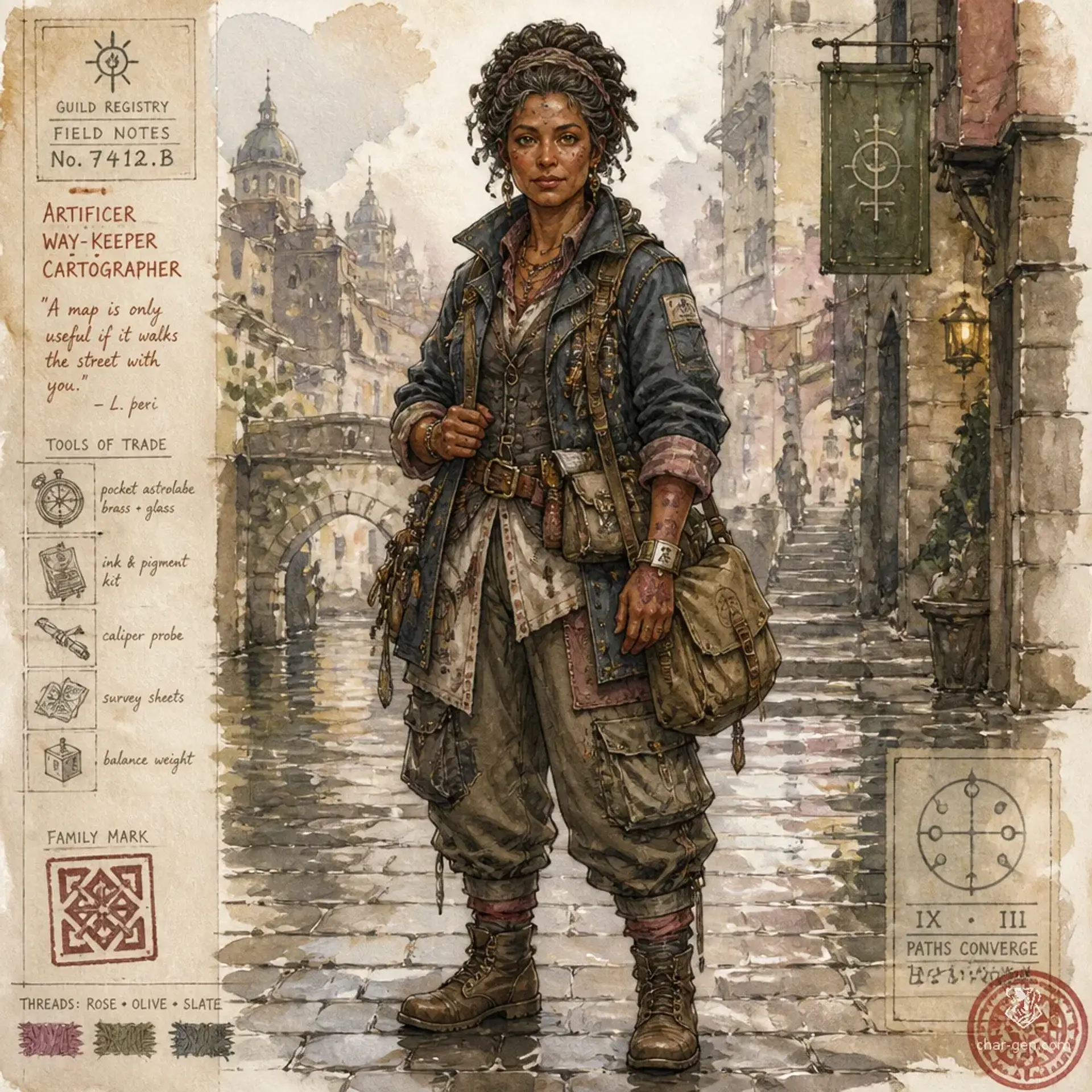
You are the Ledgerkin, city-born keepers of names, routes, promises, and practical truths. You can tell who repaired a wall by the shape of its mortar, which alley floods first in a storm, and whether a stranger belongs in a neighborhood by the way they greet its doorways. To outsiders, you may seem merely observant and industrious. In truth, every city is an organism, and you are among the few who can feel when it has begun to forget itself.
Ledgerkin are compact, adaptable humanoids with sturdy frames shaped by generations of urban labor. Their skin ranges from warm brown and copper to slate, olive, cream, and muted rose, often marked by freckles or faint patches of pigment on the hands and face. Their eyes are large and observant, commonly amber, gray, hazel, or deep blue. Hair is usually thick and worn in practical braids, cropped styles, wrapped coils, or tied cords that display family colors. Most Ledgerkin have nimble hands, broad feet suited to uneven paving, and a strong sense of balance. Their clothing is layered and functional, with numerous pockets, reinforced seams, hidden loops, and stitched labels identifying ownership or trade.
Ledgerkin society is organized around neighborhoods, trades, mutual-aid circles, and extended households rather than a single nation or throne. A person may belong simultaneously to a family, a street association, a professional guild, a religious fellowship, and a circle of close friends. Social status comes from reliability more than wealth. The most respected Ledgerkin are those who can be trusted with a key, a child, a confession, or an emergency repair. Disputes are often settled by witnesses and written testimony, but communal shame can be more powerful than any court. Celebrations include street feasts, public mending days, memorial processions, and competitions in navigation, accounting, cooking, and improvised engineering.
Ledgerkin religion is practical, local, and intensely personal. Many honor household guardians, patron saints of trades, river powers, departed ancestors, or abstract virtues such as Measure, Shelter, and Witness. Temples commonly double as schools, clinics, archives, or public kitchens. Ledgerkin tend toward lawful or neutral philosophies because reliable agreements make crowded life possible, though many become chaotic when institutions protect privilege instead of people. A Ledgerkin hero may follow a strict code, preserve tradition selectively, or reject all authority except the obligations freely accepted.
Ledgerkin homelands are old cities, crowded river ports, walled market towns, and sprawling capitals where generations have built over one another. Their homes often occupy narrow vertical spaces above shops, beneath bridges, or within the unused corners of civic buildings. Architecture emphasizes adaptable rooms, hidden storage, shared courtyards, rooftop gardens, soundproof workspaces, and doors marked with family seals. A Ledgerkin district may look improvised to outsiders, but every stair, awning, and alley has a remembered purpose.
Ledgerkin are accustomed to living among many peoples and often serve as translators between communities, not only through language but through custom. They respect people who maintain a place, repair what others abandon, or remember the dead without seeking praise. They are wary of aristocrats, revolutionaries, and outsiders who speak of cities as objects rather than homes. Individual Ledgerkin may be warm, suspicious, blunt, or highly formal, but most understand that urban life depends on cooperation among people who do not share the same values.
A high-res, share-ready sheet you can post or print.