Small or Medium, chosen when you select this species
Common
Humanoid
Humanoid·Small or Medium, chosen when you select this species
Ruunai
*Vastavulpes ambulans*
Speed
30 ft.; climb 20 ft. on natural surfaces
Lifespan
Ruunai mature at roughly 16 years and commonly live 80 to 100 years. Their final decades are often marked by a gradual whitening of the coat and a heightened sensitivity to changes in weather.
Darkvision
You have no darkvision, but your keen hearing and sensitivity to air movement help you navigate familiar terrain in dim light.
Habitat
Open plains, steppe, savanna, prairie, and high grassland
plains
wanderer
caravan
beast-speaker
scout
humanoid
variable-size
SizeSmall or Medium, chosen when you select this species
Speed30 ft.; climb 20 ft. on natural surfaces
LifespanRuunai mature at roughly 16 years and commonly live 80 to 100 years. Their final decades are often marked by a gradual whitening of the coat and a heightened sensitivity to changes in weather.
Creature TypeHumanoid
DarkvisionYou have no darkvision, but your keen hearing and sensitivity to air movement help you navigate familiar terrain in dim light.
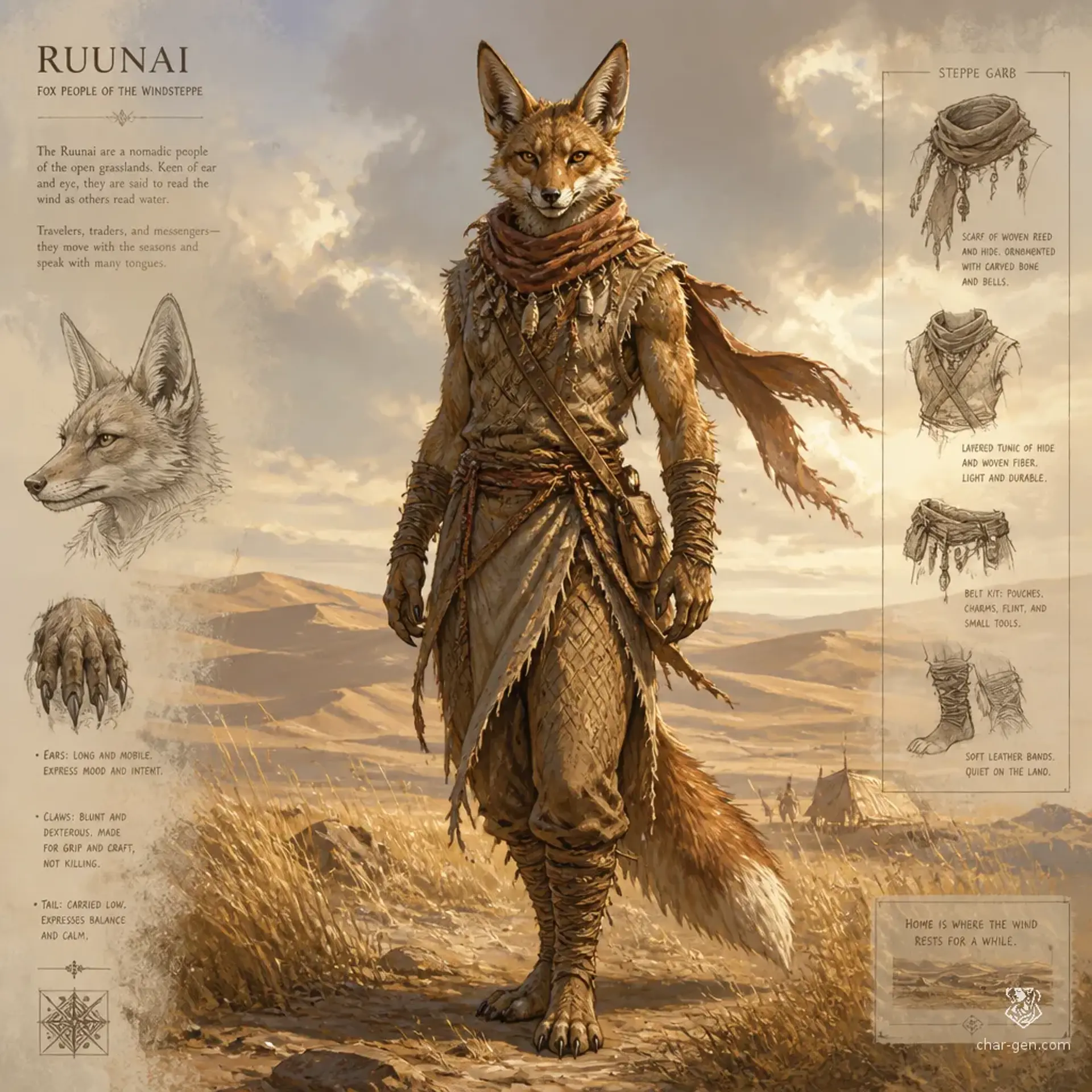
The Ruunai are fox-faced wanderers of the open world, born beneath enormous skies and raised to read every road, hoofprint, and shift of wind. They travel in clans, build homes that can be folded into a caravan, and treat memory as a form of navigation. A Ruunai adventurer may be a scout following a vanished route, a mediator carrying an ancestral promise, a healer seeking a lost herb, or simply a restless soul who has discovered that the horizon is not the edge of the world, but an invitation.
Physical Description
Ruunai are rangy, long-limbed humanoids with a distinctly vulpine cast to their faces. Their ears are tall and mobile, their noses narrow, and their eyes range from amber and hazel to storm-gray. A coat of short fur covers the body, thickening at the neck, forearms, calves, and tail. Coat colors include tawny gold, russet, charcoal, cream, silver, and mottled combinations that resemble dry grass or dappled shade. Their tails are expressive and usually carried low while traveling, both to conserve moisture and to avoid snagging on brush. Ruunai hands are dexterous and almost human in shape, with dark, blunt claws suited to digging, climbing, and gripping reins. They are not naturally secretive creatures, but their soft footfalls and patient stillness make them capable hunters and scouts.
Society & Culture
Ruunai society is organized around extended clans that travel, trade, and herd together. Clan membership is based on kinship, adoption, sworn service, and shared history rather than blood alone. Children are taught that every person carries three duties: leave water for those who follow, remember those who came before, and never make a promise without considering who else will bear its weight. Storytelling is their highest art, with skilled speakers using rhythm, gesture, and repeated refrains to preserve maps, laws, genealogies, and warnings. Their economy combines herding, seasonal agriculture, hunting, guidework, leathercraft, weaving, and long-distance trade. Disputes are traditionally settled through public testimony and a ritual walk, in which each side must lead the other to a place that proves its claim.
Religion & Alignment
Ruunai religion centers on the Living Horizon, a broad spiritual tradition that regards wind, weather, migration, and memory as expressions of a single world-spanning vitality. Most clans honor local spirits of springs, stones, animals, and ancestral roads without insisting that one pantheon is universally correct. Their rituals use ribbons, bells, smoke, footprints, and shared meals. Ruunai tend toward neutral alignments, valuing freedom, reciprocity, and practical compassion, though individual clans may be strongly lawful, fiercely independent, or devoted to heroic acts of mercy.
Homelands & Architecture
Ruunai settlements are rarely fixed for long. Their great homes are circular windbreaks of woven reed, hide, and flexible timber, designed to be dismantled and carried by pack beasts. Permanent sites use low stone foundations, sunken communal halls, and tall marker poles crowned with ribbons that reveal the prevailing winds. The largest settlements are built around watering places and seasonal meeting grounds, where several clans gather to exchange news, arrange marriages, settle disputes, and renew ancient routes.
Relationships With Other Peoples
Ruunai are generally welcoming to travelers, though they judge people by how they treat animals, dependents, and shared resources. They have a practical respect for settled peoples who maintain roads, wells, and archives, but they distrust rulers who claim permanent ownership over land or movement. Ruunai often form strong friendships with caravaners, rangers, farmers, and beast handlers. Their directness can be mistaken for rudeness, while their communal habits may seem intrusive to cultures that prize strict personal boundaries.
Visual sheet
Turn Ruunai into a sheet
A high-res, share-ready sheet you can post or print.