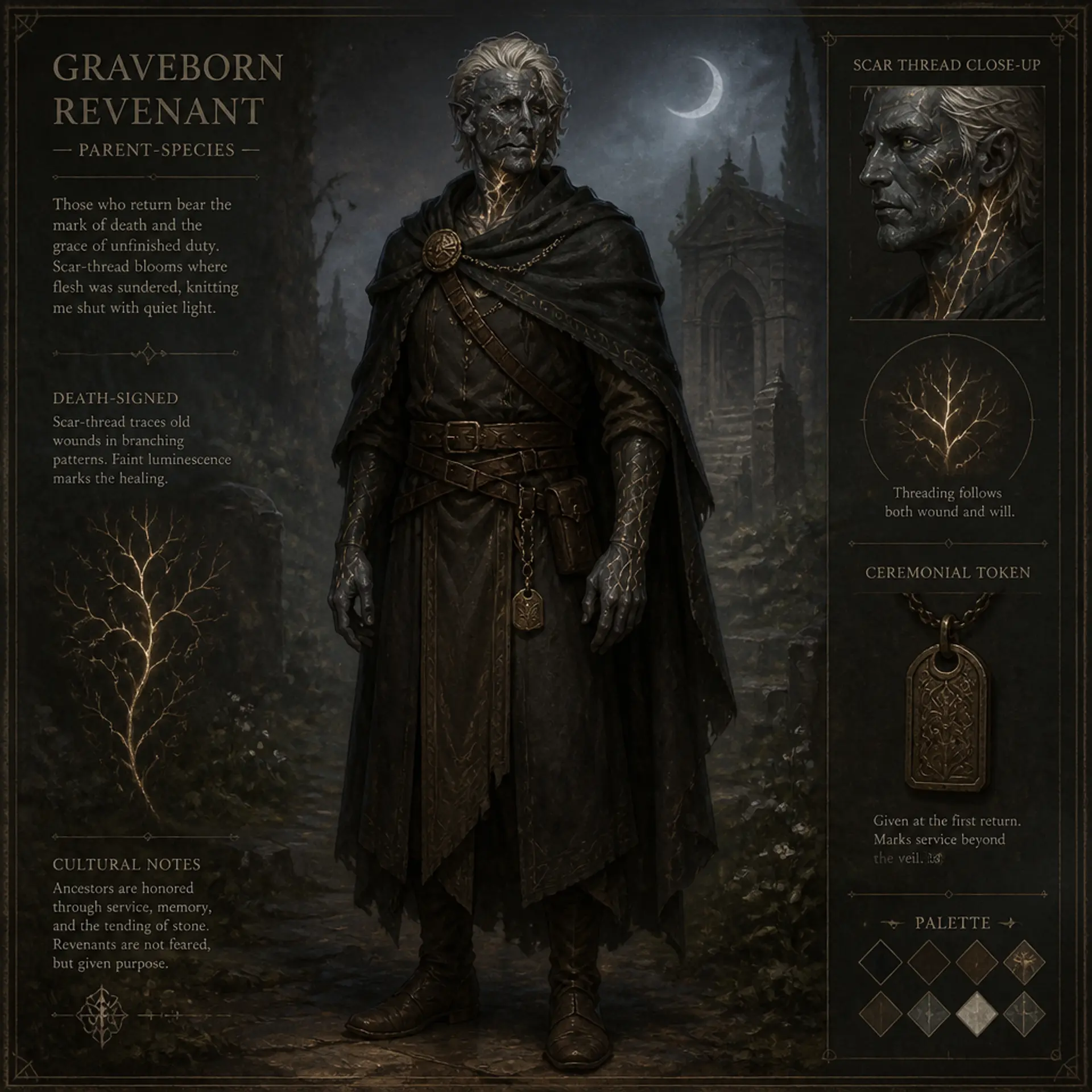
Humanoid·You retain the size of your parent species.
Everlasting
*Revenantia perpetua*
Speed
You retain the walking speed and other movement speeds of your parent species.
Lifespan
Everlasting do not die of old age. They mature at the rate of their parent species and may live indefinitely, returning from death unless permanently slain by another Everlasting.
Habitat
Everlasting communities are found wherever their parent peoples live, though they often gather near battlefields, execution grounds, ancient tombs, and other places where death has left a lasting mark.
immortal
revenant-like
regeneration
parent-species heritage
deathless
humanoid
gothic fantasy
SizeYou retain the size of your parent species.
SpeedYou retain the walking speed and other movement speeds of your parent species.
LifespanEverlasting do not die of old age. They mature at the rate of their parent species and may live indefinitely, returning from death unless permanently slain by another Everlasting.
Creature TypeHumanoid
You belong to no separate people. You were born among another race, loved by them, taught their customs, and marked by a death that should have ended everything. Instead, you returned. Now every wound is a question, every funeral a warning, and every Everlasting you meet carries a legacy that could become yours if you are willing to murder the only person who can truly kill you. The next time your heart stops, someone will be waiting to see what comes back.
Physical Description
An Everlasting looks like a member of its parent species, retaining that people's height, proportions, coloring, natural weapons, senses, and other physical characteristics. Subtle signs reveal the deeper condition: scars that close in branching patterns, pupils that briefly brighten after injury, a heartbeat that may stop without warning, or a faint chill surrounding old wounds. After returning from death, the body may bear a new mark corresponding to the manner of its demise. These marks are called death-signs and are worn with the same mixture of pride and embarrassment that other peoples reserve for family heirlooms.
Society & Culture
There is no single Everlasting culture. Each member belongs first to the society of their parent species, then to the hidden fellowship of those who have died and returned. Among themselves, they share customs called the Returning Rites. These include naming the cause of death, leaving a token at the place of demise, and asking the returned person what they remember from the interval. Everlasting communities are usually small because secrecy is safer than recognition. Their greatest taboo is the unauthorized killing of one of their own, since such an act can end a life permanently and transfer ancestral traits to the killer.
Religion & Alignment
Everlasting beliefs vary according to their parent cultures. Some worship deities of death, rebirth, memory, or fate, while others reject all divine explanations and regard their condition as an accident of nature. They tend toward alignments shaped by long memory. Compassion may deepen across centuries, but so may resentment. Many are drawn toward lawful habits because ritual gives structure to repeated loss, while others become fiercely chaotic after deciding that no mortal institution can understand them.
Homelands & Architecture
The Everlasting rarely build separate nations. Instead, they adapt the architecture of their parent cultures with practical additions: sealed recovery chambers, memorial corridors, hidden escape routes, and rooms designed to be reopened after decades of abandonment. Their homes often contain a personal death shrine, not for worship, but for recording the circumstances of each return.
Relationships With Other Peoples
The Everlasting live inside other peoples rather than alongside them as a clearly separate race. Some families conceal an Everlasting child, fearing persecution or exploitation. Others treat the condition as a sacred inheritance, a curse, or proof that the dead have unfinished work. Most Everlasting retain their parent species' customs, but their relationship with ancestry is complicated. They are simultaneously descendants, survivors, and potential inheritors of anyone else who carries the same strange immortality.
Visual sheet
Turn Everlasting into a sheet
A high-res, share-ready sheet you can post or print.