30 ft., fly 20 ft. or glide as appropriate to the campaign's handling of wings
Lifespan
Typically 120 to 180 years, though those who sink too deeply into sorrow or curse-work may fade sooner, and some who relearn wonder can linger well beyond.
Darkvision
60 ft.
Habitat
Ancient forests, overgrown orchards, moonlit glades, and ruined gardens where living things still grow among old sorrow.
Fey
Fairy
Dark Fairy
Forest
Monstrous
Powerful
Tragic
Gothic
Homebrew
Generic Fantasy
Variable Size
Winged
Shadowed Grace
Lost Paradise
Mournful Magic
Monstrous Fae
Roleplay Forward
Subspecies
Rare
Forest Dweller
Spirit-Touched
Bitter Beauty
Ancient Grief
Nocturnal
SizeVariable
Speed30 ft., fly 20 ft. or glide as appropriate to the campaign's handling of wings
LifespanTypically 120 to 180 years, though those who sink too deeply into sorrow or curse-work may fade sooner, and some who relearn wonder can linger well beyond.
Creature TypeFey
Darkvision60 ft.
Born from the garden of everything that was good, the fallen fairies were once radiant caretakers of laughter, blossom, and harmless mischief. Then something terrible entered paradise, and the world never returned to its first shape. They survived the lesson by becoming watchful, shadowed, and difficult to fool. A fallen fairy can still be lovely beyond reason, but their beauty now carries the hush of storm clouds over a ruined orchard, and every smile seems to ask whether the listener truly deserves it.
Physical Description
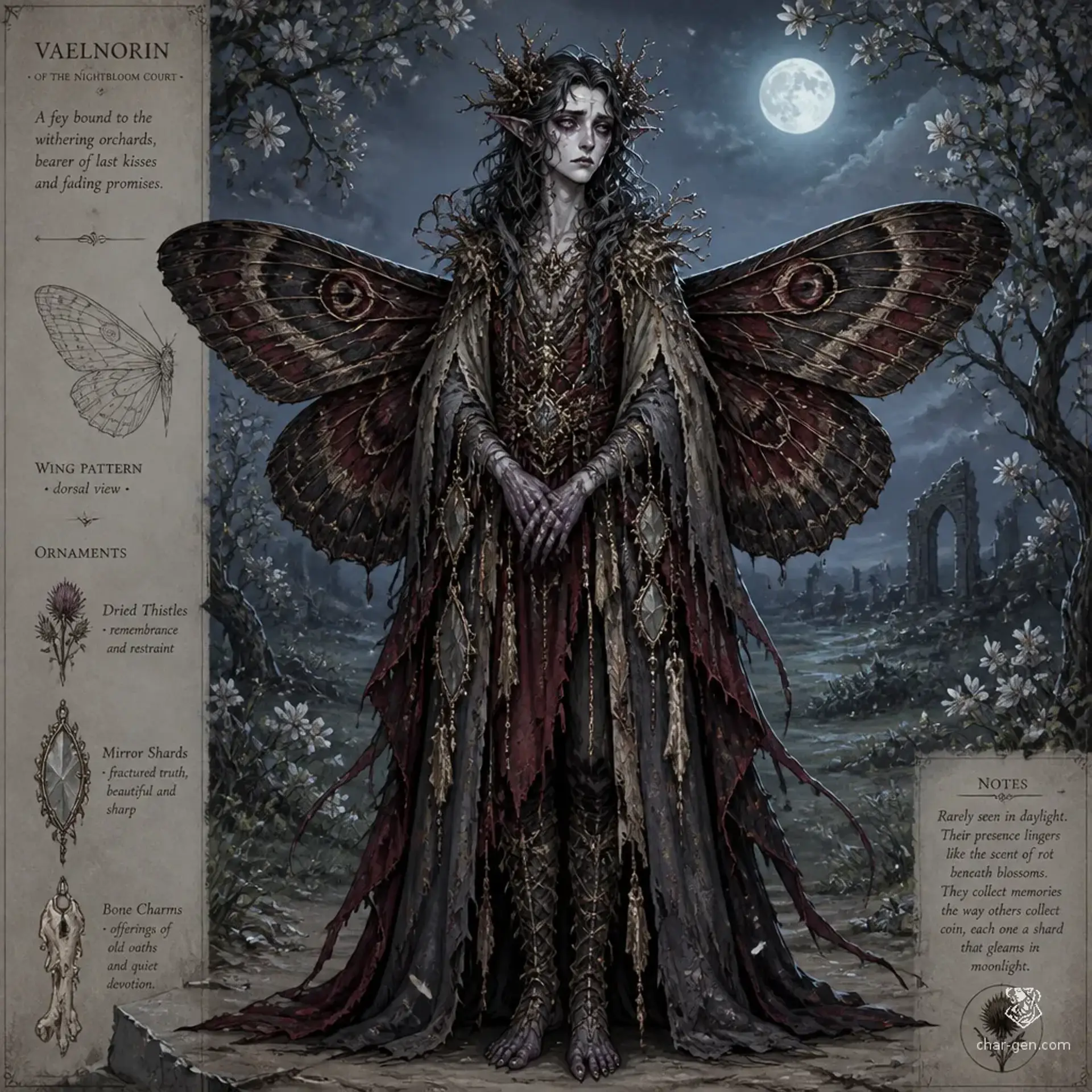
Fallen fairies are what remains when joy has been starved but not extinguished. Their skin tends toward ash-pale, dusk-brown, bruised violet, or muted green, and their former bright colors survive only in dim undertones at the throat, eyes, fingertips, or the veins of their wings. Their wings resemble those of moths, dragonflies, or fragile leaves after frost, often patterned in grays, blacks, wine reds, and tarnished gold. Their features are fine and expressive, almost painfully so, as if every feeling leaves a visible mark. They favor thornlike ornaments, dried flowers, and charms made from bone, seed, or broken mirror glass.
Society & Culture
Their society is built around remembrance. Songs record injuries as often as celebrations, and every court keeps historians who can recite the exact shape of the loss that changed their people. They prize craft, secrecy, and emotional discipline, but they also maintain elaborate rites of mourning, apology, and renewal. Young fallen fairies are often taught to name three beautiful things and three terrible truths each dawn, so neither wonder nor caution is allowed to starve. They value chosen family over bloodline, and their social rank often depends on who can endure sorrow without becoming numb to it.
Religion & Alignment
Fallen fairies are not uniformly dark in spirit, but their faiths tend toward reverence for cycles, endings, forgotten gods, and the holiness of surviving pain. Some worship garden saints, moon spirits, or the nameless patron of thresholds. Others reject all gods after witnessing too much. Their alignments often drift toward the pragmatic, the bitterly kind, or the fiercely vengeful, though any individual can choose another path. Among them, cruelty is admired only when it serves a purpose, while needless innocence is respected but rarely trusted.
Homelands & Architecture
Their homes are stitched from living branches, fungus-glow lanterns, thorn lattice, and pale glass that catches moonlight like a wound. They prefer layered shelters built into roots, hollow stumps, and high bower-bridges that can be folded away from danger. Their architecture is elegant but guarded, with many hidden exits, private sanctums, and memorial niches for lost names. Every dwelling keeps one bright room or one flowering corner, because even the fallen insist on preserving a place where beauty is not yet ashamed.
Relationships With Other Peoples
Other folk often find fallen fairies unsettling, because their courtesy can feel like a test and their kindness can feel expensive. They are wary of the openly cruel, fascinated by the secretly broken, and unexpectedly gentle with children, animals, and the exhausted. Elves and sylvan peoples may treat them as tragic cousins or dangerous omens, while witches, hedge-mages, and mortals who have suffered loss often become their closest allies. They rarely forget a debt, but they also rarely forgive an insult without a story attached to it.
Visual sheet
Turn Gloamfairies into a sheet
A high-res, share-ready sheet you can post or print.