Typically 180 to 300 years, with rare Rooted elders living longer. They reach physical maturity around age 20.
Darkvision
60 ft.
Habitat
Old battlefields, sealed laboratories, deep forest sanctuaries, ruined hospitals, volcanic valleys, and any settlement where skilled healers can be found.
regenerative
immortal-adjacent
healer
resilient
constructed ancestry
body horror
memory-keeper
SizeMedium
Speed30 ft.
LifespanTypically 180 to 300 years, with rare Rooted elders living longer. They reach physical maturity around age 20.
Creature TypeHumanoid
Darkvision60 ft.
The Morrowkin do not fear death as much as they fear being remembered incorrectly. They walk out of fires, rise from battlefields, and mend beneath the hands of strangers, carrying every scar as evidence that survival is not the same as living. When one of them joins the company, the party gains a tireless watcher, an impossible patient, and someone who knows exactly what it means to be broken while still expected to stand.
Physical Description
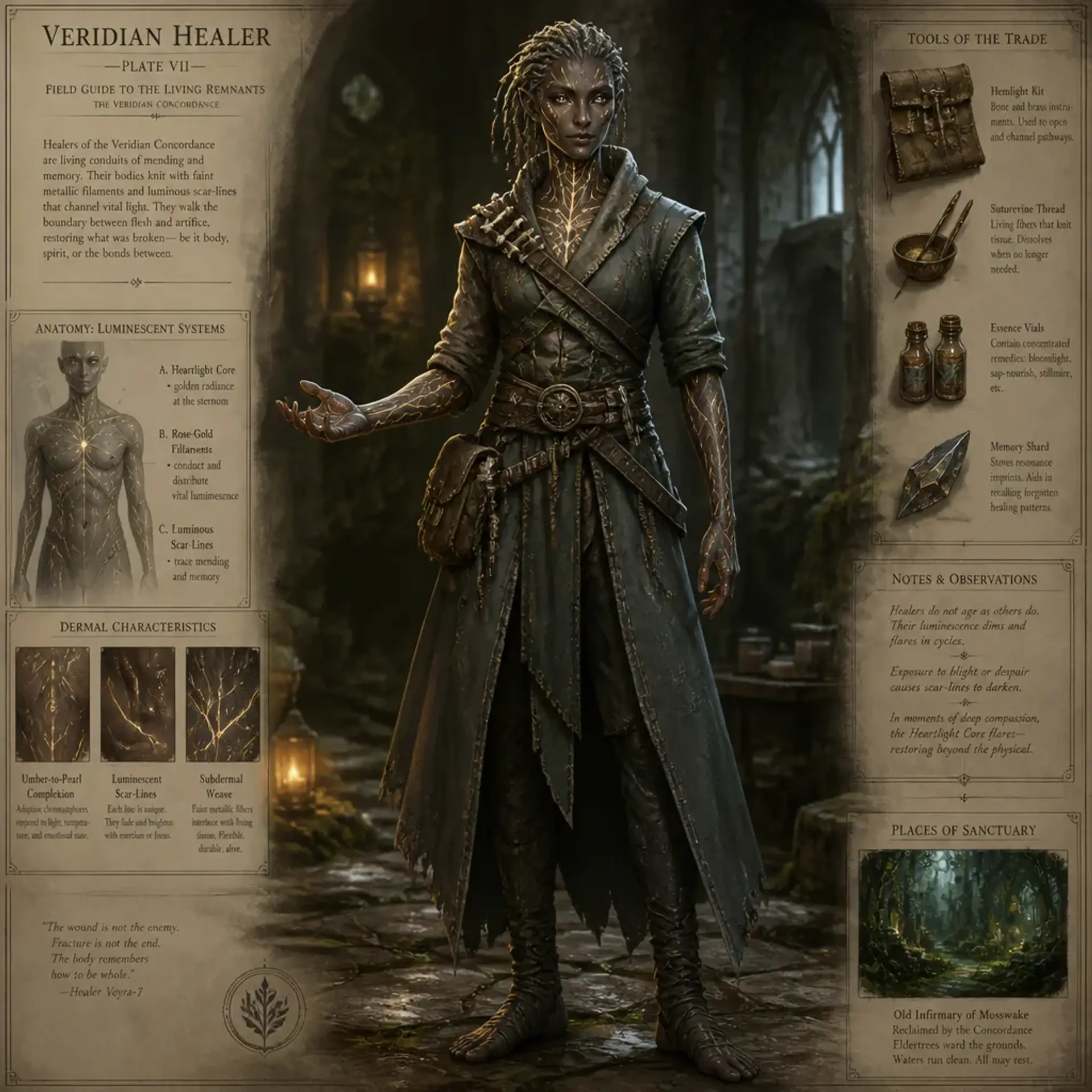
Morrowkin resemble slender humanoids whose bodies are woven from living tissue, flexible cartilage, and faintly metallic fibers beneath the skin. Their complexions range from umber and pearl to slate, copper, and translucent gray. Fine lines of amber, blue, or green light appear beneath their skin when they are frightened, injured, or emotionally overwhelmed. Hair may grow in ordinary strands, soft quills, mosslike filaments, or glossy cords. A fresh wound seals with pale, threadlike tissue before fading into a scar that often retains the color of the individual's inner light. Their eyes possess reflective pupils and can seem almost wet with starlight. Every Morrowkin bears a birth-mark called a first seam, the place where their body completed its initial regeneration.
Society & Culture
Morrowkin culture distinguishes between remembering pain and worshiping it. Each settlement maintains a house of witness where members record major injuries, deaths, reconciliations, and acts of courage. They celebrate the Day of First Seam, marking the anniversary of each person's awakening, and exchange repaired objects as gifts. Children are taught practical anatomy alongside ethics, because knowing how a body works is considered incomplete without knowing when not to interfere. Their storytellers often perform in pairs, one recounting what happened and the other describing what it felt like.
Religion & Alignment
Morrowkin faith centers on the Returning Pulse, a spiritual principle that teaches all life moves through cycles of fracture, renewal, and change. Some honor gods of healing, craft, memory, or the grave, while others regard regeneration as a sacred responsibility rather than a miracle. Their communities tend toward compassionate neutrality, though individuals may become fiercely protective, deeply ascetic, or dangerously utilitarian in the name of survival.
Homelands & Architecture
Their oldest homes are built around living structures: ironwood halls, mineral chambers, and clay vaults threaded with warm conduits of sap, blood, or alchemical fluid. Doors are broad and circular, both to accommodate damaged bodies and to symbolize return. In newer settlements, they favor communal infirmaries, memorial gardens, and rooms with no sharp corners. A home is considered unfinished until it contains a place where the wounded can be seen without shame.
Relationships With Other Peoples
Morrowkin are welcomed by some communities as miraculous healers and feared by others as unnatural survivors. They often become physicians, scouts, bodyguards, undertakers, and archivists, professions that benefit from patience and resilience. Ordinary folk may mistake their immunity and tirelessness for arrogance, while Morrowkin may misread ordinary bodily needs as weakness. The most lasting friendships usually begin when both sides learn that vulnerability is not measured by how quickly a wound closes.
Visual sheet
Turn Morrowkin into a sheet
A high-res, share-ready sheet you can post or print.