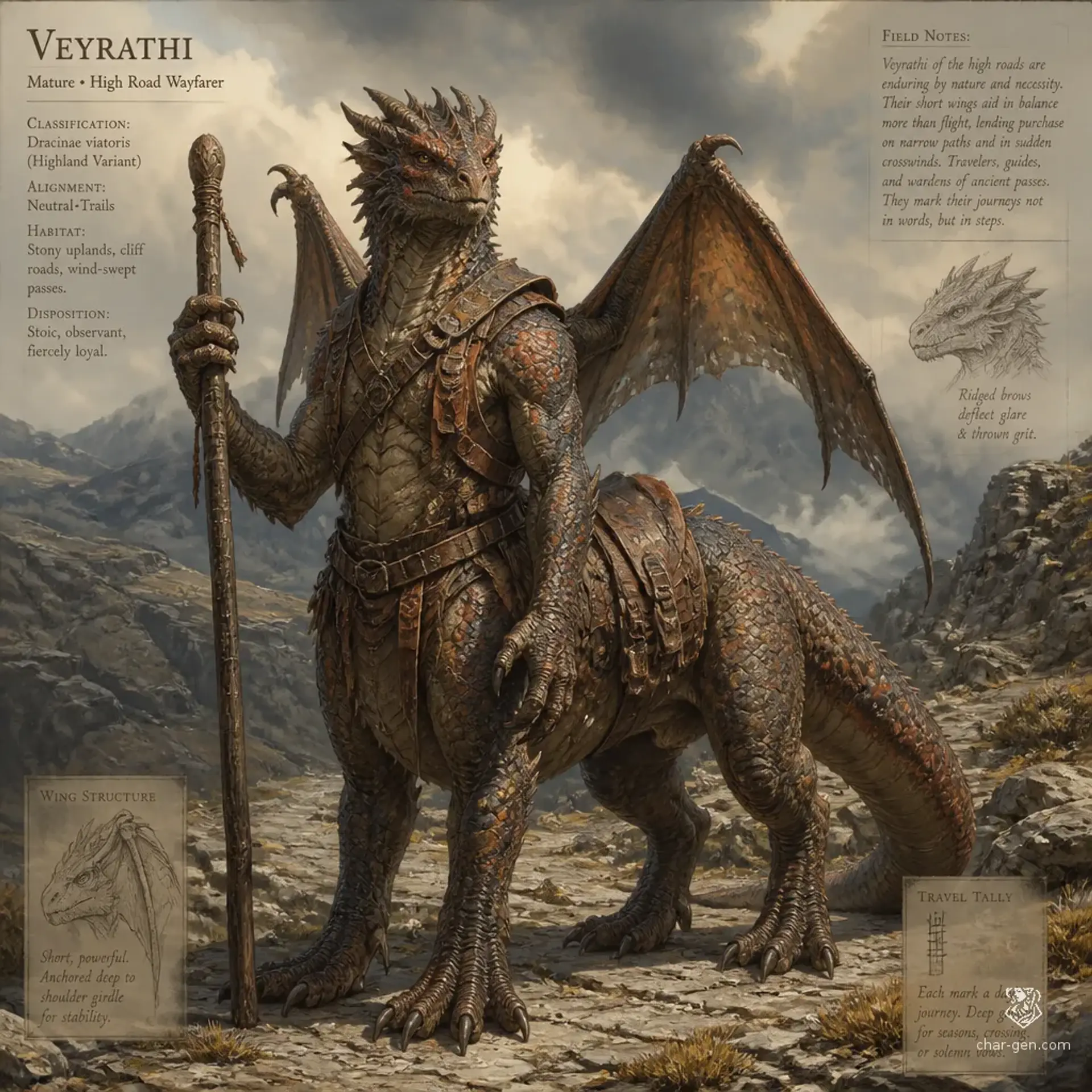
Veyrathi mature around 18 years and commonly live 75 to 90 years.
Habitat
Highland valleys, broken mesas, dry mountain forests, cliffside roads, and stony uplands where wide paths and sheltered ledges are readily available.
draconic
mountain-dweller
grounded-wyvern
centaur-like
balanced-mobility
mundane
SizeMedium
Speed35 ft.
LifespanVeyrathi mature around 18 years and commonly live 75 to 90 years.
Creature TypeHumanoid
The Veyrathi are road-keepers, cliff-dwellers, and patient survivors, born with the body of a grounded wyvern and the hands of a human. They can rear high enough to look a traveler in the eye, though few remain there without a cane, wall, or trusted companion nearby. Their pride is not in appearing graceful, but in continuing forward when grace fails.
Physical Description
Veyrathi possess a humanoid torso joined to a powerful wyvern-like quadrupedal body. Their lower frame ends in broad, taloned feet suited to stone and scrub, while their upper bodies bear clawed hands, narrow muzzles, slit pupils, ridged brows, and overlapping scales in shades of rust, slate, sand, moss, or deep umber. Small wings rise from the shoulders or ribcage, but these are too short and heavy for true flight. They use them for balance, display, cooling, and sudden bursts of momentum. A Veyrathi can rear onto its hind legs to reach shelves, threaten an enemy, or fight from a higher angle, but the posture is unstable. Most carry a stout cane, staff, or hooked walking pole, not as a mark of infirmity but as an ordinary tool of balance and travel.
Society & Culture
Veyrathi culture is organized around households, route-guilds, and watch circles. Children learn early that every settlement survives through shared attention: someone checks the ropes, someone watches the weather, someone remembers which ledges are safe. Hospitality is practical and direct, involving food, a secure resting place, and clear directions. Public displays of pride are common, but boasting without demonstrated reliability is mocked. Cane-making is a respected craft, and many Veyrathi decorate their walking poles with family marks, travel tallies, or tiny bells that warn others when a crowded path is near.
Religion & Alignment
Veyrathi religion centers on endurance, weather, ancestry, and the reciprocal duties of travelers. Some honor storm spirits or ancient draconic powers, while others revere local mountains as living witnesses. Their communities commonly favor lawful or neutral traditions, but individual Veyrathi may be fiercely independent, compassionate wanderers, or disruptive champions of change.
Homelands & Architecture
Veyrathi settlements are built around broad switchbacks, sunken courtyards, and sturdy ramps rather than narrow stairs. Homes usually have low entrances for a four-legged approach, high rafters for standing residents, and exterior rails that provide support during storms or moments of fatigue. Communal halls contain long benches, padded posts, and cane racks, all treated as practical signs of hospitality rather than accommodations to be hidden.
Relationships With Other Peoples
Veyrathi are valued as guides, laborers, scouts, caravan guards, and patient negotiators. Other peoples often mistake their low voices and guarded posture for hostility, or assume that their draconic features imply a taste for violence. Veyrathi generally answer such assumptions with dry humor, though repeated disrespect can harden into lasting distrust. They have close ties with human farming communities, mountain dwarven-like clans, and goblin-kin traders who share their preference for durable roads and practical contracts.
Visual sheet
Turn Veyrathi into a sheet
A high-res, share-ready sheet you can post or print.