Small or Medium, chosen when you select this species
Common
Humanoid
Humanoid·Small or Medium, chosen when you select this species
Rafterkin
Urbanis rimacursor, an optional scholarly classification meaning “edge-walker of the city”
Speed
30 ft.
Lifespan
Rafterkin mature at roughly 16 years and commonly live 70 to 85 years. Individuals who spend their lives in stable communities sometimes reach their early nineties.
Darkvision
None
Habitat
Urban
urban
humanoid
climber
communal
courier
subtle fantasy
citywise
SizeSmall or Medium, chosen when you select this species
Speed30 ft.
LifespanRafterkin mature at roughly 16 years and commonly live 70 to 85 years. Individuals who spend their lives in stable communities sometimes reach their early nineties.
Creature TypeHumanoid
DarkvisionNone
Rafterkin are the people who live in the city’s overlooked seams. They know which baker leaves bread by the back door, which watch captain can be bribed with honesty, which rooftops hold after-rain mushrooms, and which alley becomes dangerous when the bells stop. Compact, alert, and stubbornly communal, they turn urban knowledge into a form of survival, carrying maps in their memories and entire neighborhoods in their loyalties.
Physical Description
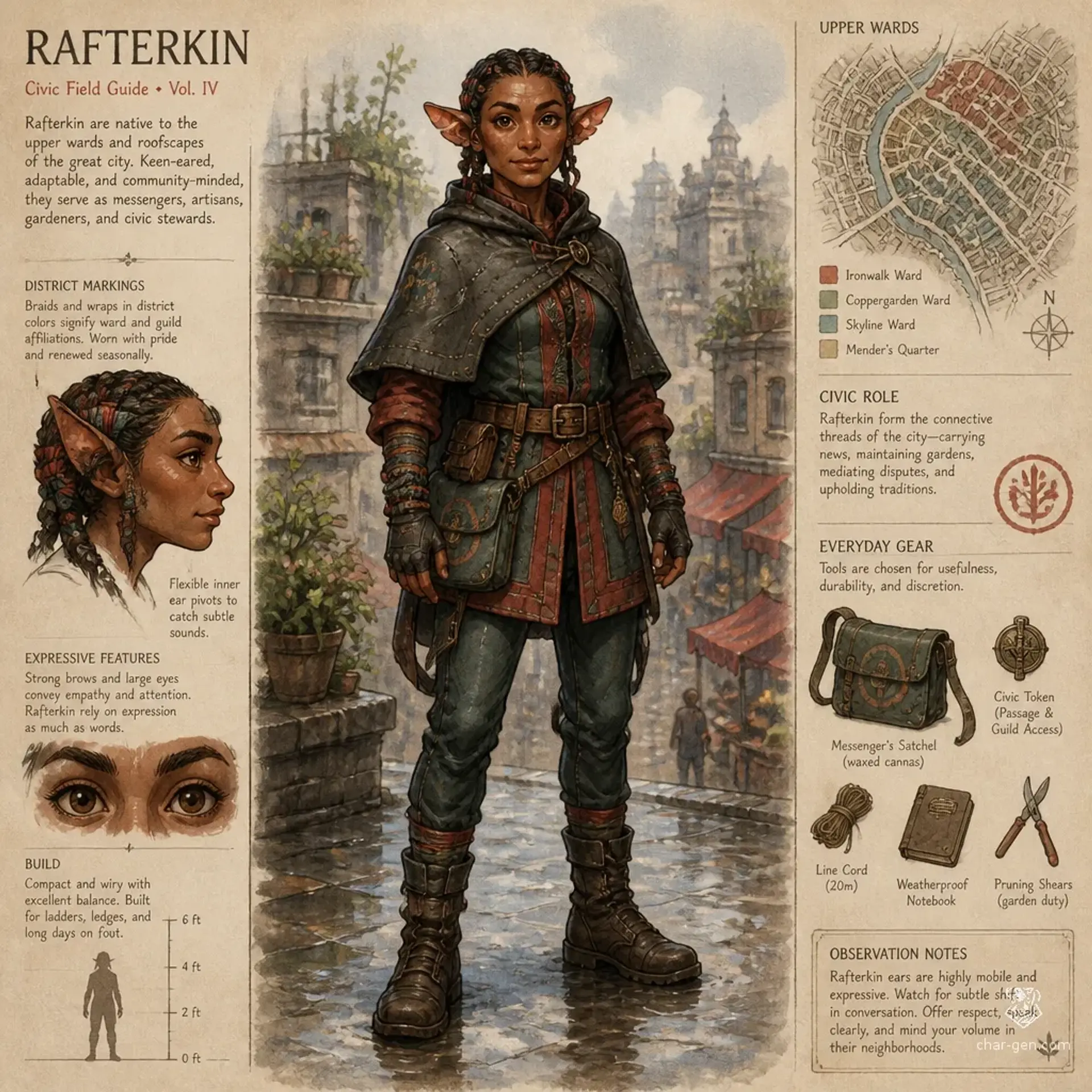
Rafterkin are compact, adaptable humanoids whose features vary widely between family lines. Their faces often have broad cheekbones, expressive brows, and large, attentive eyes, though their most distinctive trait is a flexible inner ear that can subtly angle toward nearby sounds. Their hands and feet are strong without being clawed, with thickened pads along the fingers, palms, and soles from generations of climbing stairs, masonry, and roof beams. Skin tones range from warm umber and copper to olive, rose-brown, slate, and pale gold. Hair is commonly worn short or braided close to the head, both for safety and convenience, and many Rafterkin mark their ears, wrists, or collars with the colors of their home district.
Society & Culture
Rafterkin society is organized around neighborhoods rather than bloodlines alone. A person may belong to a birth family, an apprenticeship circle, a rooftop household, a trade association, and a district council at the same time. Their most important social virtue is attentiveness: noticing who is missing, which roof is weakening, where a child has wandered, or when a familiar street has grown strangely quiet. Hospitality is offered through practical gifts such as directions, repairs, food wrapped for travel, and a safe place to sleep. Public storytelling is a civic duty, and many communities preserve history through route-songs that encode names, disasters, migrations, and agreements in memorable verses.
Religion & Alignment
Rafterkin religion is local, practical, and layered over older traditions. Most households honor a collection of threshold spirits, remembered founders, protective ancestors, and civic saints associated with bridges, wells, fires, gates, and bells. Formal temples are respected, but many Rafterkin believe a shrine is only as holy as the care given to its neighbors. Their communities tend toward neutral and good alignments, valuing reciprocity, responsibility, and survival, though individual Rafterkin may become fiercely lawful, opportunistically chaotic, or morally distant after years of witnessing civic injustice.
Homelands & Architecture
Rafterkin neighborhoods occupy the overlooked layers of a city: attic galleries, bridge houses, bell towers, service alleys, old aqueducts, and rooftop gardens. Their architecture favors narrow staircases, crawlspaces, foldaway furniture, covered walkways, and doors positioned to protect privacy without isolating the household. Most districts maintain a communal roofline, a shared route of ladders and platforms that allows residents to move above street level during floods, riots, or market congestion. Buildings are decorated with practical signs such as painted gutter marks, knotted cords, brass chimes, and patterned shutters.
Relationships With Other Peoples
Rafterkin are found in nearly every large settlement, usually as established minorities rather than isolated enclaves. They often serve as intermediaries between cultures because they understand local custom, commercial etiquette, and the practical needs of ordinary residents. Wealthy families may employ them as couriers or household stewards, while city authorities value their knowledge and fear their informal networks. Rafterkin generally respect rural peoples but find the countryside unsettlingly unstructured. They are especially wary of aristocrats who treat streets as property and outsiders who mistake familiarity with a city for servitude.
Visual sheet
Turn Rafterkin into a sheet
A high-res, share-ready sheet you can post or print.