Moonhares mature at about 15 years and commonly live 70 to 90 years. Hearth-Moons reaching a century are rare but not regarded as supernatural.
Habitat
Open plains, grass seas, dry savannas, flower steppes, and the edges of cultivated farmland
rabbit-centaur
beast-folk
plains
nomadic
hunter
ranger
druid
barbarian
dragoon
small-sized
SizeSmall
Speed30 ft.
LifespanMoonhares mature at about 15 years and commonly live 70 to 90 years. Hearth-Moons reaching a century are rare but not regarded as supernatural.
Creature TypeBeast-folk
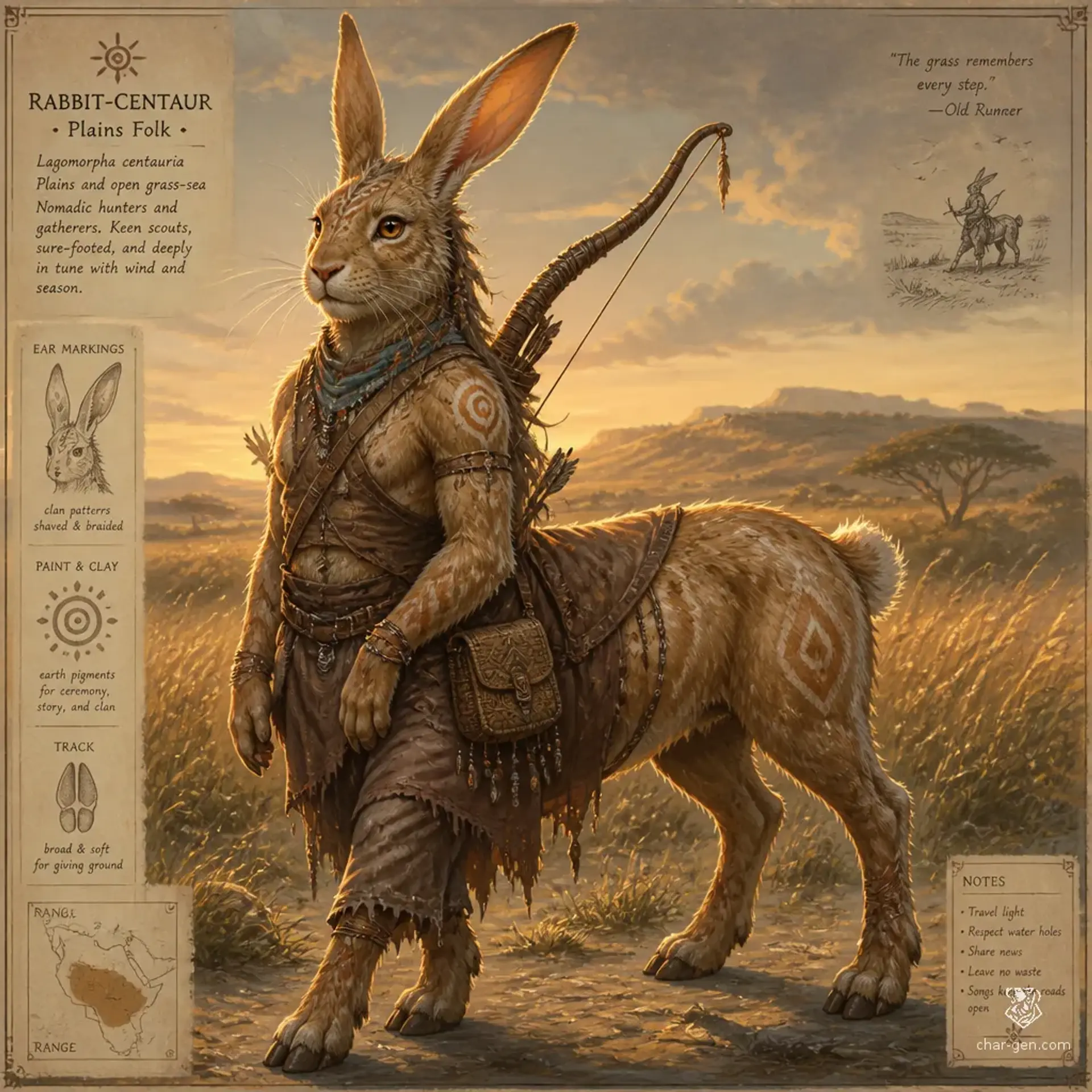
Moonhares are small rabbit-centaurs of the open plains, swift hunters and watchful travelers whose family bands follow old roads written into grass, stone, and memory. Most live as nomadic clans, but some have made homes in cities, where their restless instincts find expression in courier work, scouting, trade, and fierce neighborhood loyalty. A moonhare adventurer may carry a bow, a lance, a drum, or simply the conviction that every horizon hides a path worth taking.
Physical Description
Moonhares are small centauroid beast-folk with the compact upper body, long ears, expressive whiskers, and powerful hindquarters of rabbits joined to a sturdy four-legged frame. Their lower bodies are built for explosive acceleration rather than prolonged galloping, with broad feet suited to soft soil and hard-packed trail alike. Fur ranges from winter white, oat, russet, charcoal, and sandy gold to mottled combinations of all five. Many clans decorate their coats with temporary clay pigments, braided ribbons, or shaved patterns. Their eyes are large and reflective, often amber, brown, gray, or deep red. A moonhare's ears reveal mood with remarkable clarity, from relaxed outward sweeps to rigid, forward-pointing alarm.
Society & Culture
Traditional moonhare society is organized around trail-clans, extended families that share hunting rights, child-rearing, tools, and oral history. Leadership is usually divided among a trail-chief who handles immediate decisions, a route-keeper who preserves migration knowledge, and a hearth-circle of elders who arbitrate disputes. Hunts are cooperative rituals, and the first portion of every kill is offered to the clan's dependents, guests, and working animals. City moonhares often form warrens by district rather than bloodline, replacing migration with networks of safe houses, market stalls, rooftop gardens, and messenger routes. Whether nomadic or urban, they prize hospitality, speed, memory, and the ability to notice what others overlook.
Religion & Alignment
Moonhare spirituality centers on the living world, the remembered dead, and the invisible network of paths connecting every creature. Some revere named nature spirits, seasonal deities, or ancestral guides, while others speak of the Great Warren, a sacred metaphor for the interdependence of life. Druids and rangers are especially respected, but no single religious office dominates clan life. Moonhares often favor good or neutral alignments, valuing freedom, mutual aid, and practical compassion, though ambitious city folk and strict clan guardians can embrace any moral outlook.
Homelands & Architecture
Nomadic moonhares travel in small family bands, following seasonal forage, game migrations, and ancestral routes marked by standing stones, braided grasses, and painted wayposts. Their temporary camps use low windbreaks, collapsible awnings, and shallow sleeping hollows hidden beneath woven screens. Permanent moonhare communities are often built into the margins of larger cities, where their neighborhoods feature broad ramps, sunken courtyards, communal kitchens, rooftop gardens, and tunnel-like passages scaled for their compact bodies. Even urban homes usually include an open running space and a quiet nook facing the sky.
Relationships With Other Peoples
Moonhares are curious about settled peoples and often become trusted guides, couriers, scouts, and frontier negotiators. They respect communities that share food and protect travelers, but they distrust governments that fence common land or restrict movement without consultation. Elven and human cities often welcome moonhare traders while misunderstanding their clan obligations. Dwarf-like peoples tend to appreciate their practical craftsmanship, while goblin-kin communities frequently share their love of improvised routes and communal markets. Moonhares judge individuals more by how they treat the vulnerable and the land than by ancestry.
Visual sheet
Turn Moonhare into a sheet
A high-res, share-ready sheet you can post or print.