About 85 years, with many elders remaining active into their late seventies if the marsh and fever do not take them first
Darkvision
60 ft.
Habitat
Wetlands, river deltas, fog-laced lakeshores, flooded ruins, and canal cities built at the edge of marsh country
humanoid
wetlands
riverfolk
fog
memory-keepers
survivors
marsh-adapted
field-guide
SizeMedium
Speed30 ft., swim 20 ft.
LifespanAbout 85 years, with many elders remaining active into their late seventies if the marsh and fever do not take them first
Creature TypeHumanoid
Darkvision60 ft.
The Mireglass folk are the children of floodlands and half-remembered ruins, keepers of lantern lore, burial songs, and river paths that change with every storm. They make their homes where the world is always being rewritten, and so they are experts at reading what others overlook: the bend of reeds, the smell of rain, the silence of birds. In a party, a Mireglass character feels like a guide who knows every safe crossing, a witness who remembers every oath, and a survivor who has learned that the swamp never lies, only waits.
Physical Description
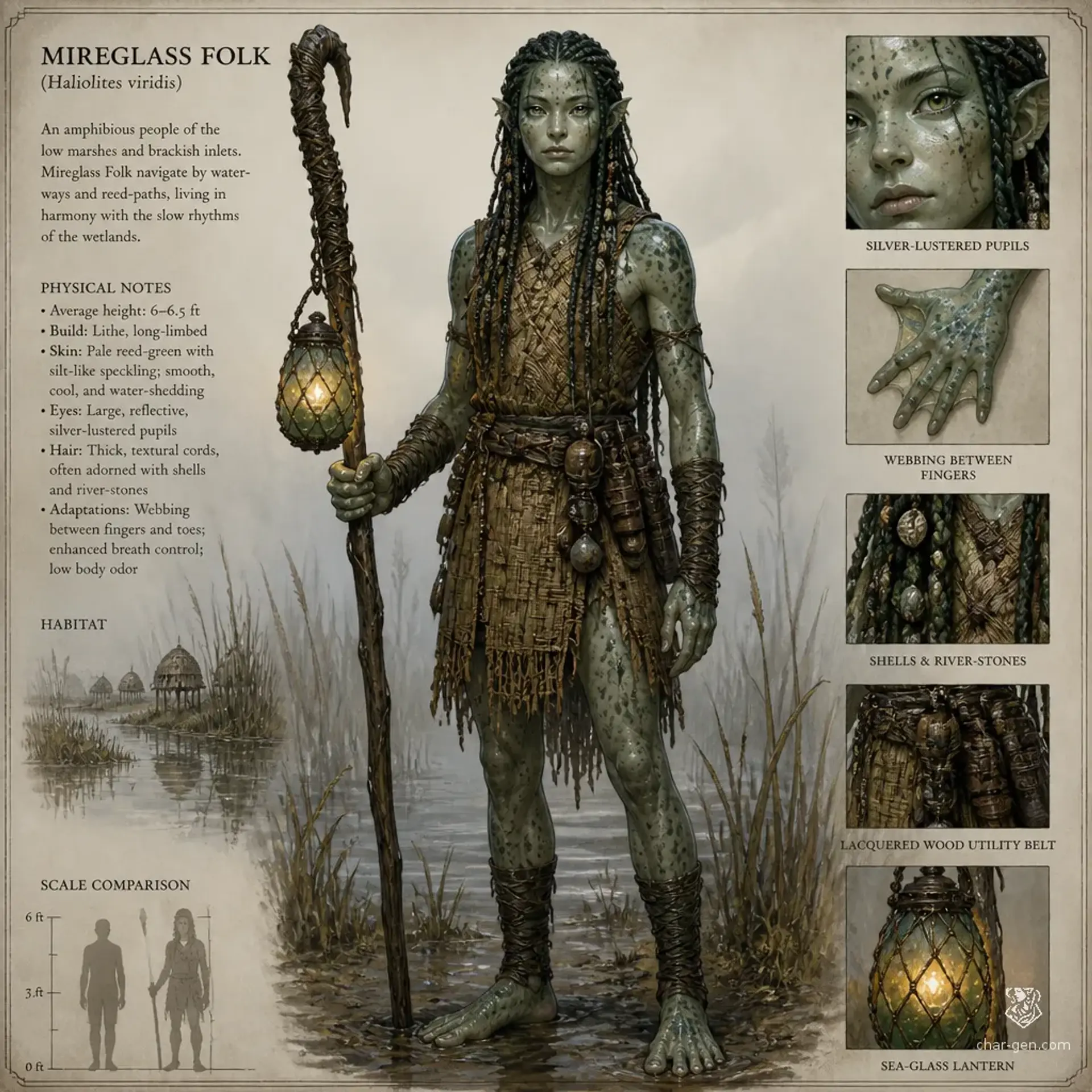
Mireglass folk are lithe, long-limbed humanoids with smooth skin that ranges from river clay brown to pale reed green, often marked by speckled patterns like silt or fish scales. Their eyes are broad and reflective, well suited to mist and low light, and their pupils narrow in bright sun. Hair is usually coarse and straight or made up in wet-braided cords, sometimes threaded with shell, bead, or pressed flowers. Their hands and feet are broad for balance on mud, rope, and narrow planks, and their voices often carry a wet, ringing clarity that makes songs and warnings equally memorable.
Society & Culture
Mireglass society is organized around households, water routes, and remembered obligations. Clan ties matter, but so do apprenticeship circles, burial societies, and river-compacts signed in public with witnesses. Children are raised communally and taught early that survival depends on reading weather, listening before speaking, and repaying kindness. Storytelling is a civic duty, because history is considered a map that warns the living away from repeating old disasters. Their festivals are often timed to first flood, first thaw, and the return of migratory birds, and their music tends to use hand drums, reed pipes, bone flutes, and chorus responses that echo over water.
Religion & Alignment
Their faith is usually practical and ancestor-centered, focused on river spirits, moon tides, the dead, and the listening presence of the land itself. They do not divide the world neatly into sacred and profane, since every crossing, burial, and harvest may require a rite. Mireglass folk can be found in every alignment, but they often lean toward duty, guardianship, and measured pragmatism rather than grand idealism. Even their rebels tend to be organized, ritual-minded, and stubbornly principled.
Homelands & Architecture
Mireglass homelands are built where land and water argue over the same space. Their homes rise on stilts, stone toes, and interlaced root-bridges. Roofs are steep to shed rain, walls are woven from reed matting and lacquered wood, and every settlement keeps at least one dry archive, one smokehouse, and one tower of bells or chimes to warn of flood, fire, and raiders. Streets are more often walkways and docks than roads, and public squares are made of platforms around wells, ponds, or memorial pools.
Relationships With Other Peoples
Mireglass folk are generally cautious but not hostile. They value reliability over charm and are quick to respect anyone who keeps promises, shares useful work, or treats graves and waters with care. They often mistrust conquering powers, reckless loggers, and merchants who poison the land for profit. With river peoples, fisherfolk, and travelers, they can be generous hosts. With the impatient or domineering, they become silent, watchful, and difficult to impress.
Visual sheet
Turn Mireglass Folk into a sheet
A high-res, share-ready sheet you can post or print.