
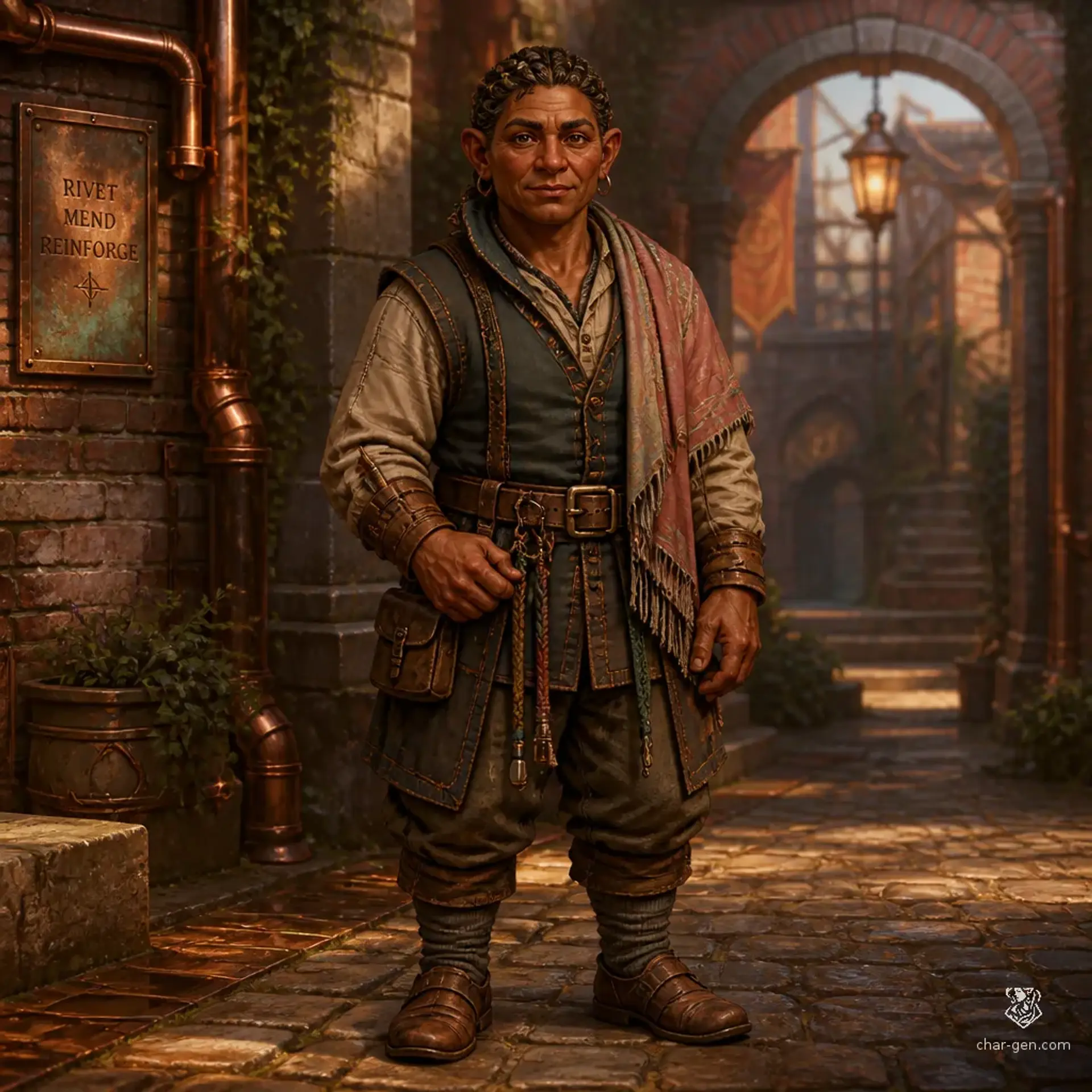
Ledgerkin are the people who make a city feel like home. They know which baker saves yesterday's loaves, which alley floods during a hard rain, which bridge plank creaks before it breaks, and which old woman has been waiting all week for company. Their lives are built from practical kindness, inherited obligations, and memories embedded in brick. To meet a Ledgerkin is to encounter someone who can find a place for you at the table, a route through the crowded streets, and a reason not to give up on a broken thing.
Ledgerkin are a variable-bodied urban ancestry whose appearance reflects generations of migration, intermarriage, and adaptation to city life. Some are compact and broad-shouldered, with rounded ears and heavy hands suited to masonry or hauling. Others are tall and fine-boned, with long fingers ideal for needlework, accounting, or lockmaking. Their skin ranges from warm brown and umber to olive, copper, gray, and muted rose. Hair is commonly worn in practical braids, wrapped coils, clipped styles, or shaved patterns that identify a household or guild. Most Ledgerkin have keen hearing, expressive eyebrows, and a habit of touching walls, doorframes, or tools while thinking. Their clothing is layered and durable, often modified with hidden pockets, reinforced seams, colored cords, and tokens marking neighborhood ties.
Ledgerkin society is organized around households, blocks, guilds, market circles, and neighborhood councils rather than rigid ethnic kingdoms. A person may belong to several overlapping communities, each with its own customs and expectations. They celebrate openings, repairs, reconciliations, and the return of travelers with as much enthusiasm as births or weddings. Public meals are important social institutions, and disputes are often settled through witnessed conversation, shared labor, or carefully negotiated restitution. Ledgerkin children are taught that every place has a memory and every privilege creates a responsibility. Their culture prizes competence, but not in a narrow sense. Knowing how to mend a coat, calm a frightened animal, remember a widow's name, or get a message safely across town can all be regarded as forms of civic wisdom.
Ledgerkin religion is intimate, practical, and deeply local. Many honor household ancestors, saints of craft, guardians of bridges, spirits of thresholds, or abstract virtues such as Welcome, Memory, and Due Measure. Their shrines are commonly found beside ovens, wells, stairwells, and public fountains. They favor no single alignment, but their traditions encourage responsibility, reciprocity, and consideration for neighbors. Lawful Ledgerkin preserve customs and records, while chaotic Ledgerkin challenge authorities who use tradition as an excuse for cruelty. Good Ledgerkin are often generous hosts and defenders of the overlooked, while evil Ledgerkin may weaponize debts, secrets, and communal trust.
Ledgerkin homelands are not single kingdoms but old districts, market towns, canal cities, fortress boroughs, and vertical neighborhoods built one practical layer at a time. Their architecture favors adaptable spaces: rooms with sliding partitions, rooftop gardens, shared kitchens, narrow stairs, hidden storage, and courtyards designed for conversation. A Ledgerkin building often displays its history openly. New brick sits beside old stone, family plaques cover the lintels, and repairs are celebrated rather than disguised. Their greatest civic works are bridges, bathhouses, archives, public ovens, covered markets, and small shrines tucked into walls where travelers can leave a coin or a written apology.
Ledgerkin are found in nearly every settled region and often serve as the connective tissue between cultures. They make dependable neighbors, discreet messengers, patient clerks, capable builders, and formidable community organizers. Other peoples sometimes mistake their local knowledge for nosiness or their hospitality for weakness. Ledgerkin, in turn, may view highly mobile adventurers as charming hazards who leave before repairing what they damaged. They respect ancestry but do not require blood ties for kinship. Adoption, sworn household, guild membership, and long friendship are all recognized as genuine family bonds.
A high-res, share-ready sheet you can post or print.