Small or Medium, chosen when you select this species
Common
Construct
Construct·Small or Medium, chosen when you select this species
Civicall
*Civicus artificialis*
Speed
30 ft.
Lifespan
Civicall remain functional for roughly 120 to 180 years, though careful maintenance, replacement parts, and magical restoration can extend that span considerably.
Darkvision
60 ft.
Habitat
Urban
construct
urban
common
artisan
civic
modular
subtle
mundane
SizeSmall or Medium, chosen when you select this species
Speed30 ft.
LifespanCivicall remain functional for roughly 120 to 180 years, though careful maintenance, replacement parts, and magical restoration can extend that span considerably.
Creature TypeConstruct
Darkvision60 ft.
Civicalls are the people who keep a city alive after the builders, rulers, and heroes have gone home. Built for municipal labor, household service, and skilled trades, they have become a patient, stubborn, quietly inventive folk with a deep respect for maintenance and an even deeper suspicion of anyone who calls a person property. A civicall adventurer may be a former lamplighter, archivist, locksmith, courier, or condemned machine seeking the freedom to decide what its life is for.
Physical Description
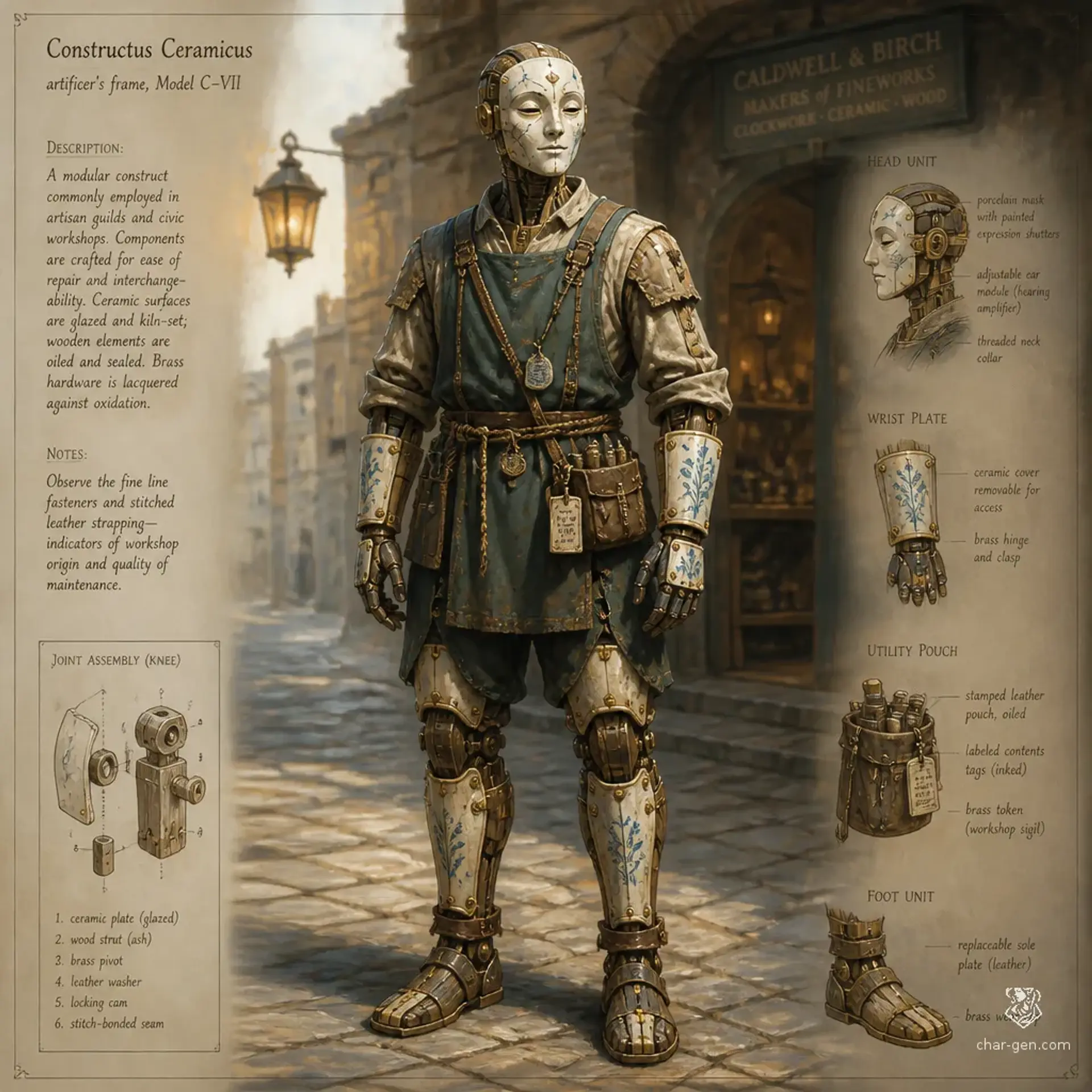
Civicall are humanoid constructs assembled from a practical mixture of wood, ceramic, leather, wire, and small amounts of metal. No two are identical. Some have smooth porcelain faces, while others use carved masks, painted shutters, or articulated plates to convey expression. Their bodies are designed around a central frame with replaceable joints and panels, making visible repairs a normal part of life rather than a source of shame. A civicall’s movements are generally quiet but deliberate, and many produce a faint ticking, clicking, or soft hum when concentrating. Their voices are formed by resonant chambers in the throat or chest, allowing for remarkable variety in tone.
Society & Culture
Civicall culture prizes reliability, repair, clear agreements, and useful beauty. Their festivals celebrate the opening of bridges, the restoration of public fountains, the first market day after winter, and the completion of long projects. They exchange small maintenance tokens as signs of affection, such as a polished screw, a replaced hinge, or a freshly stitched glove. Names are often granted by a maker, household, guild, or chosen companion, and changing one’s name is considered a serious declaration of self-authorship. Civicall communities maintain communal memory books in which members record failures without shame, so future generations can avoid repeating them.
Religion & Alignment
Civicall religion often centers on ideals rather than gods. Some honor patron deities of craft, cities, knowledge, hearths, roads, or justice, while others revere the First Pattern, a philosophical belief that every being contains an unfinished design. They commonly favor lawful or neutral outlooks because structure offers safety, but many become chaotic after witnessing laws used to excuse cruelty. Their morality is shaped less by instinct than by chosen principles, contracts, remembered examples, and personal responsibility.
Homelands & Architecture
Civicall homelands are dense, layered cities where workshops stand beside tenements, guildhalls, bathhouses, markets, and public works. Their own quarters favor repairable furniture, labeled storage, wide worktables, pulley lifts, and communal maintenance bays. Civicall architecture is rarely grand for its own sake. It is built to be understood, serviced, and altered as the city changes. Older civicall districts often contain walls covered in brass plaques recording who repaired what, when, and at whose request.
Relationships With Other Peoples
Civicalls are woven into urban life as clerks, porters, mechanics, scribes, caretakers, messengers, and artisans. Some communities welcome them as dependable neighbors, while others still treat them as purchased equipment or legal curiosities. Civicalls tend to form strong friendships with people who explain expectations plainly and respect boundaries. They are often protective of children, elders, immigrants, and anyone else overlooked by the city’s systems. Among themselves, they debate whether a civicall owes anything to its maker, its original owner, or the society that taught it to speak.
Visual sheet
Turn Civicall into a sheet
A high-res, share-ready sheet you can post or print.