Often 110 to 180 years, though those who spend decades in deep fae influence may age unevenly, seeming younger or older than their years.
Darkvision
60 ft.
Habitat
They are found wherever mortal places brush against strange crossings, including old forests, ruined keeps, moonlit marshes, abandoned roads, and cities built over forgotten sanctuaries.
fey-touched
teleportation
plane-shifted
scout
mystic
humanoid
threshold magic
field-guide
homebrew
dnd5e2024
standard pc
subspecies
arcane sense
travelers
otherworldly
liminal
fae
doorway
wandering
mortal altered by the feywild
SizeMedium
Speed30 ft.
LifespanOften 110 to 180 years, though those who spend decades in deep fae influence may age unevenly, seeming younger or older than their years.
Creature TypeHumanoid
Darkvision60 ft.
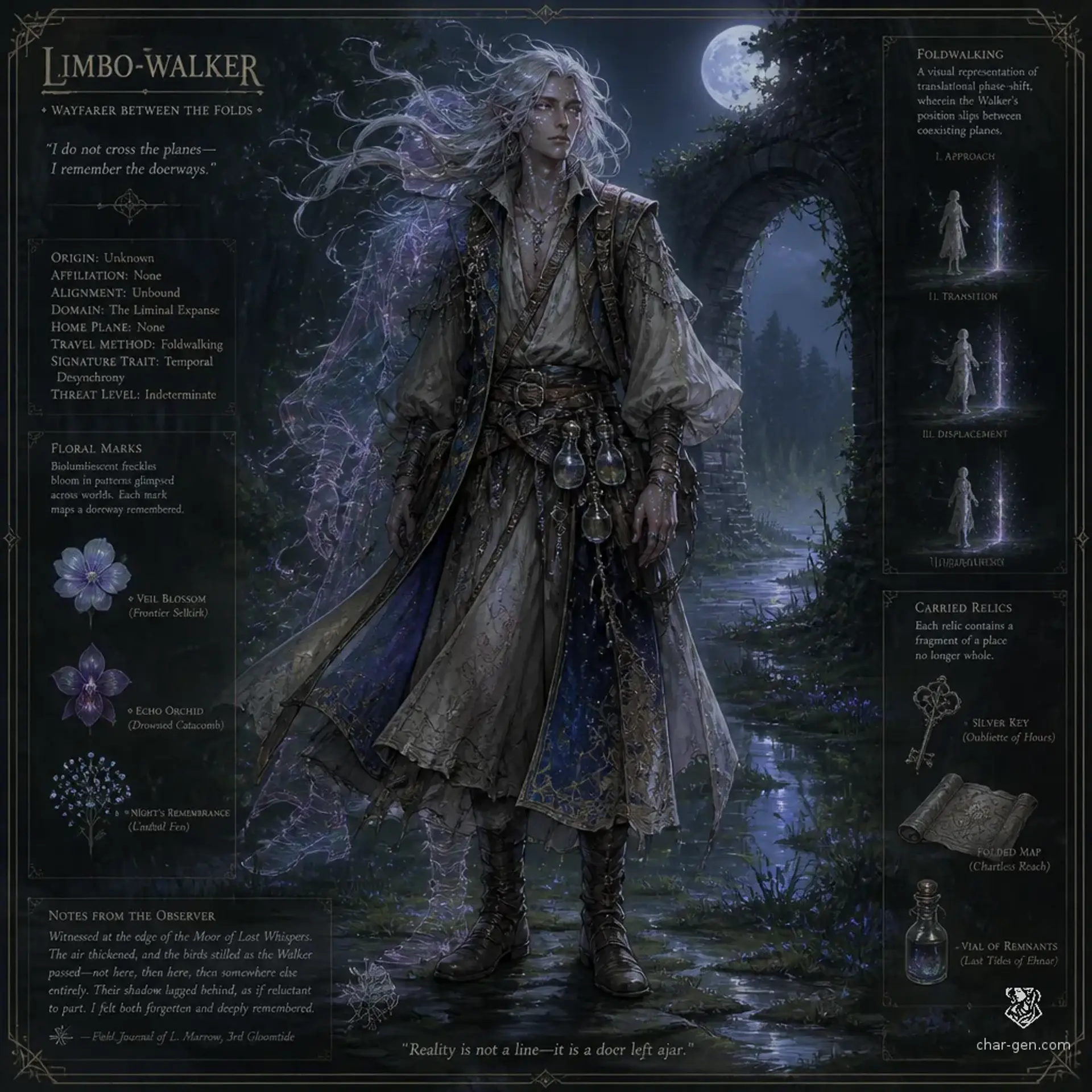
Limbo-Walkers are mortal people remade by the Feywild, forever marked by impossible roads and moonlit thresholds. They see hidden paths, sense veiled magic, and can vanish from one place to another with a thought or a breath. At the table, they feel like travelers who were once ordinary and are now part rumor, part doorway, and entirely changed by what looked back at them from beyond the trees.
Physical Description
Limbo-Walkers are not a single bloodline but a state of being shaped by prolonged contact with the Feywild. Their features remain recognizably mortal, yet they carry signs of the crossing everywhere: eyes that catch light like wet glass, hair that drifts as though underwater, skin dusted with pearlescent freckles, and shadows that arrive a heartbeat late. Their voices may echo softly at the edge of hearing, and their footsteps sometimes fail to make the same sound twice. In moments of stress, they may blur, phase, or leave a brief afterimage where they stood.
Society & Culture
Limbo-Walker culture is less a nation than a network of habits, debts, and shared sensitivities. They favor gifts over coins when possible, because a gift remembers the giver, and a gift can be returned with interest. Their stories are rich in maps, riddles, and places that only exist at certain hours. Hospitality matters deeply to them, but so does consent, since many have learned that fae bargains can begin with something as simple as opening a door. Children are taught to greet unknown thresholds with caution, to count their steps when afraid, and to never answer a voice that uses a name they did not choose.
Religion & Alignment
Their beliefs vary widely, but many honor deities of thresholds, roads, stars, secrets, or harvest. Some develop personal rites for entering new places, leaving offerings at crossroads, or greeting the moon before travel. Their alignment is just as varied as any mortal people, though the limbo-touched often prize freedom, curiosity, and adaptation over rigid law. Those who embrace the Feywild’s mercurial influence may drift toward whimsy or caprice, while others become disciplined guardians of boundaries and safe passage.
Homelands & Architecture
Limbo-Walker settlements are rarely separate nations. Instead, they gather in threshold communities built around standing stones, mirrored courtyards, root-tangled bridges, and winding lanes that never quite align twice the same way. Their homes favor layered rooms, hidden exits, curtained passages, and windows placed to catch moonlight or reflect the sky. Even in dense cities, they prefer architecture that suggests movement, with arches, balconies, and narrow stairways that make every dwelling feel like a path rather than a box.
Relationships With Other Peoples
Most Limbo-Walkers are treated with wary fascination. Common folk may see them as lucky, unsettling, or useful depending on the hour. Wizards and priests often seek their insight into crossings and curses, while fey creatures may regard them as kin, trespassers, or interesting pets. They tend to form close bonds with other outsiders, especially wanderers, scouts, messengers, and anyone who understands that a door can be both invitation and threat.
Visual sheet
Turn Limbo-Walkers into a sheet
A high-res, share-ready sheet you can post or print.