Often 75 to 95 years, with elders occasionally living beyond 100 when well-fed, stubborn, and surrounded by people who refuse to let them work too hard
Habitat
Urban
human
ancestry
pathfinder-2e
urban
diaspora
mediterranean
latin-inspired
feywar-exiles
feast-culture
competitive
hedonistic
standard-pc
homebrew
common-ancestry
humanoid
field-guide
roleplay-rich
kitchen-lore
social
rebuild-after-catastrophe
close-knit
festival-centered
diaspora-culture
ryma
SizeMedium
Speed25 ft.
LifespanOften 75 to 95 years, with elders occasionally living beyond 100 when well-fed, stubborn, and surrounded by people who refuse to let them work too hard
Creature TypeHumanoid
The Mani are the people who lost a homeland to Feywild conquest, were scattered across the continent, and turned exile into appetite, ambition, and anthem. They laugh loudly, cook better than they should be allowed to, and face hardship with the infuriating confidence of those who have already survived the worst thing once. A Mani story is about making a home from ruin, winning your place in a crowded world, and always, always bringing enough food for one more guest.
Physical Description
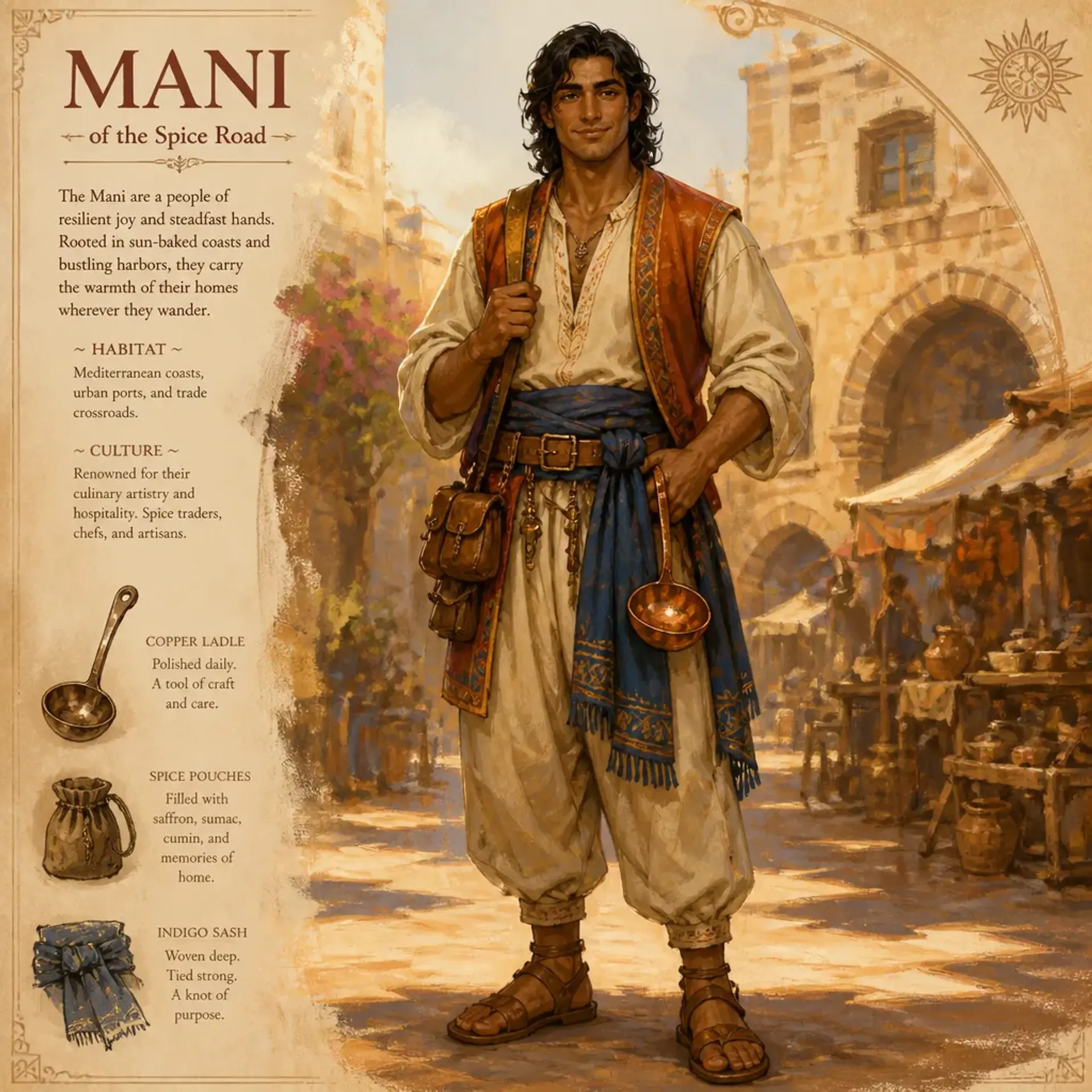
Mani are medium-sized humans with tanned to olive complexions, dark brown or black hair, and eyes usually brown or deep hazel, with rare dark green set like polished glass. Their features vary widely across the diaspora, but many Mani carry expressive brows, quick smiles, strong shoulders, and the easy gestures of people raised among close family, shared meals, and streets that never quite offered enough room. They tend to stand near others when talking, touch a forearm or shoulder for emphasis, and move with a lively, confident rhythm that can read as warmth, bravado, or both.
Society & Culture
Mani culture was forged in dispersal. Each enclave rose differently after the old homeland fell, but nearly all Mani societies prize family, public life, feasting, contest, and practical dignity. They work hard and party harder, often treating celebrations as a way to sustain morale, seal alliances, settle disputes, and remember the dead. Competitive games, duels, music battles, dance circles, and cooking contests are all common, and many Mani communities measure status not only by wealth or birth but by how well one serves the collective and how beautifully one performs under pressure. Even serious Mani tend to enjoy a bit of theater in their seriousness.
Religion & Alignment
The Mani are pragmatic believers. Their faiths often honor hearth deities, harvest powers, city guardians, ancestors, and saints of liberty, feast, and craftsmanship. Many Mani religions treat food as sacrament, labor as devotion, and hospitality as a sacred obligation. Their moral outlook is rarely simplistic. A Mani can be lawful in the sense of honoring contracts and communal duty, or chaotic in the sense of refusing any chain they did not choose, but most are defined less by abstract alignment than by resilience, appetite, and a sharp sense that joy is worth defending.
Homelands & Architecture
The Mani once lived near the great rift that opened into the Feywild, and the oldest stories begin in smoke, panic, and impossible light. After their homeland was overrun and the people were scattered across Ryma, Mani enclaves rebuilt themselves in ports, river cities, hill forts, and market capitals where trade, density, and public life could replace the lost certainty of the old homeland. Their architecture favors warm stone, painted plaster, shaded courtyards, rooftop gardens, communal kitchens, arcades, tiled floors, and broad streets that invite conversation, music, and impromptu festivals. Even the humblest Mani block usually contains somewhere to eat together, argue together, and celebrate together.
Relationships With Other Peoples
Other peoples often find Mani welcoming, vivid, and a little overwhelming. Many Mani are gregarious traders, artisans, soldiers, courtiers, and innkeepers, which makes them excellent networkers and exhausting rivals. Their easy touch, close conversational distance, and love of shared tables can surprise more reserved cultures, but most outsiders learn quickly that Mani hospitality is sincere, not performative. They are equally capable of deep loyalty and fierce competitiveness, and they rarely forget who helped them rise from exile, or who profited from their suffering.
Visual sheet
Turn Mani into a sheet
A high-res, share-ready sheet you can post or print.