They mature physically around age 18 and commonly live 90 to 120 years. Their bodies age slowly while they spend time in their true forms, and exceptional Moonroots may live nearly 150 years.
Darkvision
60 ft.
Habitat
Old-growth forests, misty ravines, secluded wetlands, and moonlit clearings where water, fungi, and roots form an undisturbed living network.
shapeshifter
forest
druidic
moon druid
amorphous
humanoid
nature
transformation
SizeMedium
Speed30 ft.
LifespanThey mature physically around age 18 and commonly live 90 to 120 years. Their bodies age slowly while they spend time in their true forms, and exceptional Moonroots may live nearly 150 years.
Creature TypeHumanoid
Darkvision60 ft.
At first glance, the traveler looks like an ordinary forest wanderer, perhaps a quiet hunter or a young druid with moonlight in their eyes. Then the disguise loosens. Their skin flows like water, their features melt and reform, and the person before you becomes a luminous living pool that remembers every face it has worn. For four hours each day, the Moonmorph returns to this honest shape, communing with the forest and listening for changes in the web of life. Many become moon druids, seeing wild shape not as an escape from themselves but as a sacred conversation between forms.
Physical Description
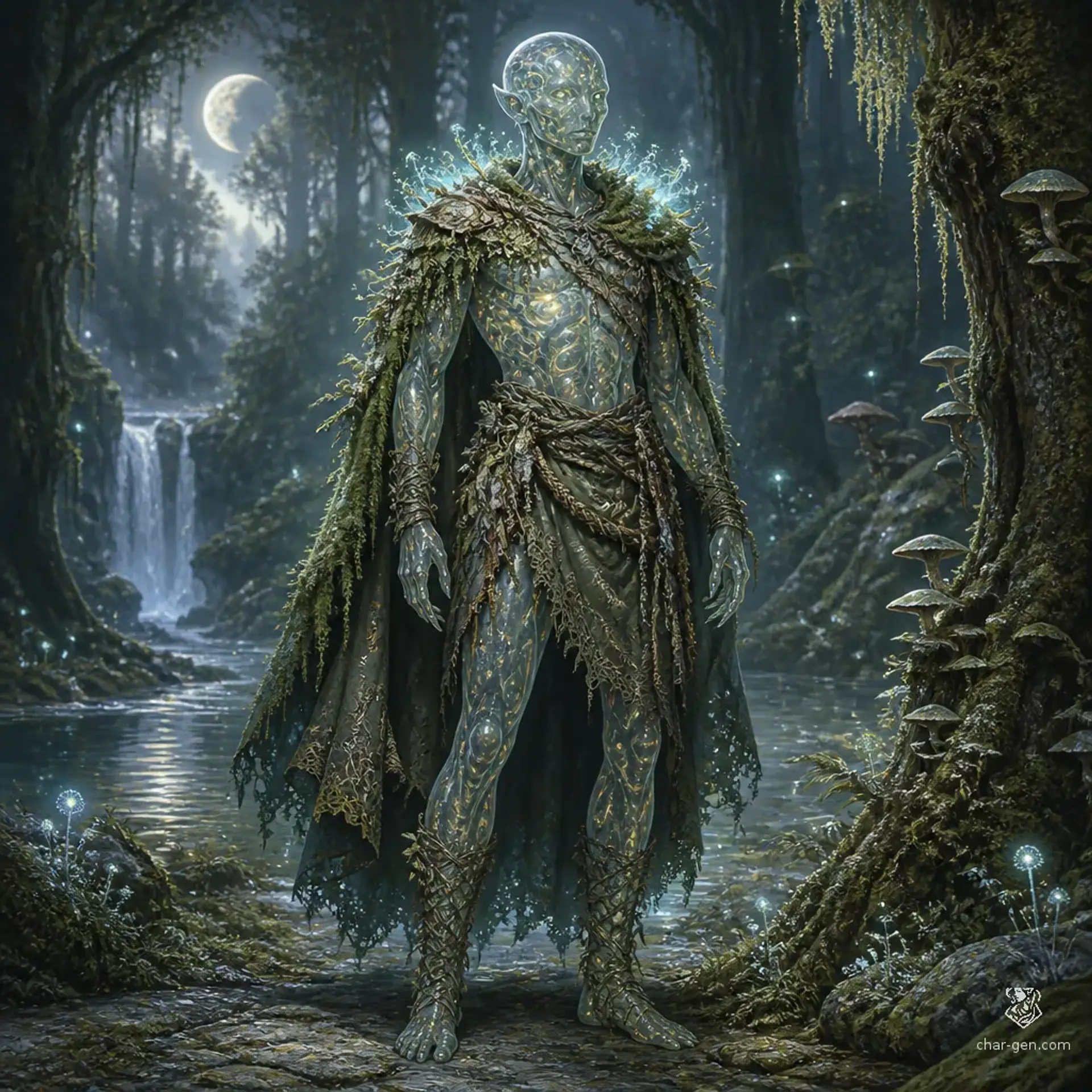
Moonmorphs are shapeshifting forest humanoids whose natural anatomy resembles a large, translucent amoeba. In true form, a Moonmorph is a softly pulsing mass of resilient living gel, usually tinted green, silver, amber, blue, or violet. Organ-like structures drift within the body, while luminous nodes gather into temporary arrangements that function as eyes, ears, and sensory organs. They move by flowing, climbing, and briefly forming pseudopods. Most spend at least four hours each day in this true form, usually beneath moonlight or within a favored pool, because prolonged concealment leaves them physically strained and spiritually unsettled. Outside those hours, they can assume a stable humanoid guise and make smaller changes to face, hair, skin, voice, and build. Their disguises are not perfect illusions. Close observers may notice unusual flexibility, a faint sheen to the skin, or a subtle delay when the shapeshifter changes expression.
Society & Culture
Moonmorph society is organized around groves, each of which acts as an extended family, school, shrine, and ecological stewardship circle. Children learn by imitation, first copying the movements and sounds of animals before attempting humanoid forms. Adults usually maintain one familiar public guise but change small details according to mood, season, or social role. Their councils include both humanoid-presenting speakers and true-form elders, with long pauses considered signs of thoughtfulness rather than weakness. Hospitality is expressed through water, shade, and food cultivated from the grove. A guest who is invited to rest in a communal pool has been granted profound trust.
Religion & Alignment
Most Moonmorphs revere the moon as a symbol of recurring change, hidden truth, and the patience required to become something new. Their spiritual traditions emphasize the balance between a stable inner self and a body that can take many forms. Moon druids are especially respected because they treat transformation as stewardship rather than disguise. Moonmorphs tend toward neutral alignments, though grove life encourages a strong ethic of mutual aid and protection. Some become fiercely protective of wilderness, while others believe nature's lessons must be carried into cities and civilized lands.
Homelands & Architecture
Their settlements are grown rather than built. They cultivate hollow trees, woven root halls, moss-lined chambers, and shallow communal pools beneath broad canopies. Doors are often living membranes or curtains of hanging leaves, and important spaces are marked by scent, bioluminescent lichen, or changes in birdsong. A grove's central pool serves as nursery, archive, shrine, and council chamber.
Relationships With Other Peoples
Moonmorphs are often mistaken for ordinary shapeshifters, infiltrators, or woodland spirits. They respond to such suspicion with varying degrees of patience. Forest communities may value them as scouts, healers, and interpreters of animal behavior, while urban societies often find their fluid identity unsettling. They form close friendships through shared routines, trusted names, and witnessed acts of care. Among themselves, they judge character by consistency of intention rather than consistency of appearance. Many prefer companions who can accept that the same individual may look different from one meeting to the next.
Visual sheet
Turn Moonmorphs into a sheet
A high-res, share-ready sheet you can post or print.