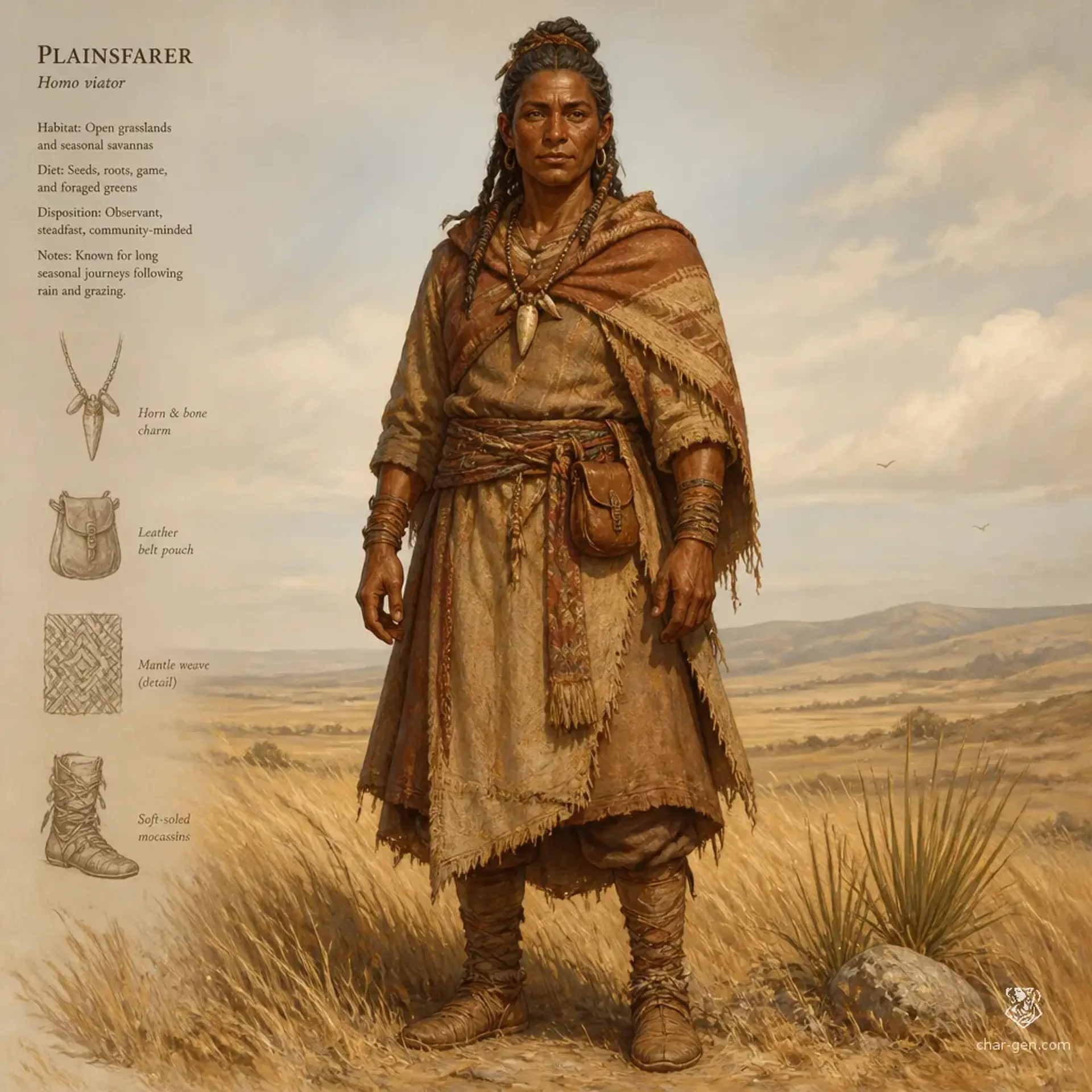
Morroweave mature around age 18 and commonly live 75 to 90 years. Their elders may remain vigorous into their seventies, though long years of travel, labor, and exposure often leave them visibly weathered.
Habitat
Open plains, rolling prairie, dry grasslands, river steppes, and seasonal savannas
humanoid
plains
mortal
mundane
herder
wanderer
weatherwise
communal
SizeMedium
Speed30 ft.
LifespanMorroweave mature around age 18 and commonly live 75 to 90 years. Their elders may remain vigorous into their seventies, though long years of travel, labor, and exposure often leave them visibly weathered.
Creature TypeHumanoid
Morroweave are weatherwise wanderers, herders, traders, and keepers of memory who believe every road is a promise between generations. They cross the plains beneath brightly patched shelters, reading storms in the grass and history in a hundred knots of cord. A Morroweave adventurer may be a clan exile, a young route-finder, a keeper of ancestral names, or simply someone who has learned that the horizon is too wide to ignore.
Physical Description
Morroweave are sturdy humanoids with long limbs, broad hands, and compact, powerful torsos shaped by a life of walking, riding, carrying, and working beneath open skies. Their skin ranges from copper and umber to deep brown and tawny gold, often marked by freckles, sunspots, or pale windburn across the nose and cheeks. Hair is usually coarse or tightly curled, worn in practical braids, wrapped knots, or cropped styles. Their eyes tend toward amber, dark brown, gray, or muted green. Most have slightly ridged nails and unusually sensitive fingertips, useful for reading woven cord, carved marks, and changes in soil. They are not supernatural beings, but generations of life on the plains have given them exceptional balance, stamina, and attention to subtle environmental signs.
Society & Culture
Morroweave society is organized around households, craft circles, and traveling clans. Leadership is usually temporary and task-based. A person may command a migration, mediate a feud, or oversee winter stores without holding authority in other matters. Stories, songs, and knot-cords preserve laws and genealogies, while public debates are held around communal fires. Hospitality is sacred but not careless. Guests receive food, water, and protection for three nights, after which they are expected to contribute labor or explain their road. Morroweave children are raised by broad kin networks, and personal achievement matters less than whether one's actions strengthen the people who depend on them.
Religion & Alignment
Morroweave religion is centered on the Open Witness, a personification of sky, land, memory, and consequence rather than a single exclusive deity. Household shrines contain a bowl of local soil, a lamp, and a cord bearing knots for the dead. Their rites ask ancestors to witness promises, not to grant miracles. Most Morroweave favor good or neutral alignments, valuing mutual aid and responsible freedom, but strict clan obligations can produce lawful communities and fierce personal loyalties can lead some toward passionate, unpredictable choices.
Homelands & Architecture
Morroweave settlements are built to move, expand, or disappear with the seasons. Permanent communities use low earthen walls, windbreaks of woven reed, and partially buried storehouses that remain cool beneath the sun. Traveling clans live in collapsible round shelters supported by jointed poles, with colored panels that identify household, craft, and alliance. The most important structures are not buildings but waystones, cisterns, fire circles, and shaded meeting grounds. Their roads are marked by cairns, planted thornbushes, and strips of dyed cloth tied where the wind can be seen.
Relationships With Other Peoples
Morroweave tend to judge neighboring peoples by how they treat guests, land, and the vulnerable rather than by ancestry or custom. They trade readily with settled farmers and river cities, though they distrust rulers who redraw borders without walking them. They admire disciplined militaries but dislike permanent armies near grazing routes. Forest-dwellers often find them too blunt, while mountain folk may appreciate their practical respect for difficult terrain. Morroweave families frequently adopt outsiders who save a life or keep faith during a crisis, creating bonds that can outlast blood relations.
Visual sheet
Turn Morroweave into a sheet
A high-res, share-ready sheet you can post or print.