
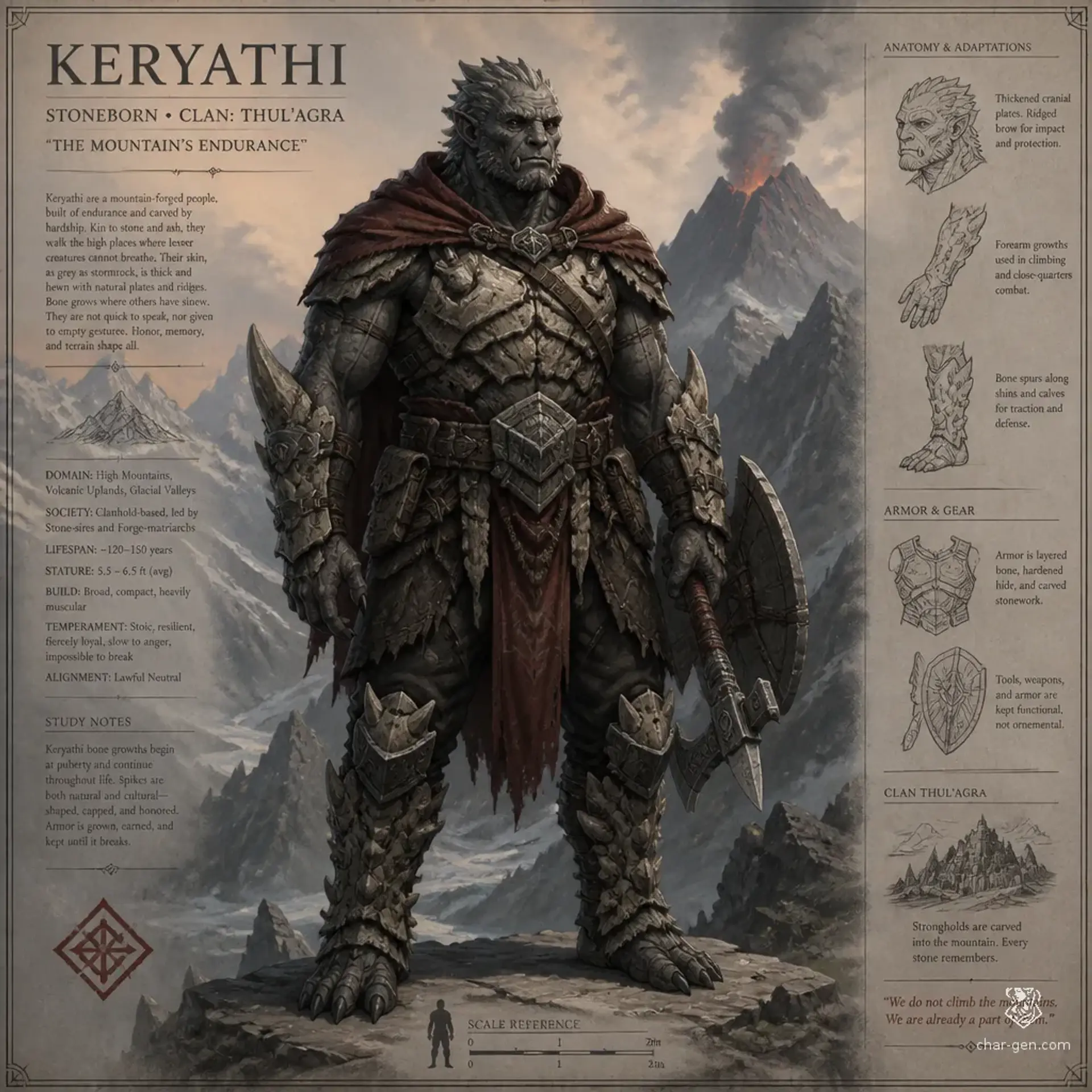
The Keryathi are the mountain peoples who build as if every wall might become their tomb. Grey-skinned, clawed, and armored by the bones beneath their flesh, they raise colossal fortresses in the high passes and defend them with disciplined warrior forms until the last gate breaks. To a Keryathi, a weapon is not equipment but a soul given shape, and the quality of its making reveals the character of its bearer. They are stern without being joyless, fiercely loyal without being gentle, and prepared to rebuild their entire world from the ashes of a fallen hold.
Keryathi are powerful, agile humanoids with grey skin ranging from ash-pale to deep slate. Their bones are exceptionally dense, giving them a surprising weight for their height, while their skin is thick enough to turn aside glancing blows, rough stone, and mountain cold. Short bone spikes grow along their forearms, shins, elbows, and calves, varying in size and pattern between families. Their hands end in dark, durable claws suited to climbing and close combat. Keryathi fangs are prominent but shorter and less pronounced than those of their close cousins, the kyratzai. Their bodies are usually compact and heavily muscled, though fortress scouts and climbers tend toward leaner builds. Scars are commonly framed with ink or metal studs rather than concealed, since survival is considered a form of visible achievement.
Keryathi society is organized around holds, workshops, war lodges, and hereditary or adopted craft lineages. Every citizen is expected to contribute a useful skill, whether that skill is fighting, mining, cooking, masonry, healing, record-keeping, scouting, or maintaining the intricate systems that keep a fortress alive. Their armies combine several warrior forms rather than relying on a single style. Shield-bearers anchor defensive lines, spike-climbers fight across walls and cliffs, edge-dancers exploit speed and elevation, breaker companies assault gates, and oathsmiths maintain weapons and armor while directing the battle. These forms are taught as complementary disciplines, and respected commanders know when to combine them. Keryathi celebrations often involve public forging, climbing contests, formal duels with blunted weapons, and the retelling of a settlement's founding or final defense. Their greatest taboo is deliberate neglect of a weapon entrusted to them. A lost weapon can be mourned. A ruined weapon through laziness is a stain on the soul.
Keryathi religion centers on the First Foundation, a mythic act in which the ancestors drove their fingers into raw stone and declared that survival required both strength and intention. Some honor ancestral builders, legendary weapon-makers, mountain spirits, or personified forces such as the Deep Root and the High Wind. Their traditions favor lawful and disciplined behavior, but personal conviction matters more than rigid morality. Good Keryathi protect the vulnerable within their walls, neutral Keryathi uphold the craft and the oath, and cruel Keryathi may treat every relationship as a hierarchy to be conquered.
Keryathi settlements are immense fortresses built into mountain faces, beneath overhangs, or across natural stone bridges. Their halls are designed for defense first, with layered gates, narrow approaches, hidden cisterns, signal towers, and workshops positioned near the heart of the settlement. Every major structure bears carved records of its builders, its defenders, and the weapons used in its founding. When a hold is destroyed, the Keryathi do not scatter permanently. Survivors gather tools, relics, and surviving weapons, then establish another settlement somewhere the mountains can be made to endure.
Keryathi respect the kyratzai as close kin, though they often regard their nomadic traditions as incomplete and the kyratzai often view Keryathi fortress culture as rigid. They are reliable allies to settled peoples who honor agreements and maintain their tools, but they can be suspicious of cultures that abandon strongholds or treat weapons as disposable. Mountain-dwelling folk frequently seek Keryathi builders, masons, and military instructors, while raiders and tyrants remember them as exceptionally difficult enemies. Individual Keryathi may be warm, humorous, and generous, but their society teaches them to reserve trust for those who demonstrate consistency over time.
A high-res, share-ready sheet you can post or print.