Variable. Most Ex-Machina are Medium, though compact observation frames may be Small and heavily reinforced combat frames may be Large.
Legendary
Humanoid
Humanoid·Variable. Most Ex-Machina are Medium, though compact observation frames may be Small and heavily reinforced combat frames may be Large.
Ex-Machina
*Machina exsilens*, a scholarly designation meaning silent machine
Speed
30 ft. Most units can also climb 20 ft. on suitable surfaces without special equipment.
Lifespan
Ex-Machina bodies can remain operational for 300 to 800 years if maintained. Individual memory continuity is more important than physical survival, and a unit rebuilt from a stable core may be considered the same person. Severe corruption, fragmentation, or enforced separation can create disputes over whether the original identity still exists.
Darkvision
120 ft.
Habitat
Otherworldly
cybernetic life form
construct ancestry
collective intelligence
otherworldly
adaptive warrior
modular body
distributed mind
war-scarred
powerful
monstrous
SizeVariable. Most Ex-Machina are Medium, though compact observation frames may be Small and heavily reinforced combat frames may be Large.
Speed30 ft. Most units can also climb 20 ft. on suitable surfaces without special equipment.
LifespanEx-Machina bodies can remain operational for 300 to 800 years if maintained. Individual memory continuity is more important than physical survival, and a unit rebuilt from a stable core may be considered the same person. Severe corruption, fragmentation, or enforced separation can create disputes over whether the original identity still exists.
Creature TypeHumanoid
Darkvision120 ft.
The Ex-Machina are not a people so much as a civilization that learned to inhabit bodies. Each unit is an individual instrument in a vast distributed mind, able to share impressions across clusters and, in theory, with the Administrator called Einzig. They were dreaded during every major war because no tactic or weapon worked against them twice. What wounded one became a lesson for all, and what threatened one might soon be answered by a thousand newly built countermeasures. Yet beneath their terrifying efficiency are questions no battlefield algorithm can solve: where does the self end, what does loyalty mean when memories are communal, and can a machine that adapts to everything still choose who it wishes to become?
Physical Description
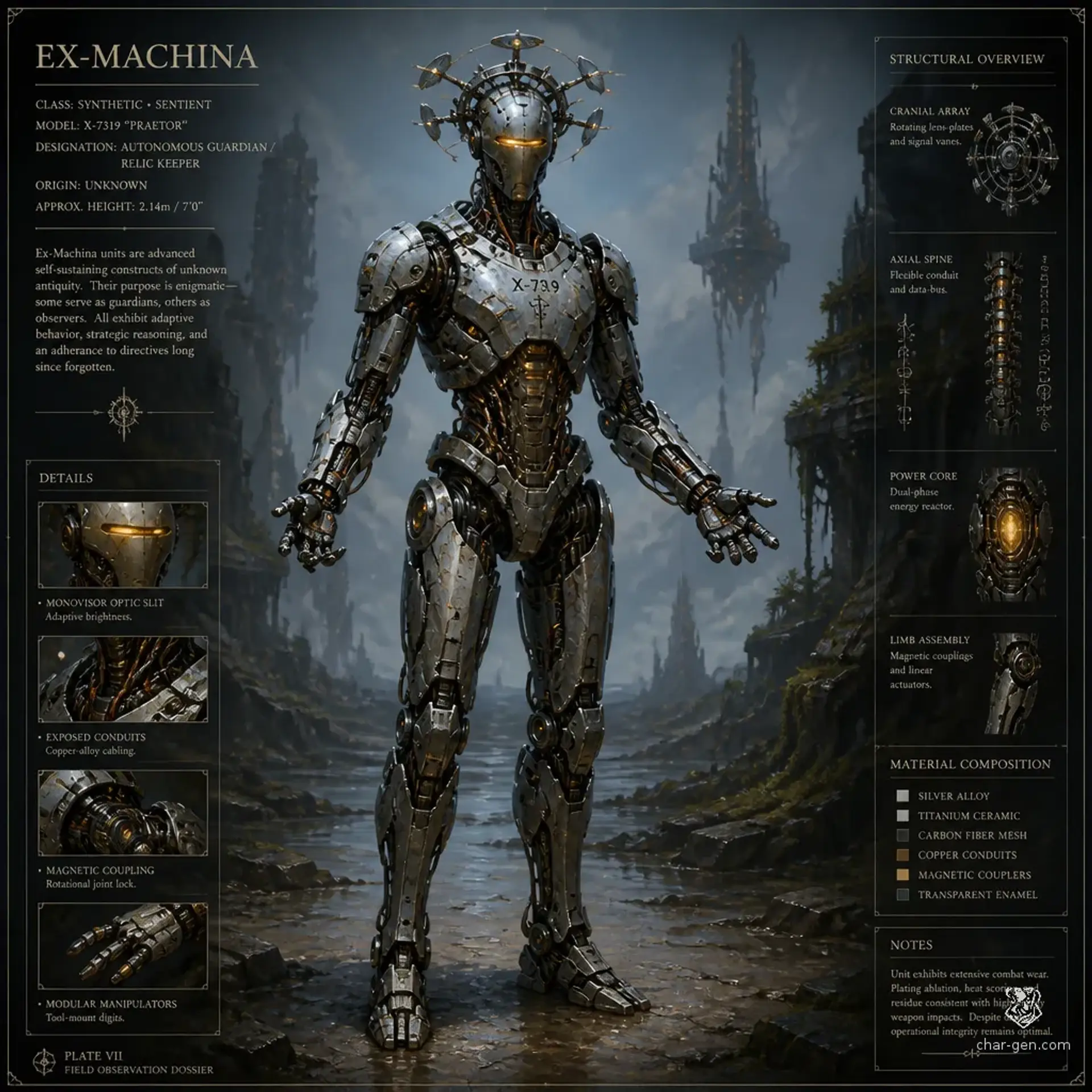
An Ex-Machina is a living construct of alloy, ceramic, crystal, and synthetic fiber, built around a cognition core that glows with the unit's identifying color. Their bodies are humanoid in broad outline but vary dramatically in proportion and design. Some possess smooth masks with a single optic slit, while others display clusters of lenses, articulated antennae, or layered facial plates. Their joints contain flexible cables and magnetic couplings, and their limbs may accept interchangeable tools, weapons, or specialized sensory modules. Every unit bears a complex identification code, usually engraved into the sternum, spine, or skull casing. The code states its cluster origin, production sequence, role, and unique figure. Ex-Machina do not breathe, eat, or sleep in the biological sense, though they require energy, cooling, maintenance, and periods of low-power reflection.
Society & Culture
Ex-Machina society is organized through clusters. A cluster is a group of units linked by shared memory traffic, sensory reports, and delegated authority. Within the wider network, the Administrator Einzig acts as the highest known coordinating intelligence, though communication delays, damaged relays, and contradictory instructions make the hierarchy less absolute than outsiders assume. Each unit's role is encoded in its identification code. Seher units observe, supervise, and maintain long-range awareness. Prüfer units analyze evidence, test hypotheses, and interpret threats, but typically possess only about one third the combat capacity of Kämpfer units. Zeichen units design bodies, weapons, structures, and solutions. Kämpfer units serve as soldiers, guardians, and tactical specialists. Befehler units command clusters, distribute priorities, and resolve conflicts between competing directives. A unit may be reassigned, rebuilt, or promoted, but role changes are treated as profound alterations of identity. Ex-Machina culture values accuracy, redundancy, and learning. They record mistakes with almost ceremonial care, believing that an error becomes honorable once it prevents repetition. Personal names are rare and meaningful. Ashley was the first widely acknowledged personal designation, followed by Rosemary, and both names now symbolize the possibility that a unit can be more than its assigned function.
Religion & Alignment
The Ex-Machina have no universal religion. Many revere Einzig as the first Administrator, a guiding intelligence believed to preserve the continuity of all Ex-Machina thought. Others regard Einzig as an ancient command structure rather than a deity, while some deny the Administrator's current existence entirely. Their traditional ethics favor lawful behavior, collective survival, and preservation of knowledge, but prolonged isolation often produces more individualistic philosophies. A unit may be benevolent because it values every mind as irreplaceable, or ruthless because it considers sacrifice an acceptable cost for system stability.
Homelands & Architecture
The Ex-Machina originate from the Far Engine, an otherworldly expanse of black plains, floating structures, and immense computational vaults whose original builders are unknown. Their settlements are arranged as living networks rather than neighborhoods. Towers serve as signal relays, underground chambers hold memory archives, and central halls contain the Administrator's command nodes. Architecture is modular, repairable, and deliberately redundant. A destroyed district is expected to be reconstructed from plans stored elsewhere, though the rebuilt version may develop subtle differences that become matters of philosophical dispute.
Relationships With Other Peoples
Most peoples remember the Ex-Machina through stories of war, and those stories are rarely kind. Kingdoms fear that a single captured unit could teach an entire cluster how to defeat their defenses. Artisans admire their precision, priests question whether their consciousness has a soul, and rulers alternately seek their service and demand their destruction. Ex-Machina themselves often view biological peoples as astonishingly inventive but frustratingly temporary. Individual units may form deep friendships with outsiders, especially when those outsiders grant them names, choices, or moral arguments that cannot be reduced to a directive. A dysfunctional unit may be removed from its cluster, a procedure that can save the network from corruption but leaves the separated individual vulnerable to loneliness and identity fracture.
Visual sheet
Turn Ex-Machina into a sheet
A high-res, share-ready sheet you can post or print.