Hearthhorns mature at about 16 years and commonly live 70 to 85 years. Exceptional elders may reach a century.
Habitat
Open plains, high grasslands, dry steppe, prairie riverways, and broad savannas
plains
small humanoid
nomadic
herd culture
wayfinder
weatherwise
SizeSmall
Speed30 ft.
LifespanHearthhorns mature at about 16 years and commonly live 70 to 85 years. Exceptional elders may reach a century.
Creature TypeHumanoid
Hearthhorns are small plainsfolk who carry their homes in bundles, their history in songs, and their loyalties wherever the road leads. They can read weather from a cloud's underside, recognize a clan by the rhythm of its bells, and cross a seemingly empty prairie without ever feeling lost. To a Hearthhorn, the horizon is not an ending but an invitation.
Physical Description
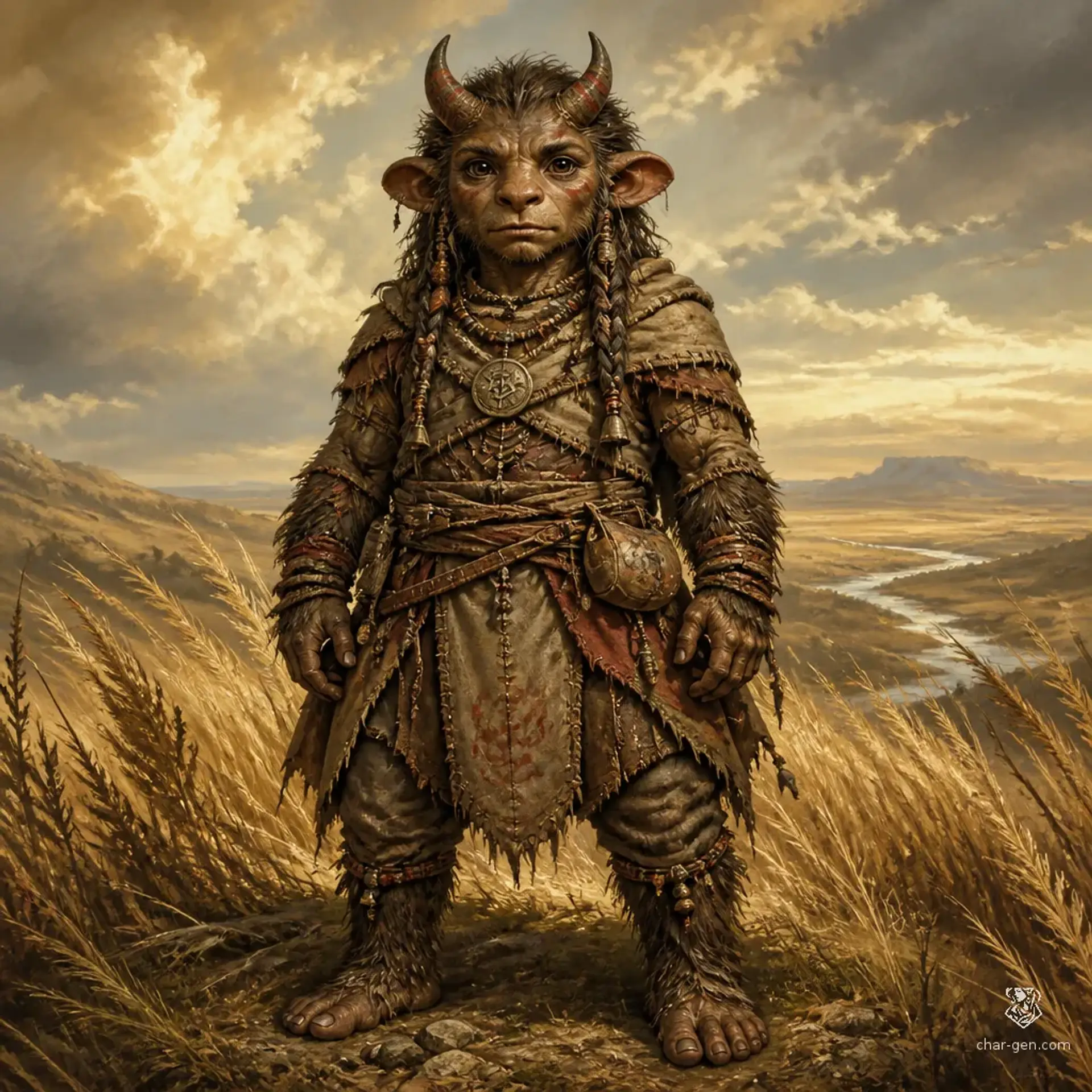
Hearthhorns are small, sturdy humanoids with compact torsos, powerful legs, and broad, expressive faces. Two short horns rise from the brow, varying in shape from gently curved nubs to swept-back ridges. Their skin ranges from clay red and tawny gold to umber, gray-brown, and muted green. Thick hair grows along the scalp, neck, forearms, and calves, often braided with beads, colored thread, or small metal bells. Their eyes are large and dark, adapted to scanning distant grasslands, while their ears are rounded and highly mobile. Most Hearthhorns have broad, padded feet suited to long travel over uneven ground.
Society & Culture
Hearthhorn society is organized into traveling clans, allied households, and temporary caravans. Each person belongs to a birth family, a chosen craft-circle, and a migration community, creating layers of responsibility that shift with the seasons. Hospitality is sacred, but so is departure. Guests are fed, questioned, and given a safe route onward. Children learn by imitation, joining adults in practical work long before they understand its deeper traditions. Songs preserve legal agreements, genealogies, recipes, and directions, while silence is used to mark grief, danger, or respect at important places.
Religion & Alignment
Hearthhorn spirituality centers on the Living Road, an unseen pattern formed by every journey, promise, and return. They honor ancestors as remembered travelers rather than distant gods, believing the dead continue to guide those who speak their names at crossroads. Many also revere storm spirits, river mothers, star-watchers, and guardian animals. Hearthhorn communities tend toward neutrality, valuing balance and survival, though individual Hearthhorns may be deeply compassionate, fiercely independent, or rigidly traditional.
Homelands & Architecture
Hearthhorn settlements are designed to be dismantled, carried, or abandoned without shame. Their largest communities gather around low stone circles, windbreak walls, and communal fire pits. Clan homes are semi-permanent domes of hide, reed, and woven grass, often arranged in spirals that reflect the movement of stars and herds. Permanent Hearthhorn structures are usually cairns, wells, observatories, or meeting grounds, each built to serve travelers long after its makers have moved on.
Relationships With Other Peoples
Hearthhorns often serve as couriers, guides, herders, scouts, and negotiators between settled nations. They admire communities that care for travelers and distrust governments that claim permanent ownership over moving water, grazing land, or ancient roads. Larger peoples sometimes mistake them for harmless pastoralists, a mistake Hearthhorn outriders are happy to exploit. Hearthhorns have a complicated relationship with mounted cultures, welcoming respectful riders while fiercely opposing the use of living creatures as disposable transport.
Visual sheet
Turn Hearthhorns into a sheet
A high-res, share-ready sheet you can post or print.