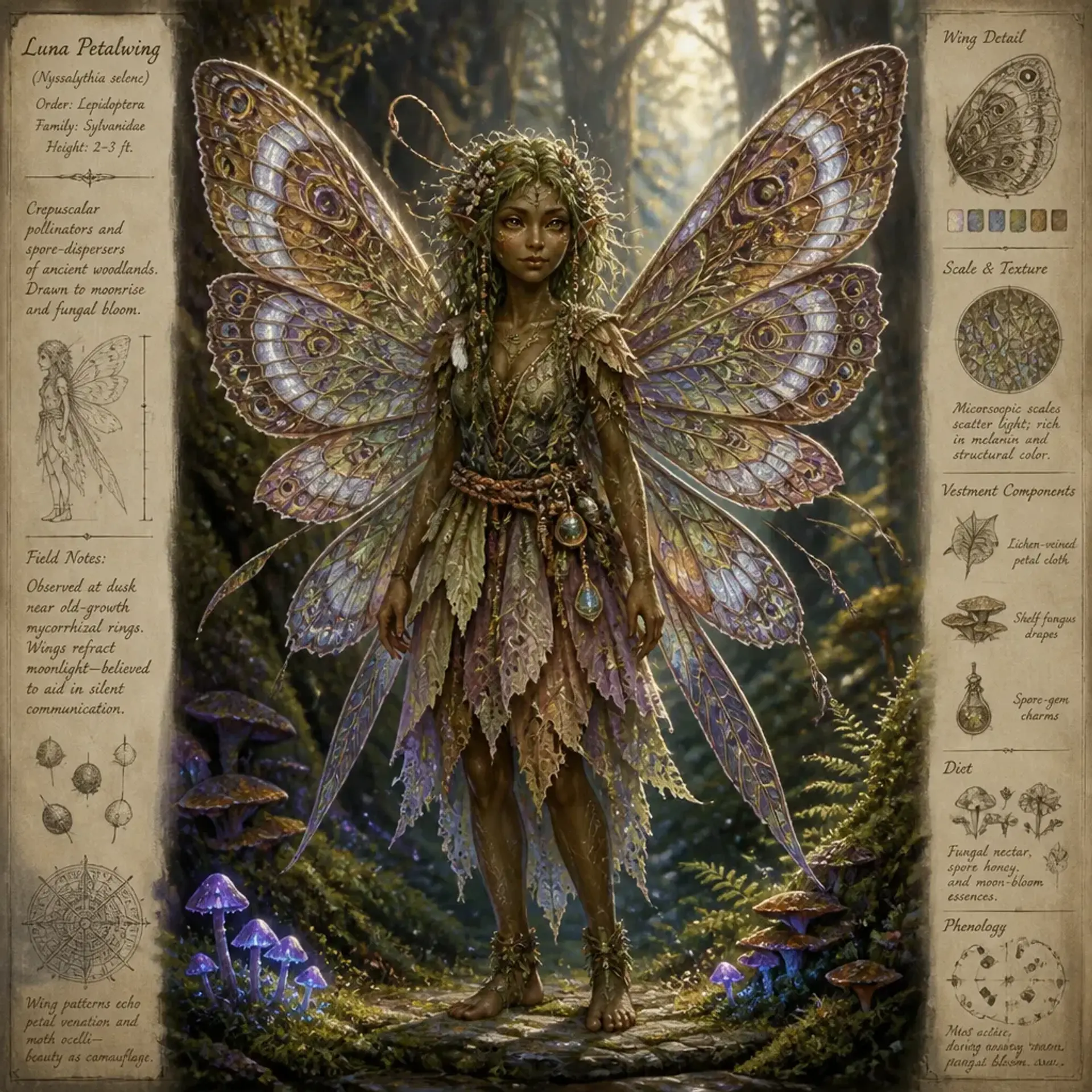
Fairys mature by about 80 years and commonly live 700 to 900 years. All fairys are female, and new children emerge from carefully tended seed-pods, flower hearts, or fungal nurseries blessed by the grove.
Darkvision
60 ft.
Habitat
Old-growth forests, flower-filled clearings, mossy ravines, and fungal groves
fey
forest
fairy
winged
small
good-aligned
mushroom-orc allies
nature magic
SizeSmall
Speed25 ft.; fly 30 ft.
LifespanFairys mature by about 80 years and commonly live 700 to 900 years. All fairys are female, and new children emerge from carefully tended seed-pods, flower hearts, or fungal nurseries blessed by the grove.
Creature TypeFey
Darkvision60 ft.
Canopy fairys are jewel-bright forest fey who zip between leaves, befriend mushroom-orc clans, and treat every living thing as part of one enormous conversation. Their wings glitter like petals, beetles, autumn leaves, or moonlit glass, while their names are wonderfully simple: Sap, Root, Lily, Cap, Bug. A fairy adventurer may be a cheerful healer, a daring scout, a mischievous diplomat, or a tiny guardian carrying an ancient promise in her heart.
Physical Description
Canopy fairys are Small fey women with delicate, expressive features and skin ranging from warm brown and moss green to petal pink, amber, cream, violet, and blue. Their hair often resembles grass, silk, lichen, vines, or drifting spiderweb, though some wear it in practical braids decorated with seeds and shells. Every fairy possesses a pair of colorful wings, although some have four, six, or even eight smaller wings arranged along the back. Wing shapes vary widely, including moth fans, dragonfly panes, butterfly sails, leaf blades, beetle cases, featherlike fronds, and translucent membranes patterned like flower petals. Their colors change subtly with mood, season, health, and magic. A fairy's wings are not merely tools of movement. They are family records, works of art, courtship displays, and visible signs of a grove's history.
Society & Culture
Fairy society is organized around groves, each one a community of relatives, apprentices, elders, plants, animals, and allied mushroom-orc families. Fairys have no males and do not consider this unusual. New fairys are nurtured communally, with several elders contributing memories, songs, food, and magical pollen to the nursery. Names are usually drawn from the natural world and often change during life. A child called Bud may become Sap after her first solo flight, then Root after a deed of lasting importance. Colorful wings are celebrated rather than standardized, and disputes over wing design are treated as matters of artistic taste, not status. Important decisions are made during moonlit gatherings called ring councils, where speakers perch on mushrooms or branches while listeners form a circle below.
Religion & Alignment
Fairy spirituality centers on the living forest, the turning seasons, and the memory held by roots and spores. Most fairys honor a broad circle of nature spirits rather than a single divine power. Ancestors are remembered through wing patterns, nursery songs, and the planting of trees. Fairys strongly favor benevolent and freedom-loving choices, but they are not uniformly lawful. Grove traditions provide structure, while curiosity, compassion, and personal whim often pull them toward chaotic good behavior.
Homelands & Architecture
Fairy settlements are woven through living forests rather than built upon them. Their homes occupy hollow branches, curled leaves, flower bells, termite towers, and giant shelf fungi, connected by silk bridges, root ladders, and lantern paths made from glowing spores. Mushroom-orc allies often maintain the larger ground-level halls, where fairys gather for feasts, councils, and seasonal celebrations. Every settlement is cultivated as a living ecosystem, with no sharp boundary between garden, home, shrine, and wilderness.
Relationships With Other Peoples
Fairys are openly good-natured, though their friendliness can become intrusive by the standards of larger peoples. They are especially close to mushroom orcs, whom they regard as steadfast cousins and honored allies. Fairys tend fungal gardens, guide orc hunters through dangerous woodland, and share warnings about threats moving beneath the soil. They often admire elves and other forest peoples but distrust cultures that clear land without ritual apology or repayment. Fairys are fascinated by city-dwellers, finding their towers impressive and their habit of ignoring birds deeply puzzling. They are wary of predatory fey courts, which they believe confuse beauty with permission.
Visual sheet
Turn Canopy Fairys into a sheet
A high-res, share-ready sheet you can post or print.