Often 180 to 260 years, though many Ossari say the true measure of their life is how many times they have been remembered.
Darkvision
60 ft.
Habitat
Otherworldly, especially places touched by the return currents of Caethios, liminal ruins, memorial sanctuaries, and quiet borders between worlds.
reanimated
skeleton
ectoplasm
undead-adjacent
otherworldly
memory
second life
mystic
field-guide
homebrew
dnd-5e-2024
humanoid
standard-pc
nontrademarked
ossari
SizeVariable
Speed30 ft.
LifespanOften 180 to 260 years, though many Ossari say the true measure of their life is how many times they have been remembered.
Creature TypeHumanoid
Darkvision60 ft.
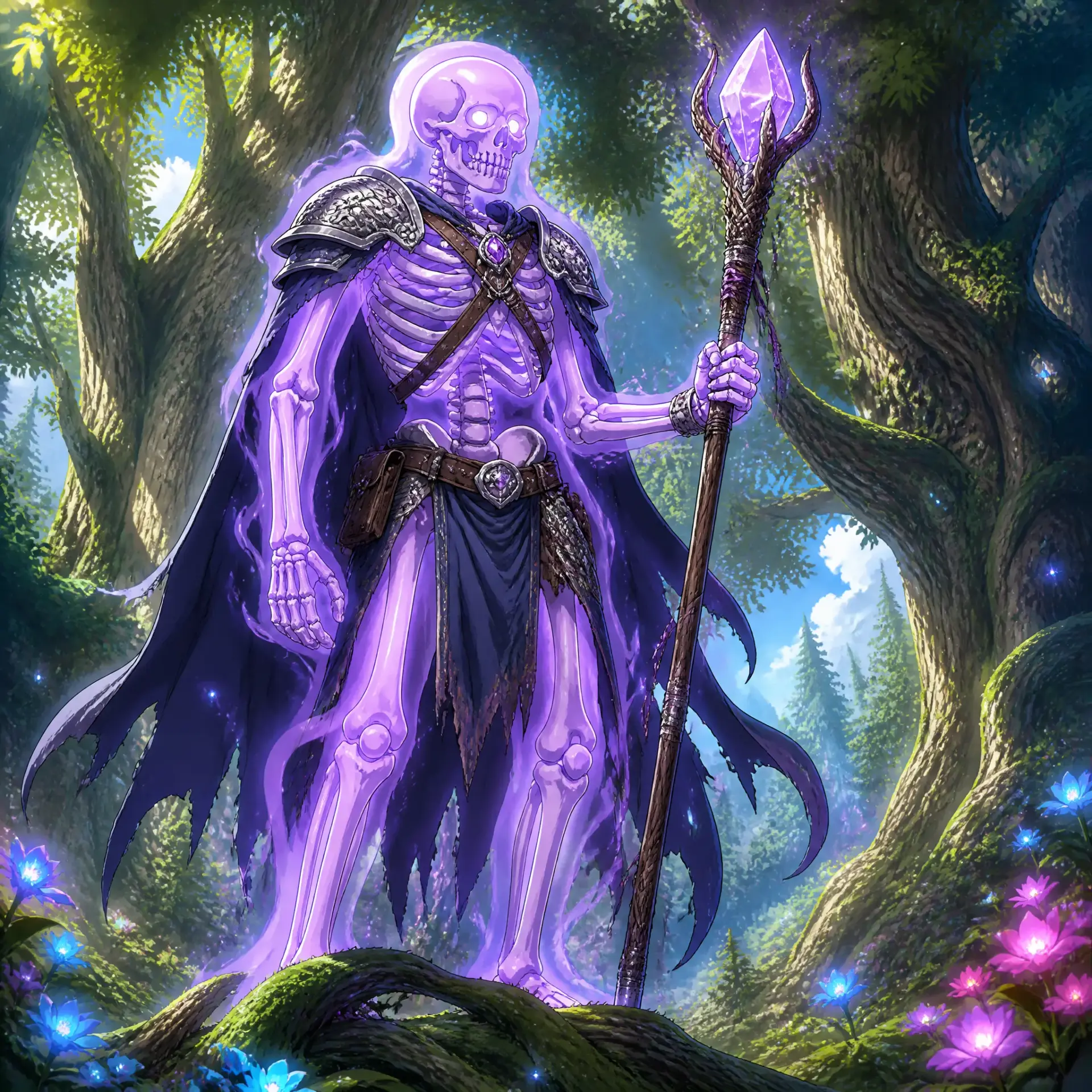
The Ossari are the ones who crossed death and came back anyway, not by dark necromancy but by the patient mercy of Caethios. Their bones are wrapped in colored ectoplasm shaped by memory, making each of them a moving silhouette of the life that once was. They are calm, watchful, and quietly haunted in the best possible way, carrying the dignity of those who know how precious a second beginning can be.
Physical Description
An Ossari is a skeletal humanoid veiled in a semi-solid ectoplasmic layer that clings to bone like a second anatomy. This etheric silhouette preserves the memory of their living shape, so one Ossari may appear broad-shouldered and tall while another seems slight, delicate, or even childlike in frame. Their ectoplasm is often pale, but it can carry distinct hues, from moss green to ember red, sea blue, lavender, ivory gold, or ash gray. The color often reflects personality, origin, or the nature of the magic that returned them. Their bones are visible beneath the veil, but rarely bare in the ordinary sense, as if the soul itself chose to wear a body that remembers being flesh without becoming flesh again. Their faces can shift in expression with surprising subtlety, and their voices often carry a soft resonance, like sound passing through crystal or still water.
Society & Culture
Ossari society is built around remembrance, stewardship, and the quiet politics of being returned. Most communities keep long archives of names, gestures, recipes, and burial songs, because they believe identity is preserved through practice as much as through record. A person’s death is not treated as a disappearance but as a change in obligation, and many rituals focus on teaching the newly returned how to live among the living without losing their own shape. Their celebrations are subdued but deeply joyful, often involving lanterns, spoken histories, painted ribs, and music that layers voices the way ectoplasm layers bone. They value competence, restraint, and the ability to remain present when others are afraid. Among themselves, they can be surprisingly playful, fond of contests in memory, riddling, and games that reward patience over speed.
Religion & Alignment
Their outlook is rarely dogmatic. Many Ossari honor gods of memory, passage, mercy, harvest, or thresholds, but just as many see Caethios as a natural force rather than a deity. They are not more likely than any other folk to be virtuous or cruel, though the experience of surviving death often makes them deliberate in judgment. Many lean toward lawful habits because they value vows, funerary custom, and continuity, while others rebel fiercely against any attempt to turn their second life into a cage.
Homelands & Architecture
Ossari communities are often built around return sites, places where the dead once stirred back into motion. Their settlements favor open courtyards, wind chimes made from bone or glass, pale stone, and layered walkways that allow the light to pass through them like memory through a mind. Homes are personal but rarely enclosed, because many Ossari prefer to see the sky, hear the land, and keep paths clear for ancestors, visitors, and wandering thought. Their architecture is marked by niches for relics, painted memorial walls, and communal halls where stories are spoken aloud so they cannot be forgotten.
Relationships With Other Peoples
Ossari tend to approach other peoples with patience rather than suspicion. They are often comfortable around the grieving, the elderly, and anyone who has rebuilt a life from loss. Many living folk find them eerie at first, but Ossari culture prizes gentle introductions and practical kindness, which usually turns fear into familiarity. They do not universally share the customs of the dead or the same moral stance on mortality, so outsiders sometimes mistake them for solemnity itself. In truth, many Ossari are warm companions, especially once conversation turns to stories, maps, repairs, food, and the small absurdities of being alive twice.
Visual sheet
Turn Ossari into a sheet
A high-res, share-ready sheet you can post or print.