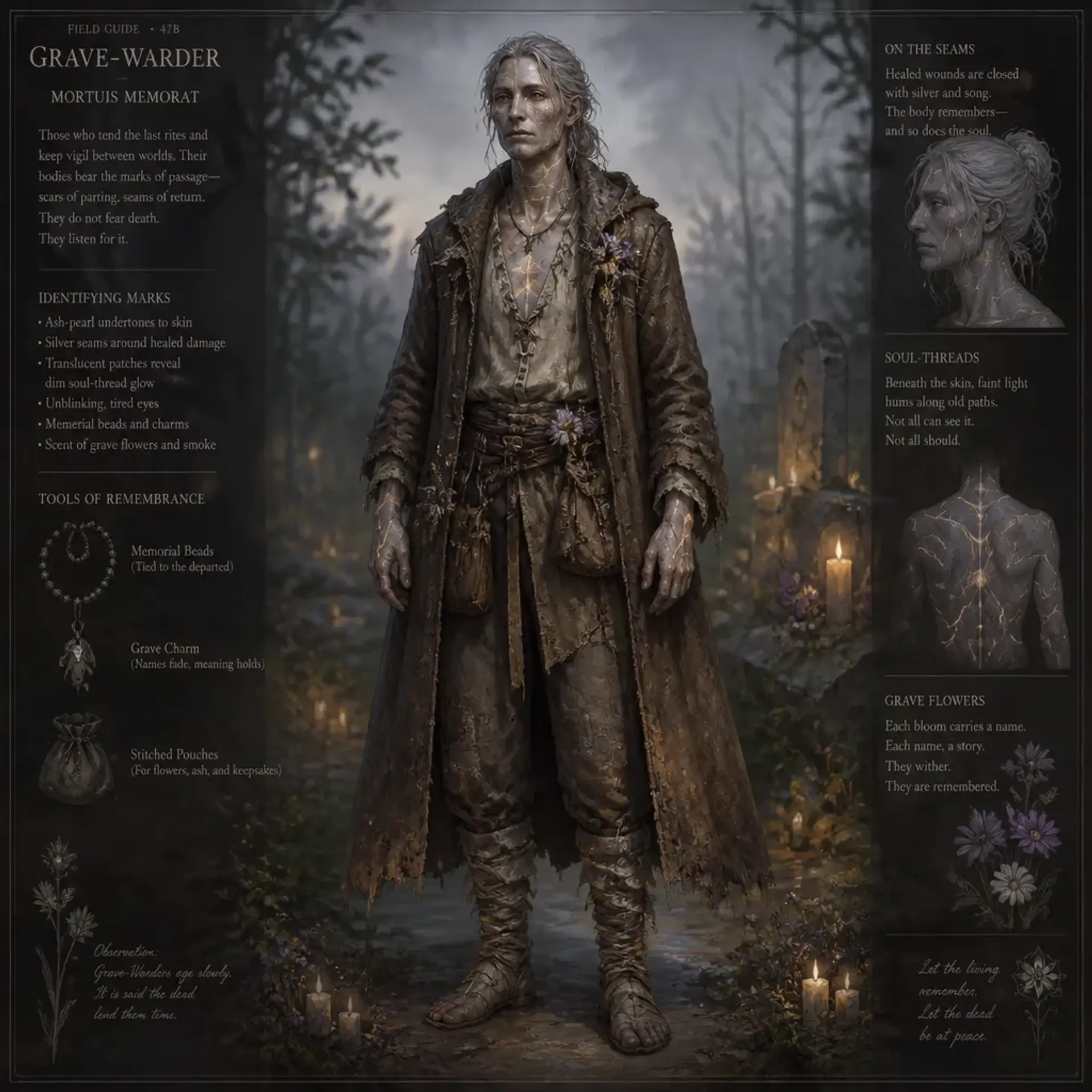
Homo redivivus, the returned condition found among many humanoid lineages.
Speed
Retains the walking speed and any other movement speeds of the parent ancestry.
Lifespan
Returned people do not die of old age. They remain physically close to the age at which the condition took hold, though scars, memories, and repeated restoration may alter their appearance. They can still die through injury, magic, or other hazards, and may return afterward.
Darkvision
Retains the parent ancestry’s darkvision, if any.
Habitat
Returned people can arise anywhere, from crowded cities and ancestral villages to battlefields, plague houses, deep forests, and lonely ships. They often settle near places with strong memories or unresolved tragedy.
returned
resurrection-touched
parent-ancestry overlay
undying
humanoid
SizeRetains the size of the parent ancestry.
SpeedRetains the walking speed and any other movement speeds of the parent ancestry.
LifespanReturned people do not die of old age. They remain physically close to the age at which the condition took hold, though scars, memories, and repeated restoration may alter their appearance. They can still die through injury, magic, or other hazards, and may return afterward.
Creature TypeHumanoid
DarkvisionRetains the parent ancestry’s darkvision, if any.
You died once, and the world continued without you. Then, beneath cold rain and the sound of someone begging you not to leave, your heart began again. You woke with dirt beneath your nails, a name on your lips, and a debt no priest could explain. You are not immortal. You are not invulnerable. You are simply unfinished, and something in the dark keeps insisting that you have more to do.
Physical Description
A returned person looks chiefly like a member of their parent ancestry, but death has left a visible signature. Their skin may hold a faint undertone of ash, pearl, bruised violet, or candle-gold. Old wounds sometimes remain as silver seams, dark cracks, or translucent patches through which dim soul-light can be seen. Their eyes rarely blink at the expected rhythm, and their bodies may become unnaturally still when they are listening. None of these signs are universal, and many returned appear entirely healthy until a wound closes too quickly.
Society & Culture
The returned are not a separate people so much as a condition that appears among other peoples. Their culture is therefore shaped by inherited ancestry, family, homeland, and the circumstances of death. Many adopt practical customs: keeping written identity records, naming trusted witnesses for a future return, and marking each resurrection with a new thread or bead. Some returned refuse to discuss their deaths, while others speak about death plainly because secrecy gives fear too much power. Their most important social rule is simple: no one should be treated as property merely because they came back.
Religion & Alignment
Returned people follow the faiths of their parent ancestry, but their beliefs often become more personal after death. Some honor gods of fate, graves, healing, or renewal, while others reject divine explanations entirely. They tend toward no particular alignment. A returned person may become compassionate through repeated encounters with mortality, or ruthless after deciding that the living have squandered the time they were given.
Homelands & Architecture
They have no homeland of their own and retain the architecture of the parent ancestry. Returned communities often add memorial rooms, sealed crypts, watch platforms, and public ledgers where deaths and resurrections are recorded. Their homes are built for continuity, with replaceable doors, redundant food stores, and spaces reserved for belongings that may outlast their owners.
Relationships With Other Peoples
Returned people exist within many ancestries rather than replacing them. A returned member of a forest-dwelling lineage still carries that lineage’s customs, body, and inherited traits, while a returned member of a subterranean lineage remains shaped by its old clan and craft traditions. Some families treat the returned as blessed, others as contaminated, and many shift between love and fear whenever a resurrection occurs. Returned people often form quiet bonds with healers, undertakers, soldiers, and anyone else who understands that survival can be its own kind of grief.
Visual sheet
Turn Returned into a sheet
A high-res, share-ready sheet you can post or print.