You are Small or Medium, chosen when you select this species.
Common
Humanoid
Humanoid·You are Small or Medium, chosen when you select this species.
Gutterglass Folk
Homo urbanus vitreocursor, a Latin-style scholarly name meaning city-dwelling glass-runner.
Speed
30 ft.
Lifespan
Gutterglass Folk mature at about sixteen and commonly live 70 to 90 years. Those who work dangerous trades, endure poor conditions, or spend their lives in unstable cities often die younger.
Habitat
Urban
urban
common
mundane
adaptable
community-minded
streetwise
SizeYou are Small or Medium, chosen when you select this species.
Speed30 ft.
LifespanGutterglass Folk mature at about sixteen and commonly live 70 to 90 years. Those who work dangerous trades, endure poor conditions, or spend their lives in unstable cities often die younger.
Creature TypeHumanoid
Gutterglass Folk are the people who know which baker leaves yesterday’s bread out after dusk, which watch patrol can be bribed with a hot drink, and which locked door has not been opened in fifty years. Born to crowded streets and forgotten courtyards, they survive through observation, cooperation, and an almost physical understanding of how cities breathe. They may be locksmiths, couriers, archivists, scavengers, caretakers, merchants, or adventurers, but wherever they go, they are already building a map of who belongs there.
Physical Description
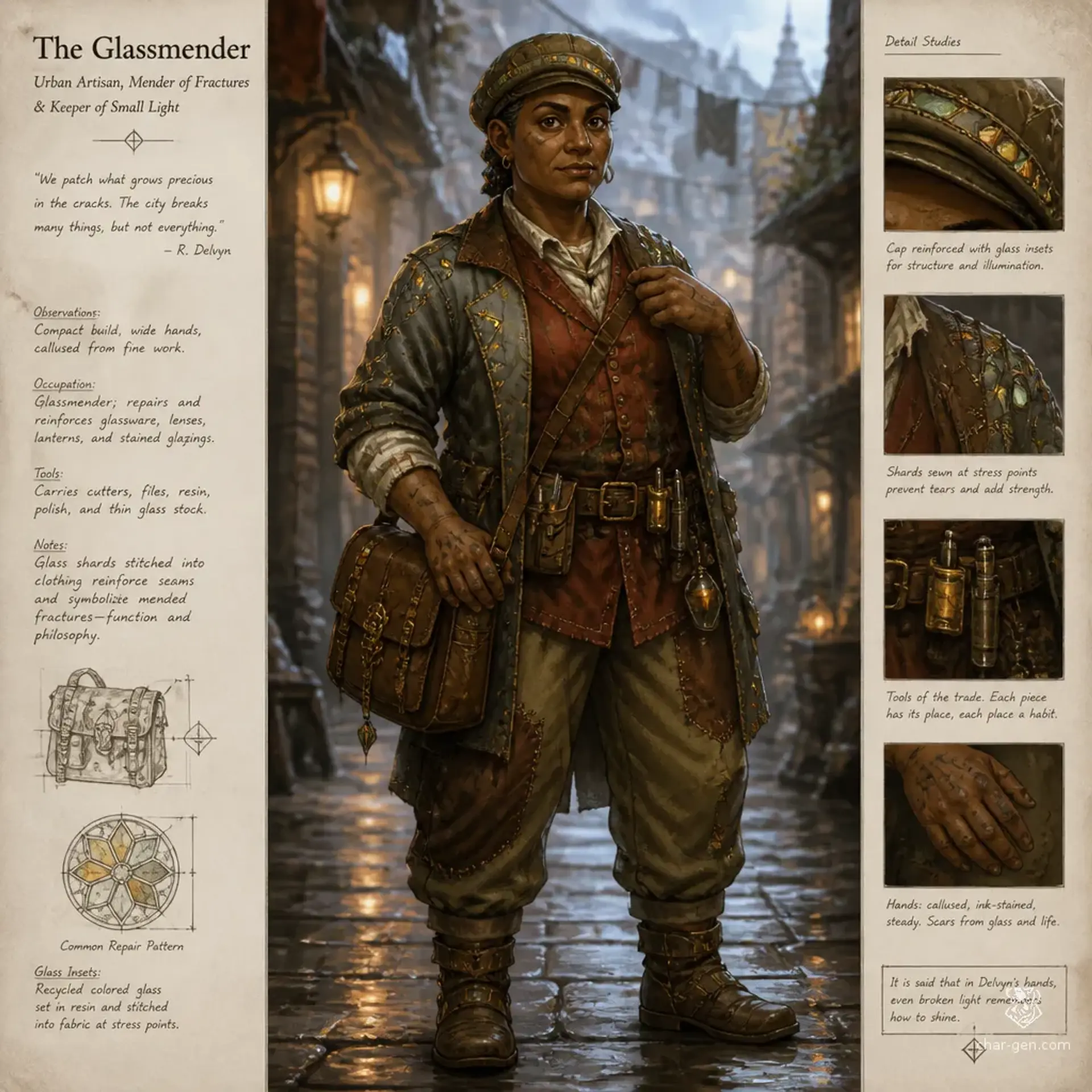
Gutterglass Folk are a highly variable urban ancestry, shaped by centuries of intermarriage and adaptation to crowded human cities. Some are small and compact, with broad hands, large eyes, and flexible joints suited to ladders, rafters, and cramped workshops. Others are tall and narrow, with long fingers, strong shoulders, and an easy balance developed on rooftops and bridgeways. Their skin ranges from soot brown and warm umber to brick red, olive, ash gray, and pale cream. Hair is commonly worn short, braided, wrapped, or tucked beneath a cap, both for practicality and to display neighborhood fashion. Many bear small scars, calluses, ink marks, or decorative patches of colored glass sewn into clothing. They are not naturally magical, but they possess a remarkable sensitivity to the habits, sounds, and hidden rhythms of settled places.
Society & Culture
Gutterglass society is organized less by bloodline than by block, trade, household, and trust. A person may belong to several overlapping circles, each with its own obligations and quiet signals. Children learn local geography through errands and games, while adults exchange favors through a system known as the Open Hand, in which assistance is offered without an immediate demand for repayment. The debt may be answered months later by helping someone else. Gossip is treated as a civic resource, but knowingly spreading a lie that endangers a neighbor is among the gravest social offenses. Festivals favor practical spectacle: lantern walks, rooftop music, communal cooking, street theater, and contests to repair or improve old public works.
Religion & Alignment
Gutterglass religion is practical, local, and shaped by remembrance. Many honor household ancestors, founders of neighborhoods, saintly laborers, departed friends, and personified civic forces such as the Hearth, the Bell, the Bridge, or the Key. Their shrines are often tucked into walls, beneath staircases, or beside public wells. Gutterglass Folk have no strong tendency toward any alignment, but their culture prizes mutual aid, keeping promises, and protecting the vulnerable. Those who embrace ruthless individualism are viewed with suspicion, even when they achieve wealth or prestige.
Homelands & Architecture
Gutterglass communities live wherever a city has accumulated enough age, trade, and neglected corners to support them. Their homes occupy attics, cellar apartments, converted workshops, bridge houses, and narrow buildings built around shared courtyards. Architecture favors hidden storage, multiple exits, rain collection, foldaway furniture, and windows positioned to watch the street without inviting notice. A Gutterglass district is rarely uniform, but its inhabitants can identify one another’s influence in repaired masonry, painted doorframes, community ovens, and public fixtures maintained long after the authorities have forgotten them.
Relationships With Other Peoples
Gutterglass Folk are woven into the daily life of larger settlements, though outsiders may mistake their discretion for secrecy or their neighborhood loyalty for insularity. They often work as couriers, translators, repairers, household staff, shopkeepers, informants, and civic caretakers. Humans and other common urban peoples frequently regard them as dependable but difficult to surprise. Nobles may underestimate them, while criminals may fear the speed with which Gutterglass news travels. Rural communities can seem painfully quiet to them, although many Gutterglass travelers eventually come to value the absence of hidden eyes and crowded obligations.
Visual sheet
Turn Gutterglass Folk into a sheet
A high-res, share-ready sheet you can post or print.