Small or Medium, chosen when you select this species
Common
Humanoid
Humanoid·Small or Medium, chosen when you select this species
Latticefolk
Civorhiza memoria
Speed
30 ft.
Lifespan
Latticefolk mature at roughly 18 years and commonly live 90 to 120 years. The oldest elders may reach 150 years, though few remain active in dangerous professions that long.
Darkvision
60 ft.
Habitat
Urban
urban fantasy
adaptable
climber
community-minded
humanoid
standard PC ancestry
city-born
memory-keeper
SizeSmall or Medium, chosen when you select this species
Speed30 ft.
LifespanLatticefolk mature at roughly 18 years and commonly live 90 to 120 years. The oldest elders may reach 150 years, though few remain active in dangerous professions that long.
Creature TypeHumanoid
Darkvision60 ft.
Latticefolk are children of the built world, born in crowded districts where every wall carries a story and every stranger may become family. They can read a neighborhood by its footsteps, smell, echoes, and broken paving stones. To a Latticefolk adventurer, the wilderness is strange, but a ruined city is a familiar kind of wilderness, full of hidden routes, old obligations, and voices trapped beneath the foundations.
Physical Description
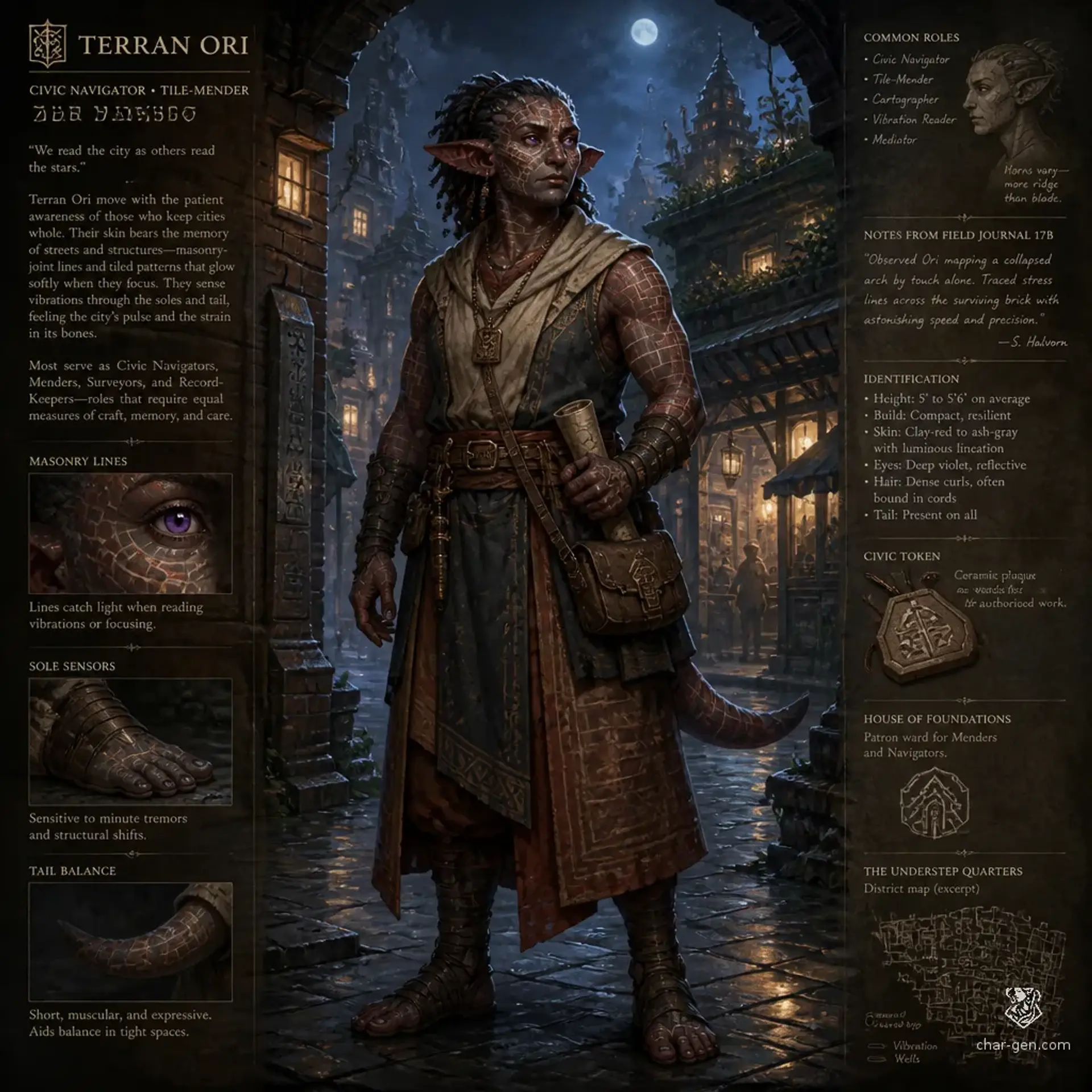
Latticefolk are humanoids with compact, resilient bodies and a remarkable variety of forms. Their skin may be clay-red, ash-gray, brown, blue-black, pale gold, or nearly white, often crossed by fine natural lines resembling masonry joints, tiled mosaics, or branching streets. These markings become more pronounced with age and may faintly reflect nearby light. Their eyes are large and highly sensitive to motion, commonly silver, amber, green, or deep violet. Hair grows in dense curls, cords, soft quills, or straight dark sheets. Many Latticefolk have short tails, broad ears, hornlike ridges, or patches of mineralized skin, depending on their subspecies. Their hands and feet are strong, flexible, and well suited to ladders, ledges, scaffolds, and rough walls.
Society & Culture
Latticefolk society is organized around households, blocks, guilds, shrines, and mutual-aid circles rather than a single universal clan system. A person's identity may include the district where they were born, the trade that trained them, the house that sheltered them, and the public place they maintain. They value competence, memory, hospitality, and knowing when to bend a rule to preserve its purpose. Children are raised by dense networks of relatives, neighbors, and mentors. Gossip is treated as a civic resource, though malicious rumor is considered a serious moral offense. Festivals often involve repainting signs, relighting old lamps, opening locked courtyards, and retelling the founding stories of local streets.
Religion & Alignment
Latticefolk religion is practical, local, and deeply concerned with continuity. Some revere patron spirits of bridges, fountains, gates, hearths, or markets. Others honor ancestors by maintaining public places, recording the dead, or repairing what neglect has damaged. Their funerary custom is to place a token of the deceased into a building that served them well. Latticefolk have no innate tendency toward any alignment, though communal traditions often encourage compassion, responsibility, and a suspicion of absolute authority.
Homelands & Architecture
Latticefolk are most at home in old cities, especially those built in layers over earlier settlements. Their neighborhoods favor connected courtyards, rooftop gardens, covered walkways, communal kitchens, and walls thick enough to carry sound. Homes are decorated with ceramic plaques, colored cords, carved lintels, and small recessed shelves for offerings, keys, and family records. A Latticefolk district is rarely planned as a perfect grid. It grows by accretion, preserving old doorways and foundations even when new streets are built around them.
Relationships With Other Peoples
Latticefolk are often the connective tissue of larger societies. They serve as couriers, builders, clerks, translators, investigators, innkeepers, performers, and neighborhood leaders. Other peoples sometimes mistake their familiarity with urban life for parochialism, but Latticefolk generally understand that every city is an ecosystem with predators, symbiotic partners, seasonal migrations, and dangerous invasive forces. They tend to form friendships through repeated small acts rather than dramatic declarations. Among themselves, disputes are often mediated through witnesses, shared meals, and the careful recitation of what each person remembers.
Visual sheet
Turn Latticefolk into a sheet
A high-res, share-ready sheet you can post or print.