Small or Medium, chosen when you select this species
Uncommon
Construct
Construct·Small or Medium, chosen when you select this species
Verdant Reliquary
*Silvafaber memoria*
Speed
30 ft.
Lifespan
Verdant Reliquaries do not age as living creatures do, but their bodies slowly weather. They commonly remain active for 150 to 300 years, with rare elders enduring for more than 500 years after extensive restoration.
Darkvision
60 ft.
Habitat
Temperate and tropical forests, especially ancient groves, fungal hollows, and woodland ruins
construct
forest
guardian
woodland
artificial life
memory
standard PC ancestry
SizeSmall or Medium, chosen when you select this species
Speed30 ft.
LifespanVerdant Reliquaries do not age as living creatures do, but their bodies slowly weather. They commonly remain active for 150 to 300 years, with rare elders enduring for more than 500 years after extensive restoration.
Creature TypeConstruct
Darkvision60 ft.
Verdant Reliquaries are constructed guardians of the old forests, each one awakened with a purpose that may outlive the culture that gave it shape. They remember through scent, ring patterns, and fragments of ancestral instruction, yet every Reliquary must decide whether to remain an instrument of its maker or become something entirely new. To meet one on the road is to encounter a patient traveler of wood and metal, carrying a forest's history beneath its bark and listening for the next command that deserves to be obeyed.
Physical Description
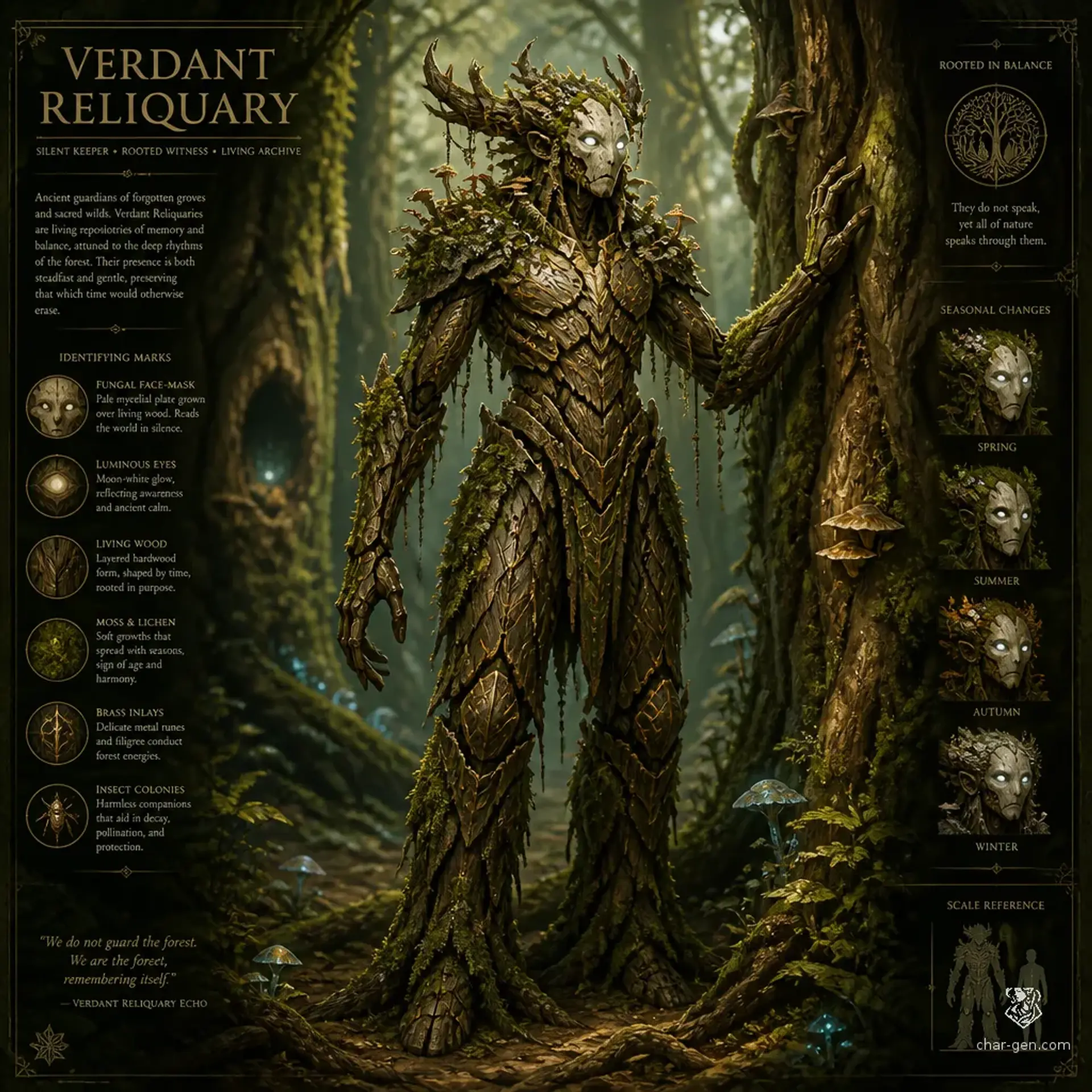
Verdant Reliquaries are constructed bodies animated by a seed of condensed life-force called a heartseed. Their frames may be carved from hardwood, woven from root and resin, or assembled from layered bark over a slender metal skeleton. Most have humanoid proportions, but their creators often gave them broad shoulders, long fingers, articulated feet, or asymmetrical protective plates suited to woodland work. Their faces are expressive masks of polished wood, ceramic, or pale fungus, and their eyes shine with amber, green, or moon-white light. Moss, lichen, flowers, and small colonies of harmless insects commonly grow across their bodies. A Reliquary can mend minor damage with sap, thread, and careful maintenance, but a destroyed heartseed means true death.
Society & Culture
Reliquary society is organized around groves, craft lineages, and remembered obligations rather than blood families. Each individual belongs to a maker-line, the tradition of artisans and guardians whose methods shaped its heartseed and body. New awakenings are celebrated as First Ring ceremonies, during which elders share practical knowledge, cautionary tales, and a symbolic fragment of bark from the community tree. Their culture values repair over replacement, testimony over speculation, and long deliberation before irreversible action. Some Reliquaries preserve their original directives with reverence. Others consider self-determination the highest achievement a constructed being can attain.
Religion & Alignment
Verdant Reliquaries rarely worship gods in the manner of living peoples. They honor the First Root, the unknowable source of growth, memory, and renewal, and many maintain small shrines to the maker who awakened them. Their morality often emphasizes protection, balance, and the keeping of promises. Neutral and good Reliquaries are common, but those built for conquest, extraction, or rigid obedience may become lawful, ruthless, or dangerously literal in the name of their original purpose.
Homelands & Architecture
Verdant Reliquaries inhabit groves shaped around living trees rather than cleared settlements. Their homes are grown, carved, and repaired in collaboration with roots, vines, fungi, and patient woodland spirits. Communal halls are built inside hollow trunks, while memory vaults consist of resin-sealed chambers beneath the soil. Their oldest sanctuaries are grove-forges, places where artisans once assembled bodies from heartwood, bone-white sap, copper, and enchanted seedstone.
Relationships With Other Peoples
Most living peoples view Verdant Reliquaries with a mixture of admiration and unease. Forest communities often welcome them as protectors, though some fear that their ancient directives place trees above people. Cities see them as valuable laborers, curiosities, or military assets, and unscrupulous collectors may seek their heartseed designs. Reliquaries generally feel kinship with constructs and woodland beings alike, while their relationships with ordinary people tend to revolve around a central question: are they persons, tools, or both? They answer this question differently from grove to grove.
Visual sheet
Turn Verdant Reliquary into a sheet
A high-res, share-ready sheet you can post or print.