Small or Medium, chosen when you select this species
Common
Humanoid
Humanoid·Small or Medium, chosen when you select this species
Lanternfolk
*Homo lucernalis*
Speed
30 ft.
Lifespan
Lanternfolk mature between sixteen and twenty years and commonly live seventy to ninety years. Exceptional elders may reach a century, though few retire from civic life entirely.
Habitat
Urban
urban
humanoid
common
community
streetwise
mundane
subtle
SizeSmall or Medium, chosen when you select this species
Speed30 ft.
LifespanLanternfolk mature between sixteen and twenty years and commonly live seventy to ninety years. Exceptional elders may reach a century, though few retire from civic life entirely.
Creature TypeHumanoid
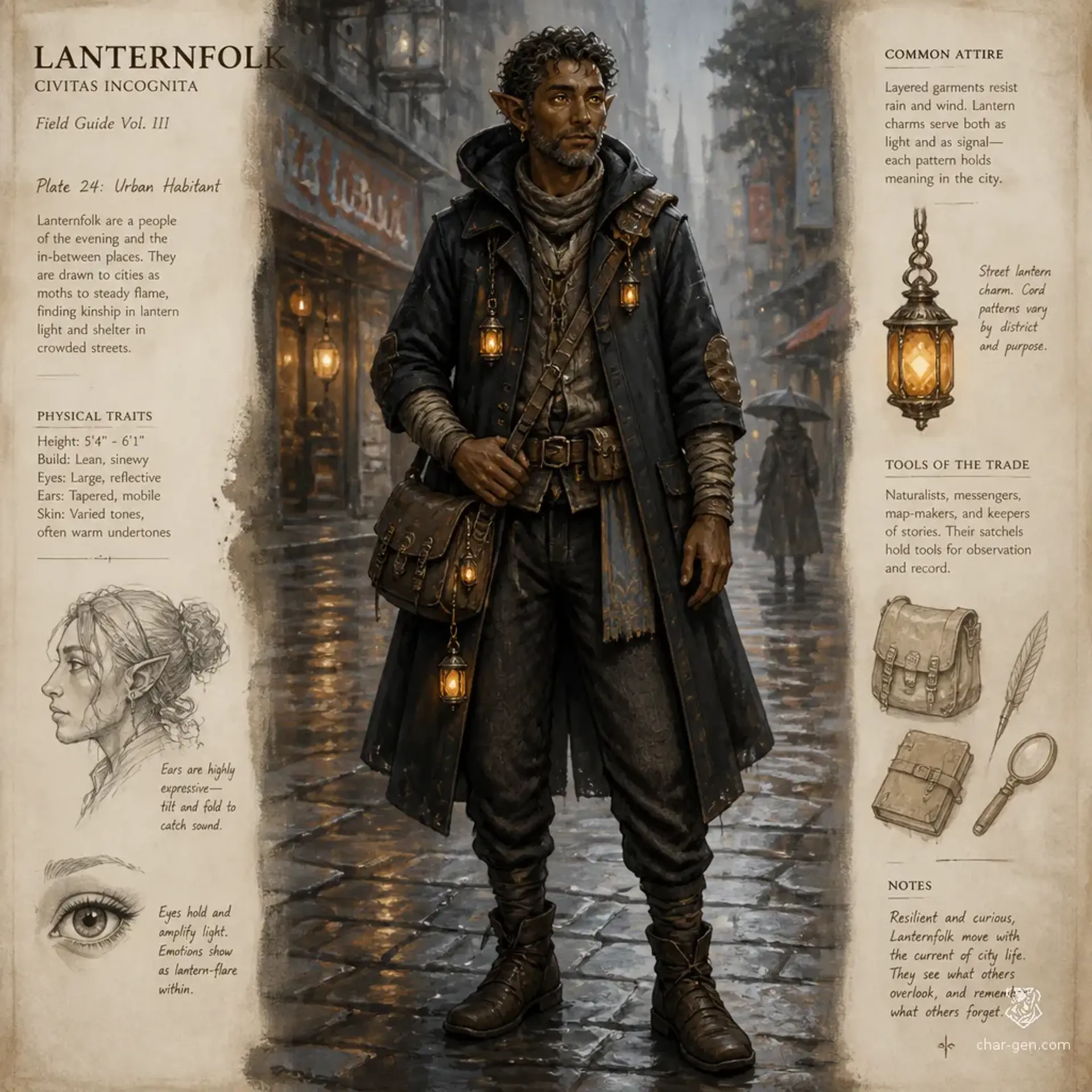
Lanternfolk are the people who know which baker opens before dawn, which bridge creaks beneath a heavy cart, and which alley becomes dangerous when the fog rolls in. Born from generations of crowded streets and shared survival, they are couriers, artisans, advocates, innkeepers, investigators, and neighborhood guardians. A Lanternfolk adventurer carries an entire city inside their habits: watch the exits, remember the names, leave a light for the next traveler, and never assume that an unmarked door is unimportant.
Physical Description
Lanternfolk are a varied urban ancestry, united less by a single appearance than by a recognizable alertness. Their builds range from compact and sturdy to tall and rangy, with most adults falling within the human range. Skin tones, hair textures, and facial features reflect the many peoples who have joined their city communities over centuries. Their eyes often show a faint reflective glimmer in low light, a harmless adaptation to life among dim alleys and shuttered rooms. Lanternfolk favor layered clothing suited to sudden weather and crowded streets. Coats have hidden pockets, sleeves are often reinforced at the elbows, and practical shoes are considered a mark of good sense rather than a lack of elegance.
Society & Culture
Lanternfolk culture is built around neighborhood memory. Every district has people who know its old boundaries, family histories, unwritten rules, emergency shelters, and seasonal traditions. Children learn practical navigation alongside reading, and many households maintain a tradition of memorizing one route that leads safely across the city during a crisis. Hospitality is measured by useful acts: mending a coat, carrying news, watching a child, sharing a key, or saving the last bowl of stew. Lanternfolk are comfortable with commerce and negotiation, but they distrust transactions that leave no room for mercy. Their festivals transform streets into temporary commons, with hanging lamps, rooftop music, public cooking, and competitions in storytelling, lockmaking, sign painting, and route-finding.
Religion & Alignment
Lanternfolk tend to honor household guardians, civic saints, crossroads spirits, ancestral founders, and deities associated with shelter, labor, truth, or safe passage. Their religious practice is usually local and practical. A blessing may be spoken over a new shop, a candle left for the dead, or a shared meal offered to a traveler. Lanternfolk show no single alignment tendency, though communal expectations often encourage compassion and responsibility. Those who reject these expectations may become fiercely independent, secretive, or ambitious.
Homelands & Architecture
Lanternfolk thrive in old, layered cities where homes, workshops, markets, shrines, and public passages have grown together over generations. Their neighborhoods favor narrow balconies, covered walkways, rooftop gardens, communal courtyards, folding partitions, and doors painted with household symbols. A Lanternfolk building often contains more than one apparent entrance, not because its residents are secretive, but because city life teaches that every home should offer a safe route in and out. In wealthier districts, Lanternfolk architects are known for elegant arcades and ingenious use of light. In poorer quarters, their practical talent appears in patched stairways, rain channels, hidden pantries, and walls that can be opened when neighbors need shelter.
Relationships With Other Peoples
Lanternfolk usually form strong bonds with other urban communities, especially laborers, merchants, displaced families, and civic servants. They are often mistaken for informants because they notice everything, though most see information as a communal resource rather than a weapon. Rural peoples may find them restless or overly cautious, while aristocrats often underestimate them as ordinary workers until a Lanternfolk quietly names every person in the room. Relations with criminal organizations vary by district. Some Lanternfolk oppose such groups fiercely, while others maintain uneasy arrangements that keep violence away from their streets.
Visual sheet
Turn Lanternfolk into a sheet
A high-res, share-ready sheet you can post or print.