Medium or Small. You choose the size when you select this species.
Common
Humanoid
Humanoid·Medium or Small. You choose the size when you select this species.
Hearthstride
Vastivagus campestris
Speed
30 ft.
Lifespan
Hearthstride mature around age 16 and commonly live 80 to 100 years. Their oldest elders may reach 120 years, though few remain physically vigorous for that long.
Habitat
Open plains, savannas, steppe, prairie, and broad upland grasslands
humanoid
plains
nomadic
caravan
endurance
animal-bonded
weatherwise
SizeMedium or Small. You choose the size when you select this species.
Speed30 ft.
LifespanHearthstride mature around age 16 and commonly live 80 to 100 years. Their oldest elders may reach 120 years, though few remain physically vigorous for that long.
Creature TypeHumanoid
Hearthstride are road-born guardians of the great grasslands, people who measure a life in campfires, changing skies, and the miles between one promise and the next. They can cross a plain without losing the trail, sense danger in a shift of wind, and turn a temporary camp into a home before sunset. To meet one is to meet a traveler, scout, trader, storyteller, or exile carrying an entire homeland in memory.
Physical Description
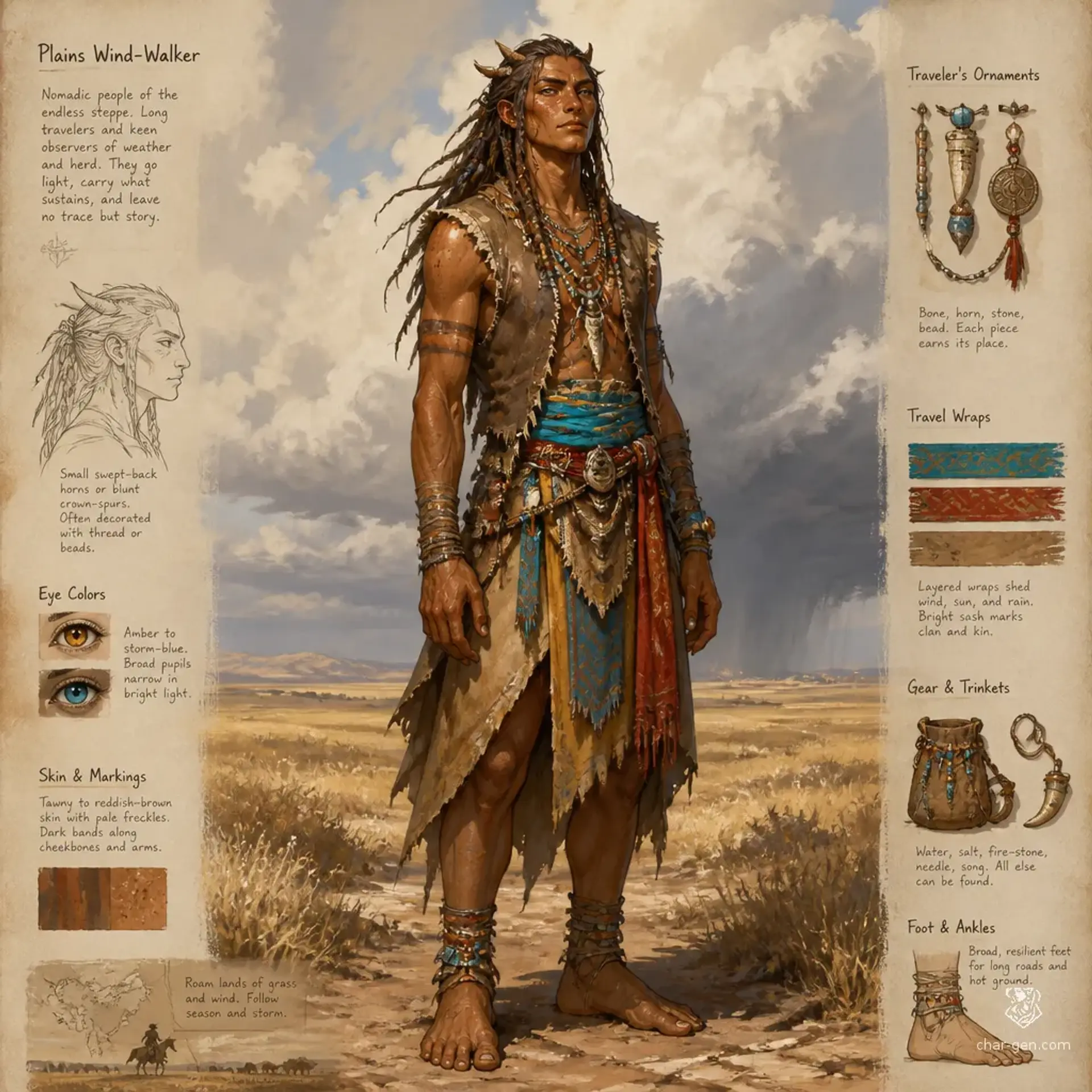
Hearthstride are tall, long-limbed humanoids shaped by generations of travel beneath an enormous sky. Their skin ranges from tawny gold and reddish brown to deep umber, often marked by pale freckles or dark bands along the arms and cheekbones. Their hair is usually thick and worn in cords, braids, or loose windblown waves. Small swept-back horns, ridged brows, or blunt crown-spurs are common, though their exact form varies by lineage. Their eyes tend toward amber, gray, green, or storm-blue, with broad pupils that narrow sharply in bright sunlight. Most hearthstride have unusually flexible ankles and broad, resilient feet suited to long-distance travel. Their clothing favors layered wraps, sleeveless coats, bright sashes, and ornaments that click softly while they walk.
Society & Culture
Hearthstride society is organized around caravans, extended families, and chosen circles called hearthbands. Every hearthband maintains a route archive containing maps, songs, weather signs, burial places, and warnings about dangerous spirits. Leadership is temporary and practical. A person may guide the caravan during a drought, surrender authority to a healer during an outbreak, and follow a skilled outrider when danger appears. Storytelling is both entertainment and law, preserving agreements that were never written down. Hospitality requires offering water, shade, and a place near the fire, while refusing these things to a traveler is considered a grave moral offense. Young hearthstride are encouraged to spend at least one season among another hearthband, ensuring that loyalty does not become isolation.
Religion & Alignment
Hearthstride religion centers on the First Fire, an ancestral flame said to have been carried across the world by the earliest wanderers. They honor sky, rain, grass, herd beasts, ancestors, and the unnamed spirits of roads. Their priests are called firekeepers, and their rituals involve shared meals, sung genealogies, and the scattering of ash at crossroads. Hearthstride favor personal freedom tempered by mutual duty, making many neutral, good, or chaotic good, though strict clan traditionalists and ruthless road-kings are not unknown.
Homelands & Architecture
Hearthstride homelands are not defined by permanent borders. Their caravans move between seasonal camps, spring-fed hollows, standing-stone circles, and ancestral wells. Most dwellings are round, low-profile tents built from felt, woven reed, and hide, designed to be dismantled before the next migration. Permanent settlements use windbreak walls, sunken courtyards, and bright ceramic markers that record safe water, dangerous ground, and the names of honored dead. A hearthstride town is less a collection of buildings than a remembered pattern of roads, markets, grazing fields, and communal fires.
Relationships With Other Peoples
Hearthstride are often welcomed as guides, drovers, caravan guards, and negotiators, but settled peoples sometimes mistake their mobility for unreliability. They have a long history of trade with agrarian communities and a wary relationship with imperial powers that attempt to tax, fence, or regulate the open plains. Hearthstride generally respect goblin-kin artisans, dwarf-like builders, and elf-like keepers of ancient groves, while remaining suspicious of any society that treats land as property rather than responsibility. Among themselves, hospitality is sacred. A hearthstride may quarrel bitterly with a guest and still defend that guest from danger without hesitation.
Visual sheet
Turn Hearthstride into a sheet
A high-res, share-ready sheet you can post or print.