Kyratzai mature physically around age 18 and commonly live 80 to 100 years. Their strength tends to remain impressive into old age, though injuries and accumulated scars often limit their mobility before age itself does.
Darkvision
60 ft.
Habitat
High mountain ranges, wind-carved valleys, cliffside passes, and fortified settlements built around natural stone spires
mountain
warrior culture
honor-bound
fangs
humanoid
standard PC ancestry
SizeMedium
Speed30 ft.
LifespanKyratzai mature physically around age 18 and commonly live 80 to 100 years. Their strength tends to remain impressive into old age, though injuries and accumulated scars often limit their mobility before age itself does.
Creature TypeHumanoid
Darkvision60 ft.
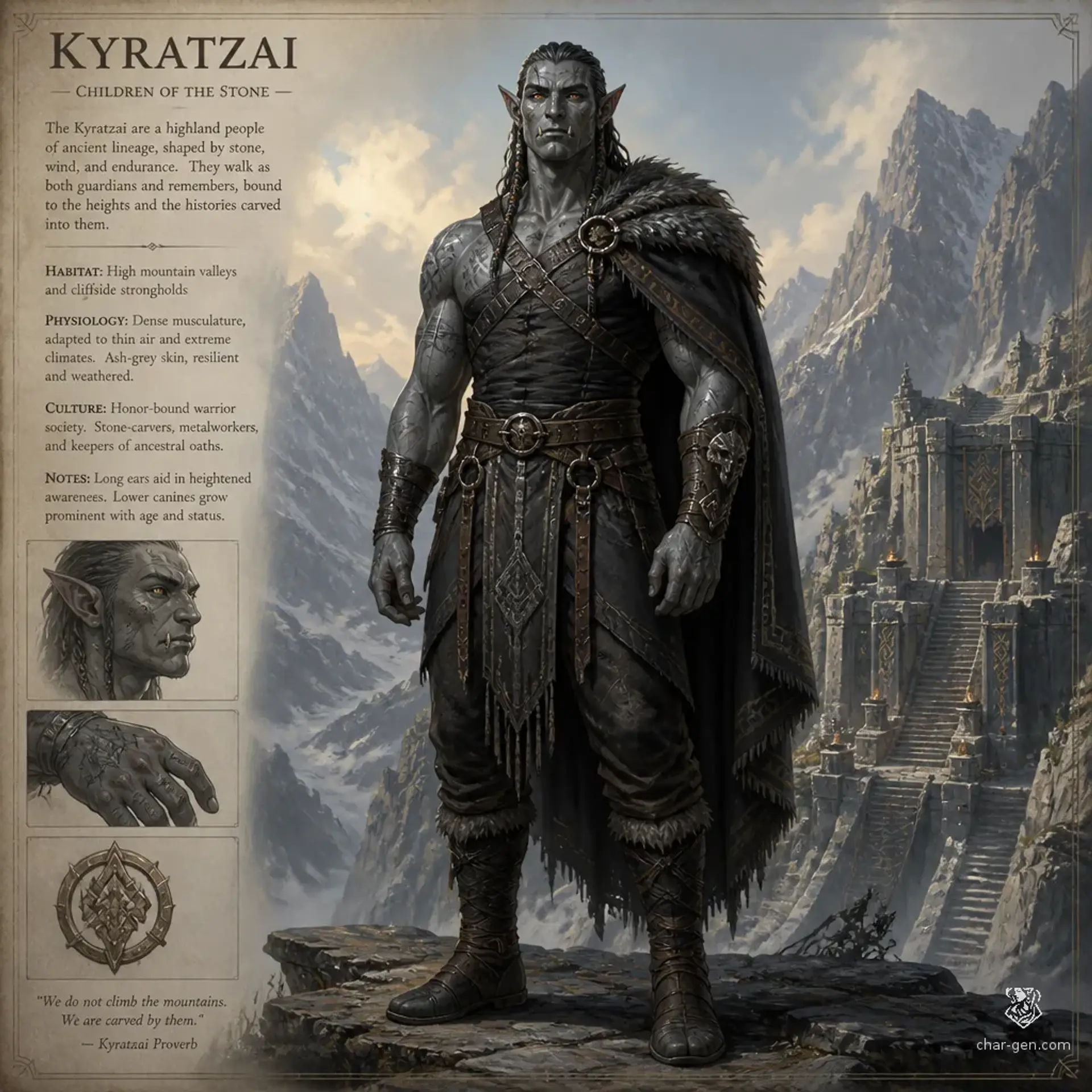
The Kyratzai are mountain-born warriors whose grey skin, long ears, and sweeping lower fangs make them unmistakable even before they speak. They believe strength is a responsibility, honor is a form of law, and leadership belongs to whoever can prove they deserve it. In their highland halls, a stranger may become kin by sharing a meal, or become sovereign by defeating the clan's strongest fighter. Kyratzai adventurers carry this severe, generous code into the wider world, seeking worthy challenges, protecting those under their care, and learning whether honor can survive in lands where victory is rarely clean.
Physical Description
Kyratzai are tall, broad-shouldered humanoids with dense musculature and a natural bearing that makes them seem even larger than they are. Their skin ranges from ash grey to slate, often darkening at the elbows, knees, knuckles, and jaw. Two large fangs rise from the lower sides of the mouth, curving past the upper lip without preventing clear speech or eating. Smaller teeth line the rest of the jaw. Kyratzai ears are long and sharply pointed, and their eyes commonly appear amber, copper, pale blue, or deep brown. Hair is usually black, iron grey, or dark auburn, worn in braids, cords, shaved patterns, or high crests that mark household and military affiliation. Kyratzai clothing is practical and deliberately reveals physical capability. Men commonly go bare-chested, while women often wear a close-fitting breast covering with belts, skirts, trousers, cloaks, or protective harnesses. Both sexes decorate themselves with scars, metal rings, painted symbols, and trophies earned through honorable service.
Society & Culture
Kyratzai society is organized into clans, households, and war-bands. Every adult is expected to possess at least one form of useful strength, whether physical, intellectual, artistic, spiritual, or social, though martial skill receives the greatest public honor. Men commonly train as climbers, hunters, shield bearers, and duelists, while women are equally likely to serve as champions, judges, commanders, or artisans. These roles are cultural expectations rather than biological limits, and a Kyratzai who proves exceptional in an unusual discipline earns lasting respect. Leadership is not inherited automatically. A reigning champion, called the High Fang, may be challenged under strict ritual rules by a Kyratzai or outsider who can demonstrate a legitimate claim. If the challenger defeats the High Fang in fair battle, the clan must accept the victor as its leader unless the victory violated sacred rules. The tradition makes Kyratzai politics unusually meritocratic, but it also creates tension whenever clever diplomacy, age, or magical power defeats raw physical might. Hospitality is sacred, and a guest who has eaten salt beneath a Kyratzai roof is protected until they depart or break the laws of the household.
Religion & Alignment
Kyratzai religion centers on ancestral remembrance, sacred oaths, and the belief that every life is a trial of strength. Their priests preserve the names of the dead, witness formal challenges, tend the wounded, and judge whether a victory was honorable. Many Kyratzai revere a pantheon of mountain spirits, war ancestors, forge powers, and storm heralds, while others honor only the collective wisdom of those who came before. Kyratzai societies often favor lawful traditions, but individuals range from compassionate protectors to ruthless conquerors. Their culture prizes courage and responsibility more than kindness, so both good and neutral Kyratzai are common, while cruel Kyratzai may justify domination as a natural right of the strong.
Homelands & Architecture
Kyratzai homelands cling to mountainsides where ordinary roads cannot reach. Their settlements are arranged in ascending terraces connected by ladders, narrow bridges, and carved stairways. Homes are built from dark stone, with broad communal halls sunk into the mountain and open training courts exposed to the cold air. Every major settlement maintains a challenge ground, a shrine to its ancestors, and a high seat where the clan leader receives petitions. Architecture favors weight, permanence, and defensibility. Even a private home often includes a small practice yard and a wall for displaying weapons, trophies, or records of honorable deeds.
Relationships With Other Peoples
Kyratzai respect people who keep their word, stand by their companions, and accept the consequences of their choices. They are quick to admire disciplined warriors, courageous leaders, skilled artisans, and anyone who protects the vulnerable despite personal cost. They distrust boastfulness unsupported by action and often test unfamiliar allies through demanding but nonlethal contests. Their direct manner can appear aggressive to other peoples, though Kyratzai generally consider open disagreement healthier than concealed resentment. They maintain old rivalries with several neighboring mountain cultures, but these conflicts are governed by traditions of hostage exchange, formal challenge, and protection for travelers who bear recognized peace tokens.
Visual sheet
Turn Kyratzai into a sheet
A high-res, share-ready sheet you can post or print.