The Ashen Crossing Dispute
Stakes Control of a burial crossing that determines which dead may be interred, which trade routes remain open, and whether the southern road becomes a toll road or a battlefield.
World Atlas·Sphere·A continent where ley lines are borders, temples are fortresses, and every spell has a political cost.
trade heart and political middle ground · river plains and trade roads
Hook
Merchants, judges, and mages compete for the busiest crossing on the continent.
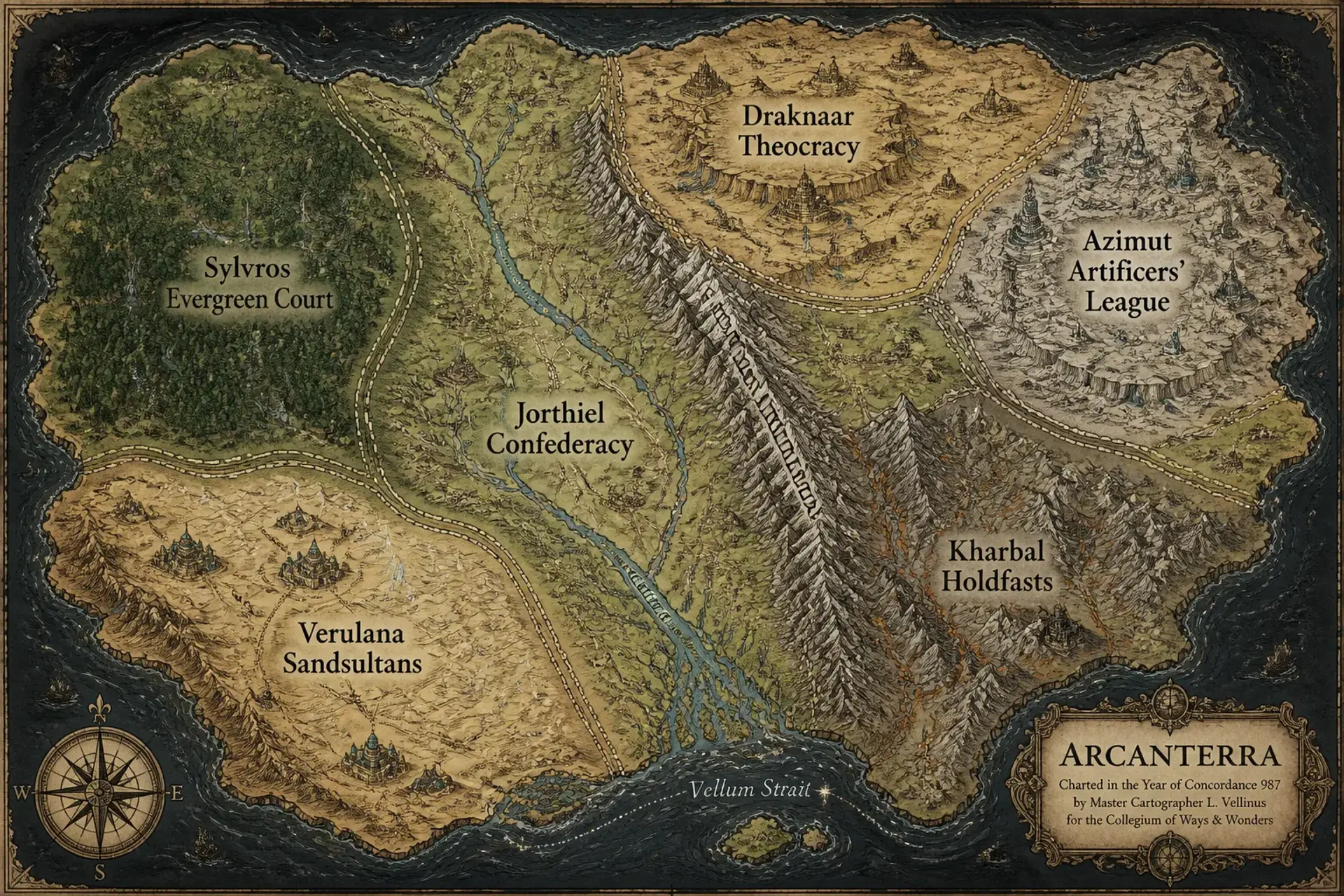
Arcanterra is a continent of rival ley lines, temple states, and border wars fought as much by priests and wizards as by kings. Every major road runs through a sacred crossing, so trade, burial, and war all depend on who guards the stones. The realm feels old, crowded, and uneasy, with faith, spellcraft, and law locked in constant struggle.
Themes
Form · Sphere
A single continent on a broad world, ringed by distant seas and crossed by visible ley roads that mark its political and sacred geography.
Traversal
Travel follows roads, river routes, and ley crossings; magic and pilgrimage shorten some journeys, while hostile borders and shrine tolls slow others.

Sphere

Magic
Common

Technology
Medieval

Death & Souls
Mythic Dawn
When the Leys Woke
Founding Age
The Stone Accord
Temple Kingdoms
The Age of Vestments
Border Wars
The Sundering Marches
Concord Years
The Pact of Seven Lanterns
The Ashen Crossing Dispute
Control of a burial crossing that determines which dead may be interred, which trade routes remain open, and whether the southern road becomes a toll road or a battlefield.
The Seven-Spires Schism
A split over who has the right to bind ley lines to public spellwork, threatening city wards, royal authority, and the legitimacy of sanctioned magic.
The Weeping Stone Border War
A disputed standing stone network that anchors the eastern frontier, deciding which realm can raise defenses, levy tolls, and claim farmland along the border.
The Salt Basilica Uprising
A temple-fortress built on a tidal ley node has begun taxing harbor magic, and the revolt could collapse sea trade or place the entire bay under priestly rule.
Defend the old groves and deny all empires access to living ley wood.
Forge artifacts and map the lines before the temples can claim them.
Turn the most powerful crossings into altars for state faith and war.
Mobile orcish hordes of ferocious warriors and elemental shamans
Controls every major eastern mountain pass and the starsteel trade routes. Their runic forges supply arms to allied kingdoms and dwarven warbands across Arcanterra.
Deploy armed caravans guarded by sand knights, employ sand mages to quell sandstorms or conceal their routes, negotiate mercantile treaties, and send covert envoys to influence oases and rival tribes.
Wherever the sunrise touches the land, defend the innocent and vanquish encroaching darkness.
Truth emerges only when clothed in mystery.
Dedicated to unyielding judgment, the binding of souls, and the enforcement of cosmic order through fear and obedience
A political and military alliance of human feudal dukes and wealthy merchant princes united to resist the Obsidian Tribunal and is located on the continent of Eleniara. The Jorthiel Confederacy draws on disciplined pike infantry, longbow archers, and college-trained wizards, they defend vital trade routes and leyline nexuses across the eastern plains.
Stakes Control of a burial crossing that determines which dead may be interred, which trade routes remain open, and whether the southern road becomes a toll road or a battlefield.
Stakes A split over who has the right to bind ley lines to public spellwork, threatening city wards, royal authority, and the legitimacy of sanctioned magic.
Stakes A disputed standing stone network that anchors the eastern frontier, deciding which realm can raise defenses, levy tolls, and claim farmland along the border.
Stakes A temple-fortress built on a tidal ley node has begun taxing harbor magic, and the revolt could collapse sea trade or place the entire bay under priestly rule.
Stakes A doctrine that allows memory magic in funeral rites may either be recognized as sacred practice or purged as dangerous sorcery, changing how the dead are honored and questioned.
Stakes A contested coronation depends on an ancient oath forged into temple metal, and whoever controls it can legitimize a ruler or shatter the kingdom into rival claims.
Stakes A living ley network is expanding into new farmland, forcing a choice between preserving a sacred wild, opening settlement, or bleeding the land dry with arcane drainage.
Stakes A magical canal that shortens inland travel is disputed, and control of its gates would reshape tariffs, military logistics, and the balance of wealth across Arcanterra.
Stakes An old holy road has been closed by siegeworks, and reopening it could restart pilgrimage, expose relics, and force armies to move through sacred ground.
Stakes A tribunal is deciding whether battlefield magic must be restricted by law, and the outcome could empower mage registries, local autonomy, or total temple oversight.
Stakes A submerged shrine rumored to stabilize nearby ley lines could solve regional famine or unleash a flood of unbound miracles if disturbed.
Stakes A peace treaty that limits battlefield miracles is being rejected by frontier lords, risking a renewed holy war over how much devastation counts as lawful defense.
Stakes A hidden library containing banned spell accords and temple bloodlines may determine who owns past treaties, which bloodlines are legitimate, and whether old wars can be restarted on legal grounds.
Stakes Every sacred crossing was sealed after an omen, trapping armies, merchants, and refugees on the wrong side and turning every gatehouse into a potential flashpoint.
Stakes A giant ritual bell that keeps the high passes safe from storms is damaged, and repairing it may require a political concession that would redraw mountain borders.
In the oldest songs, Arcanterra was a silent land until the ley lines stirred beneath mountain and marsh. Shrines rose first, not cities, because the first priests learned that prayer could calm the surges and keep the crossings from tearing the earth apart.
Competing sanctuaries gathered at the great crossings and hammered out the first shared rites of passage. Burial rights, toll rights, and spellcasting limits were carved into standing stones, creating the custom that every road in Arcanterra answers to sacred law before crown law.
Fortified temples became the true rulers of the continent, each controlling harvest magic, funerary grounds, and the gate-roads between provinces. Kings still wore crowns, but only the high clerics could bless armies, name heirs, and declare a road open for trade.
As ley line crossings grew more valuable, temple states turned their holy boundaries into battlegrounds. Walled monasteries, spell siegeworks, and sanctioned inquisitors became common, and entire border towns learned to live by siege schedule and ritual ceasefire.
After a generation of ruin, rival faiths and wizard houses agreed to regulate travel, spellwork, and burial across the major crossings. The pact reduced open war, but it also made every major miracle subject to taxes, inspection, and political bargaining.
A cycle of divine blight and unstable ley surges struck the continent, making many spells dangerous unless channeled through licensed rites. Public faith deepened, but so did suspicion, as people blamed forbidden ritual, foreign shrines, and unregistered mages for each outbreak.
Temples and courts tightened control over archives, prophecy, and arcane teaching. Borders stayed mostly intact, but information became the deadliest currency in Arcanterra, with smugglers, relic hunters, and heretical scribes moving more freely than diplomats.
The great temple states now hold together only through uneasy treaties, hostage marriages, and mutually assured ruin at the crossings. Trade still flows, wars still begin, and every spell cast in public can shift the balance of power between priesthoods, courts, and ley line guilds.
A new crossing begins to sing beneath a ruined chapel, and every power on the continent wants it before dawn.
A caravan route has gone silent between two holy borders, leaving only ash, prayer beads, and one living witness.
Three temples claim the same relic can calm the ley lines, and each sends agents to steal it first.
A border fortress has started burying the dead in secret, and the buried are not staying buried.
Arcanterra's crossings were not found, but built.
Discovery · Old boundary stones all point to the same buried fault line beneath the continent.
Impact · The ley network may be artificial, and someone still tends its machinery.
The Tribunal does not control every soul claim.
Discovery · Funeral records, temple ledgers, and resurrection fees never match in any region.
Impact · Someone is rerouting souls before they reach the afterlife, creating leverage over the living and the dead.
There is a sixth road no empire admits exists.
Discovery · Crossing maps change after eclipses, and only one order can read the new routes.
Impact · A hidden path may bypass the old powers and expose a lost seat of authority.