The Salvage War
Stakes Who owns the drowned ruins, the war engines below them, and the right to profit from the old world.
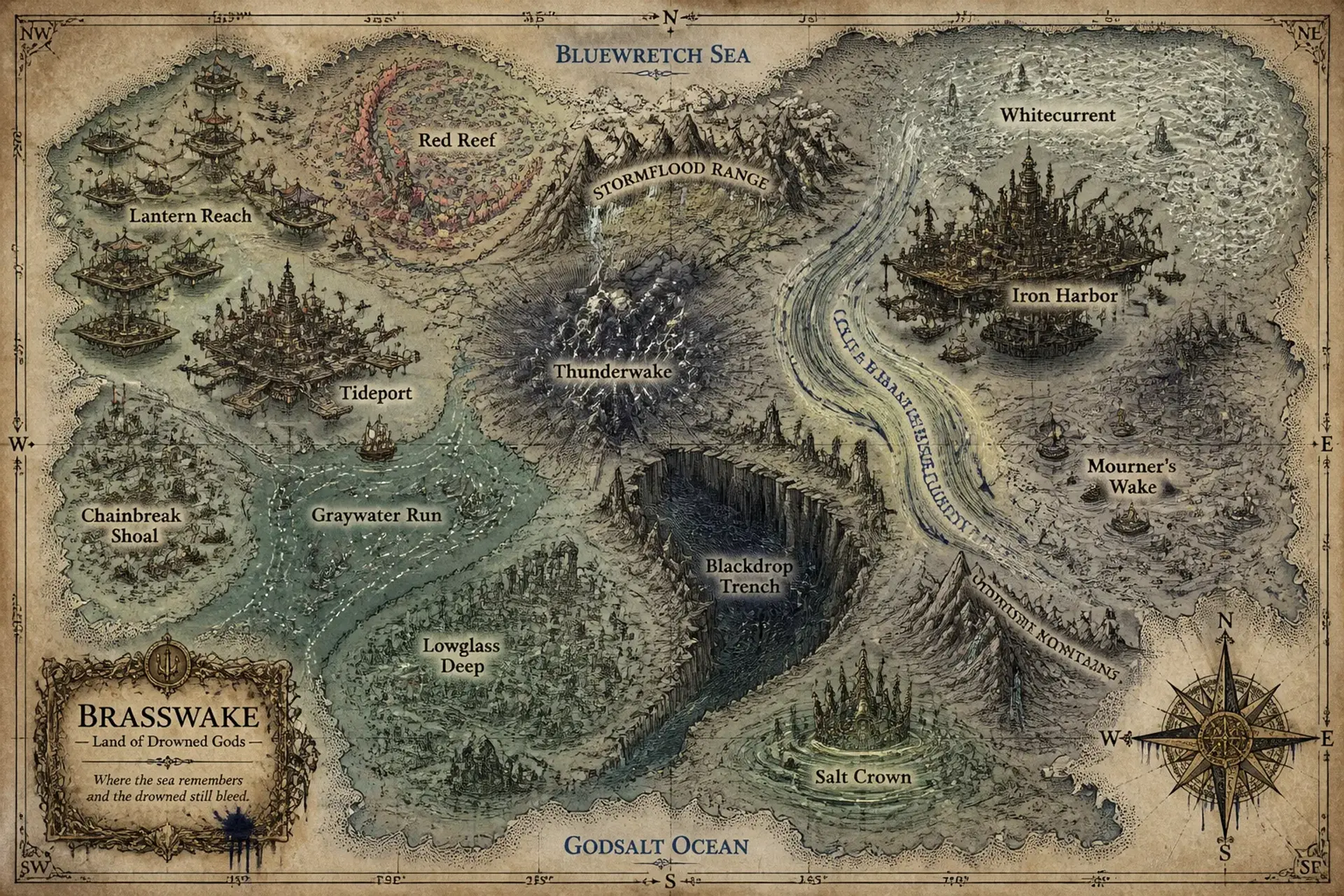
World Atlas·Ocean world·The world is all sea, and the drowned gods still bleed into it.
trade capital and political center · floating city
Hook
The largest market in the world is built from welded hulls and borrowed laws.
Brasswake is a water world of floating cities, salvage fleets, and drowned ruins scattered across a planet remade by the war of the gods. No true land remains above the waves, so people live on chained ships, reef platforms, and colossal barges that drift with the tides. Fortune comes from deep dives, relic hunting, and keeping the sea engines fed while divine scars poison the water and promise greater power below.
Themes
Form · Ocean world
Brasswake is a near-spherical ocean planet that has been subtly deformed by divine violence, swollen along one pole and compressed along the other, as if the world were once twisted in a god's hand. Its surface is a single continuous sea broken only by reefs, drowned spires, floating cities, and the chained hulls of colossal barges. Beneath the waves, long submerged ridges and cratered basins guide the oceans into six immense current loops that circle a central abyss known as the Godscar, where the sea is warm, metallic, and wrong. Around that wound the water is richest, most dangerous, and most cursed, so settlements cling to the safer rings of current, salvage fields, and reef shelves, always one storm away from ruin.
Traversal
Movement across Brasswake follows the sea itself. Voyages are planned by current charts, moon tides, and the seasonal drift of the great gyres, since crossing them directly is slower and deadlier than riding their edges. Most travel uses sailships, tow-barges, dive skiffs, and lantern-lit salvage rigs, with crews hopping from chained station to station to refit, trade, and avoid open-water hazards. Long distance routes are not straight lines but tidal arcs, and the boldest captains descend into the Godscar only when a bleed tide opens a brief lane through the ruins below.
Ocean world
Magic
High
Technology
Magitech
Death & Souls
Before the Tide
Age of Harbors
The War of Gods
Age of Scars
After the Flood
Age of Drifting Crowns
The Salvage War
Who owns the drowned ruins, the war engines below them, and the right to profit from the old world.
The Tide Scar Famine
Polluted waters and shifting currents threaten food, clean water, and the survival of entire flotillas.
The Broken Gods' Wake
Divine scars keep leaking power, and anyone who controls them could reshape trade, faith, and the seas themselves.
Control salvage rights, deep routes, and the labor that keeps city-fleets alive.
Map divine scars, manage rites, and keep the dead from troubling the waters.
Profit from wrecks, secrets, and illegal relics.
Seal or exploit the old war wounds before they unravel the seas again.
Stakes Who owns the drowned ruins, the war engines below them, and the right to profit from the old world.
Stakes Polluted waters and shifting currents threaten food, clean water, and the survival of entire flotillas.
Stakes Divine scars keep leaking power, and anyone who controls them could reshape trade, faith, and the seas themselves.
People lived on coastlines and chained islands, trading by sail and prayer while the gods still kept their distance. Ironworks, sky-lifts, and tide engines began to spread, but the world still had shorelines and stable seasons.
The gods fought across the sea and broke the land apart, raising storms, sinking continents, and leaving divine wounds that still leak strange power. Whole nations drowned, and the survivors fled onto fleets, reefs, and floating city-barges.
The present age is ruled by ship-cities, tide guilds, and salvage fortunes made from the drowned old world. Magitech keeps the great flotillas moving, but every new deepwater expedition risks waking relics, curses, and the unfinished violence of the gods.
A guild charter says a newly surfaced ruin belongs to the first crew that reaches it, but several flotillas are already racing there.
A tide engine in a major city is failing, and the repair parts are said to lie in a sunken temple that still sings at night.
A priest claims one of the divine scars is healing, but the currents around it now pull ships off course toward a hidden trench.
Smugglers are moving cursed relics through the fish markets, and each buyer soon vanishes with water in their lungs.
A wrecked warship from the gods' last battle has begun to rise, and every faction wants its weapon vault before it sinks again.
A hidden tidal scar below the western convoy lanes acts like a divine magnet, pulling shipwrecks and holy debris toward it. It is not a natural current but a wound left by a drowned god struggling in its sleep.
Discovery · A salvager notices that wrecks found near the same trench all carry melted brass prayer tokens from different centuries.
Impact · The trench is a pilgrimage wound in the sea itself. Whoever maps it can predict where lost relics will surface next, but the route also draws the attention of something that treats prayer as food.
Dreams on Brasswake are not private. Certain tide pools, fermented waters, and black salts can carry thoughts between minds, letting cults, smugglers, and prophets trade secrets through sleep.
Discovery · Crewmembers who drink from the same cask keep dreaming of the same woman with barnacles in her hair, even on separate ships.
Impact · A sleeper cult has learned to pass orders through shared dreamspace. If the PCs trace the dream source, they can cut a wide conspiracy apart or use it to communicate across oceans without signal fires.
Long before the floating cities, engineers built bell-buoys to guide ships around submerged god-machines. Some still work, and some were never meant to guide ships at all.
Discovery · A rusted buoy recovered from open water still rings like a cathedral bell whenever blood is spilled nearby.
Impact · The buoy is a beacon built to awaken an ancient sea engine beneath the waves. Repairing it could restore a lost trade route, or trigger a chain reaction that wakes leviathans bound under the abyss.
A forbidden currency survives from the war of the gods. Brasswake's moneychangers know that these relic coins can bend fate, though every miracle carries an interest payment.
Discovery · Salvage divers find that certain coins never corrode and always land face-up when tossed into a pool from a drowned ruin.
Impact · The coins are minted from divine residue and can be used to force a single impossible luck. Repeated use, however, marks the owner as collateral to the sea gods, who eventually come to collect.
The sea itself remembers the old war through living coral script. Reef growth is not random here, but a slow recording of divine violence and the routes it carved through the planet.
Discovery · Every so often, a reef platform's barnacles rearrange into a warning in a language no living scholar remembers.
Impact · The reefs are part of an old defense grid created by the first shipwrights. If decoded, the warnings reveal safe channels, hidden wrecks, and the location of a sealed weapon cache beneath the waves.
Some drowned ruins are protected by forgetting. Entire districts have survived intact beneath the waves because reality itself refuses to let sailors remember their shape for long.
Discovery · A famous harbor has no map of its underside because anyone who dives there loses the ability to describe what they saw.
Impact · Something under the harbor erases memory as a defense. Breaking the seal could expose a buried city intact, but it would also release the thing that has been eating every witness since the last age.
Death certificates in Brasswake can be bought, traded, and stolen. The rich use false drownings to vanish, and the poor sometimes sell their lives to escape worse fates.
Discovery · A guild ledger lists several crews as dead, yet those same crews keep turning up on distant waters under altered names.
Impact · The crews are part of a debt exchange run by a secret consortium. Exposing the scheme could topple merchant houses, while joining it grants access to ships, papers, and the ability to fake death.
The sea engines that keep Brasswake afloat are not entirely mechanical. They respond to living resonance, and some crews secretly use captive sea life as stolen harmonics to make impossible repairs.
Discovery · A cage of singing eels is found pulsing in time with the engine room, even after the engine is shut down.
Impact · The eels are tuned to an undersea signal coming from a colossal machine far below the charted depths. Following the signal could lead to an engine that powers whole city fleets, or to a gate best left closed.
The great city-charters were not founded by merchants alone. Their authority descends from a covenant signed with the survivors of a divine slaughter, and the terms were never meant to be public.
Discovery · A cracked shrine plank drifts in after a storm bearing the same sigil carved into modern admiralty seals.
Impact · The ruling admiralties are descendants of the priests who ended the gods' war, not just pragmatic ship captains. Their legitimacy rests on a pact that may still require periodic sacrifice to hold the ocean calm.
Not all land was erased. A few sealed fragments of the old world endure beneath the waves inside sanctified hollows, airless reliquaries, and god-made pockets of preserved earth.
Discovery · Divers find a drowned statue whose eyes are hollow tunnels leading somewhere dry and warm.
Impact · The tunnels connect to a pocket of preserved land under the sea, where something impossible has survived. A group that reaches it first might claim a new homeland, or wake the last true land born before the flood.
Weather on Brasswake is partly liturgical. Storms arrive when old celestial wounds align, and some monasteries preserved the knowledge to read those wounds as navigation.
Discovery · A tide chart copied from an abandoned monastery predicts storms with impossible accuracy only when read backward.
Impact · The chart is a cipher for divine alignments. Using it lets navigators evade annihilating storms and find hidden routes, but it also reveals when the drowned gods are closest to waking.
Certain children, especially those born near divine scars, can hear structures that do not exist anymore. Their drawings often map places that were sunk, sealed, or deliberately erased from the world.
Discovery · A dockside child draws the same black tower on every scrap of paper, though no one on the pier has ever seen such a place.
Impact · The child is an unwilling medium for a drowned god trying to remember its own prison. Protecting them could reveal the prison's location, while exploiting them may open it prematurely.