The Boundary Crisis
Stakes Whoever controls the changing boundaries will decide where people may live, trade, travel, and belong.
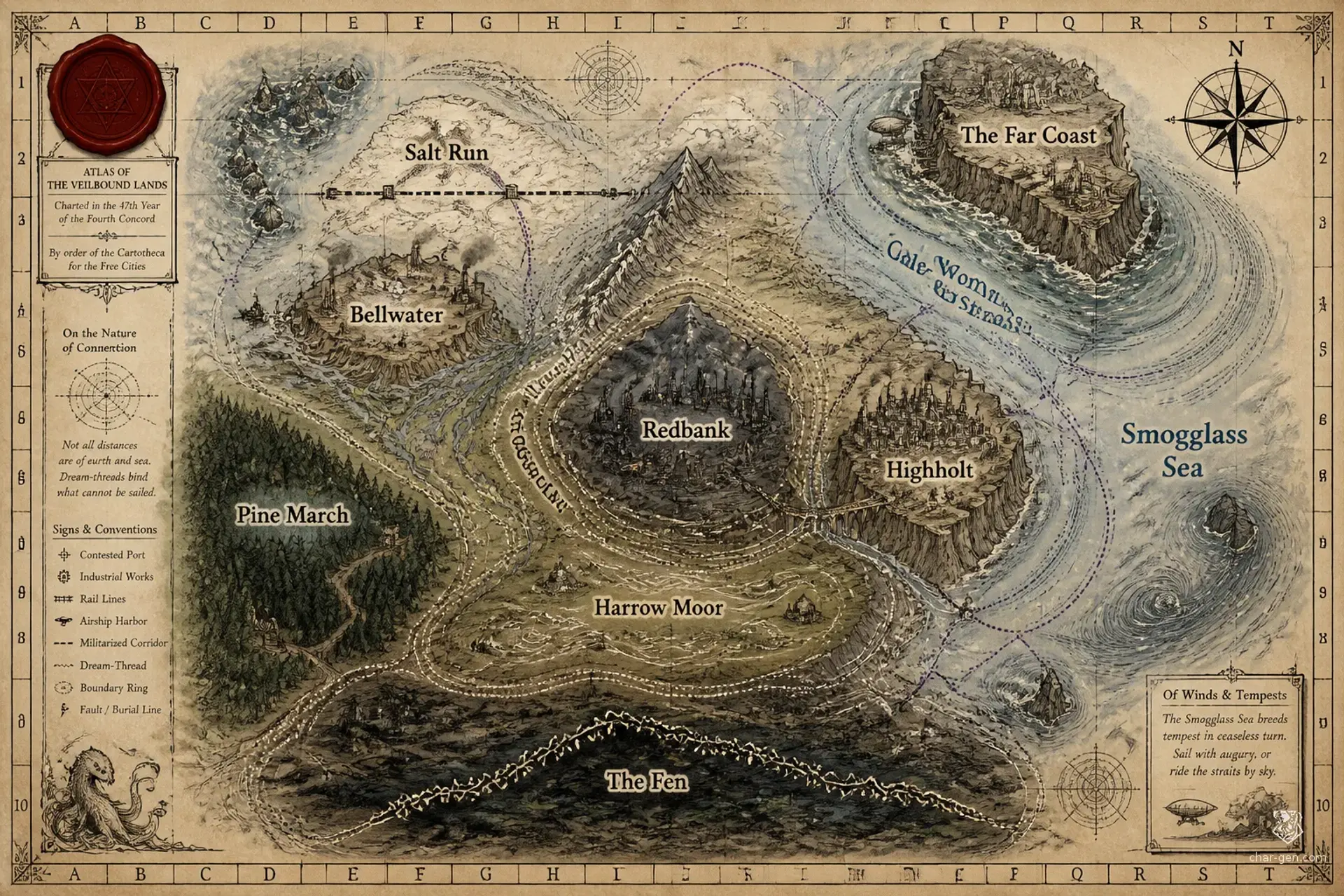
World Atlas·Strange Realm·In this world, a place exists because enough people agree that it does.
Trade gateway and contested port · Smoggy river delta
Hook
A drowned customs city changes allegiance whenever its harbor bells ring.
The Common Measure is a realm whose geography is made from agreements rather than distance. Cities, marshes, mines, and fortresses connect through roads that exist only when properly named, witnessed, and maintained. Brass industry has made travel faster and wealth more concentrated, while failing boundaries strand villages between jurisdictions. Every community argues about who owns a place, because ownership is one of the forces that keeps the world real.
Themes
Form · Strange Realm
A realm of overlapping jurisdictions, named routes, remembered places, and legal boundaries rather than ordinary geography.
Traversal
Travel requires a recognized route, a shared description, and a witness or document that confirms arrival; changing any of these can reroute the journey.
Strange Realm
Magic
Mythic
Technology
Industrial
Death & Souls
Founding
The Measured Age
Expansion
The Brass Century
Present
The Unlicensed Years
The Boundary Crisis
Whoever controls the changing boundaries will decide where people may live, trade, travel, and belong.
The Soul Patent Dispute
The parties fight over whether souls are sacred inheritances, usable fuel, or property of the dead.
To restore a single stable map and place every settlement under enforceable law.
To make boundary magic public and prevent factories from owning routes and communities.
To patent soul-powered engines and turn unstable boundaries into profitable infrastructure.
To guarantee every dead soul passage to the Last Station, even if the living must surrender names and memories.
Stakes Whoever controls the changing boundaries will decide where people may live, trade, travel, and belong.
Stakes The parties fight over whether souls are sacred inheritances, usable fuel, or property of the dead.
Engineers discovered that roads, rivers, and borders could be fixed in place by naming them aloud and recording their measures.
Factories, railways, and spell engines spread across the mapped realm, binding distant communities to shared standards and unequal laws.
The old measurements are failing, causing districts to overlap, vanish, or open only to people carrying the right names and papers.
A railway arrives at a town that officially does not exist, and its passengers remember three different reasons they came there.
A factory consortium offers the party legal ownership of a dangerous region in exchange for moving its boundary around a rival city.
A famous surveyor dies, but her soul continues sending telegraph messages from the Last Station.
A border-engine has begun rewriting old roads, forcing refugees and monsters through the same shrinking corridor.
The Common Measure is not a natural world but a vast prison made from agreements.
Discovery · Ancient boundary stones bear the same handwriting as living officials who have never seen them.
Impact · The realm was deliberately designed as a containment system, and its failing borders are releasing what it was built to hold.
Industrial progress is secretly powered by the destruction of forgotten places.
Discovery · Soul engines produce power only when fed memories of places that no longer exist.
Impact · The Consortium's industry is erasing lost regions from history and weakening the boundaries that protect the living.
The first map still exists, and it would save the realm only by undoing its present civilization.
Discovery · A dead surveyor's ghost appears wherever a party redraws a boundary.
Impact · She can reveal the original map, but restoring it would strand entire modern communities outside reality.