
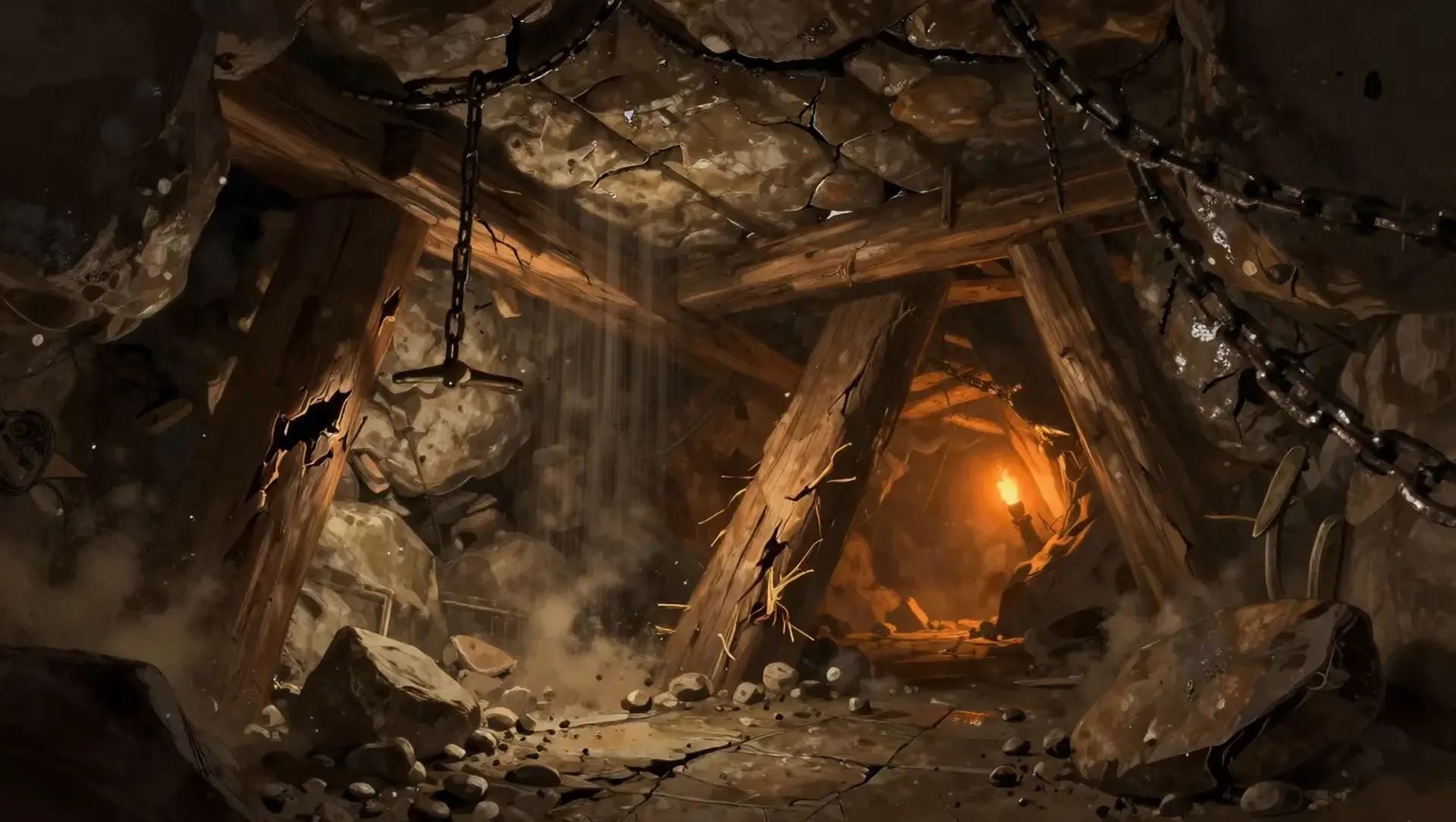
Failing Support Tunnel
This hazard represents a stressed tunnel on the edge of failure. It is less a single explosive trap than a living emergency, with support beams cracking, stone shedding, and pockets of instability responding to movement and noise. At the table, it should feel like the chamber is pressuring the party to move fast, choose routes carefully, and spend actions on survival instead of bravado.
Failing Support Tunnel
Defenses
Detection
“A long tunnel of warped timber braces, cracked stone ribs, and sagging support chains. Fine dust sifts from the ceiling in constant little curtains, and every few moments a deep, hollow groan rolls through the passage like the tunnel is breathing through clenched teeth.”
Standard Engagement
The tunnel is triggered by heavy vibration, loud force, combat stress, or any action that meaningfully disturbs the compromised supports. The first round after the trigger, the hazard begins shedding debris and becomes active.
On its turn, the tunnel creaks and sheds debris. If at least one creature is within the hazard's area, the hazard makes its Ceiling Shower effect against all creatures in the area. If the hazard has taken 6 or more damage since the end of its last turn, or if a creature critically fails to Disable it, the ceiling gives way and the Full Collapse effect occurs immediately.
The hazard does not reset once it fully collapses. If partially stabilized, it can become a new unstable tunnel at the GM's discretion after significant repairs.
The first time each round that a creature moves more than half its Speed within the hazard's area, or uses a spell or effect with the attack or loud auditory flair at the GM's discretion, the tunnel shudders. Loose stone showers the area and each creature in the hazard must attempt a DC 19 Reflex save.
The tunnel gives way in a heavy collapse. Each creature in the hazard's area must attempt a DC 19 Reflex save. On a failure, the creature takes 2d10 bludgeoning damage and is knocked prone. On a critical failure, the creature takes 3d10 bludgeoning damage, is knocked prone, and is buried under rubble.
A buried creature is immobilized and begins suffocating if unable to breathe. It can Escape or otherwise clear itself with DC 19 Athletics, Acrobatics, or a suitable tool use, at the GM's discretion. A buried creature is also concealed by rubble and difficult to locate without a successful search.
While the hazard remains active, any creature that enters, leaves, or begins its turn in the hazard's area treats the area as difficult terrain from loose rubble.
If a creature spends 2 or more actions in the hazard's area without attempting to disable, stabilize, or intentionally brace the tunnel, the GM may call for an immediate Ceiling Shower effect to reflect the extra strain.
Turn Failing Support Tunnel into a sheet
A high-res, share-ready sheet you can post or print.