
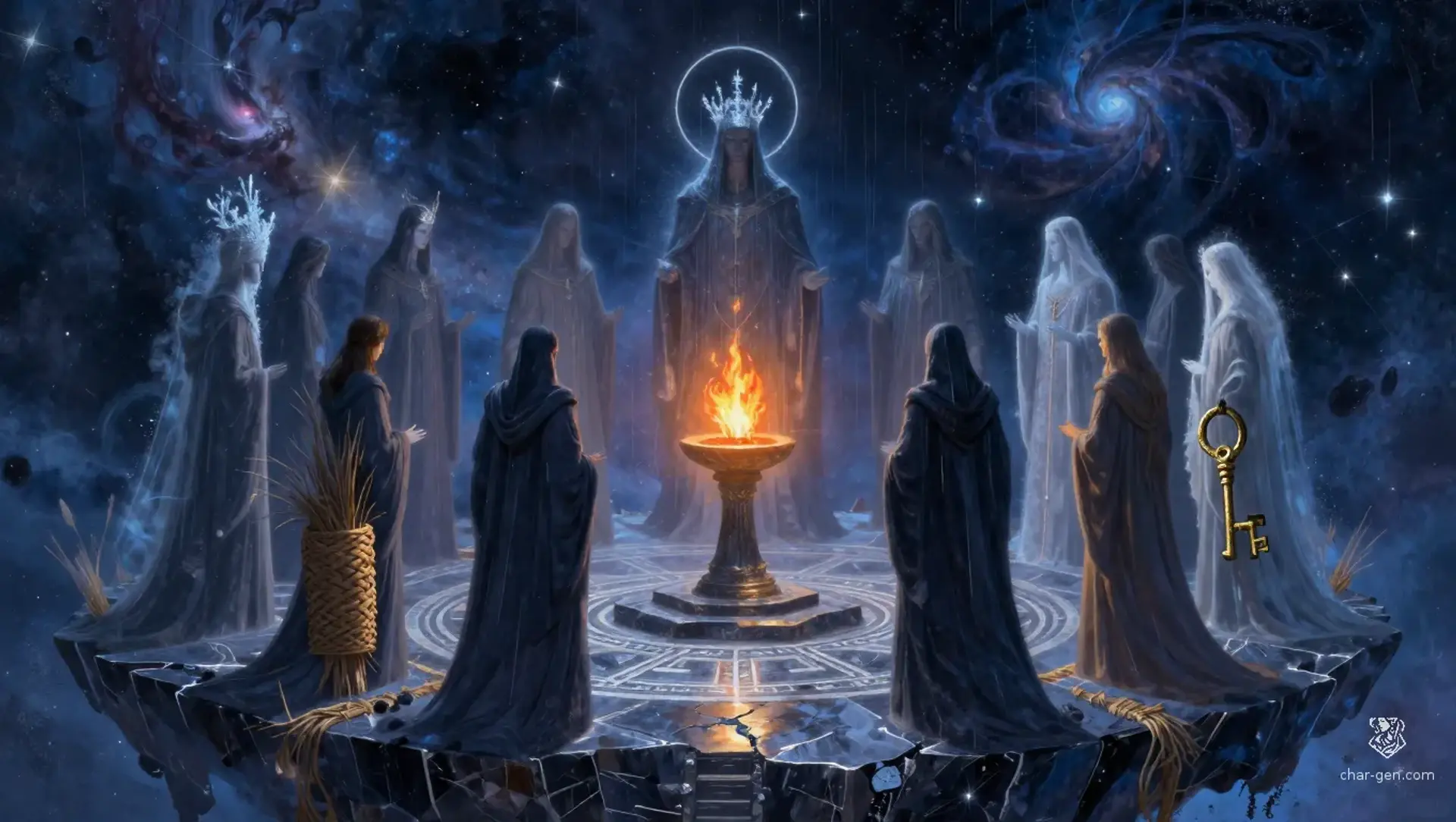
Unnamed Pantheon
Origin
The gods are said to have emerged from the first division of the Long Silence, when Asterion made measure and the other powers answered from the newly separated distances. No mortal record captures the true beginning; every tradition agrees only that the world became knowable after the gods learned to remain apart.
Cosmology
At the beginning, there was only the Long Silence, until Asterion drew a first measure through it and the world gained distance, sequence, and mortal duration. The elemental gods arose from the corners of that measure: Brannoc in heat, Sylth in cloud and rain, Eir in motion, Morra in weight, and Vhal in depth. The remaining divinities formed as reflections of the same order: Solenne to mark distant guidance, Ilyra to preserve likeness, Umbel to name thresholds, Nox to embody absence, Thren to close what must end, and Caelun to keep the old hunger of the void from swallowing the road between stars. Together they maintain a world that feels large, remote, and only partly knowable.
Structure
The religion is a loose constellation of temple-houses, roadside shrines, cliff observatories, burial gardens, and gate sanctuaries. There is no single earthly pope; instead, each region keeps a hierarchy suited to its dominant god or goddess. Scholars maintain the cycles of Asterion, wardens serve Umbel, tide-priests serve Vhal, forge-houses serve Brannoc, and funerary orders serve Thren. Pilgrimage routes are important, but they are long and sparse, reflecting the gods’ own remoteness.
Mortal Relations
Mortal civilizations experience the gods as remote patrons rather than ever-present rulers. Temples are often isolated observatories, cliff shrines, gate-houses, and tomb gardens. Most people pray to one or two gods for specific needs, while state religions try to balance Asterion, Morra, and Umbel to preserve law, land, and succession. Seafaring cultures lean toward Vhal and Solenne, frontier folk toward Eir and Brannoc, and secret societies toward Nox or Caelun. Open miracles are rare, so faith is expressed through calendars, taboos, and ancestral practice more than spectacle.
Afterlife
The dead are gathered into the Pale Distance, a quiet expanse of starless roads and far horizons. Souls do not blaze or judge themselves; they drift toward the deity whose dominion best matches the shape of their lives, then pass into memory, weather, or timeless service. Those who resist all claims become nameless echoes in the margins between worlds, where the Time God alone can still hear them.
Turn Unnamed Pantheon into a sheet
A high-res, share-ready sheet you can post or print.