
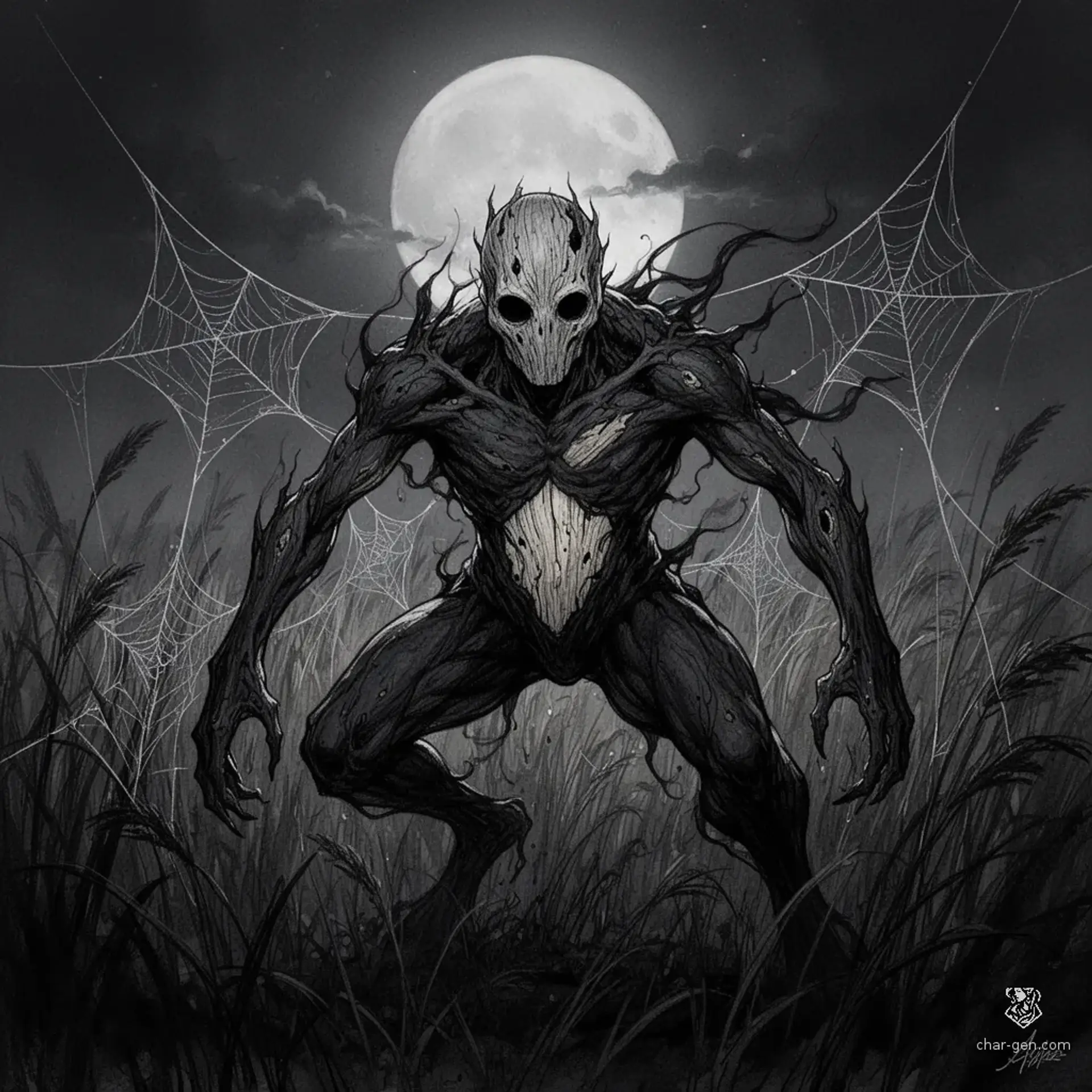
Unnamed pantheon
Origin
According to the oldest Thornwhisk songs, the pantheon arose when the first living web was spun between two saplings by a hungry but patient spider and a compassionate gardener. The gods are said to have grown from that act: some from the need to protect, some from the need to prune, some from the need to feed, and some from the need to remember. Their origin story teaches that nature was never a single voice, but a woven chorus.
Cosmology
Reality is imagined as the Great Underbough, a world-tree whose roots drink from memory and whose branches hold the paths of weather, beasts, and omens. Beneath its roots hangs the Briarweb, an invisible lattice of silk-fate spun by Silkspawn and maintained by the others through seasons, births, hunts, and burials. Everything natural is purposeful: leaf-fall, venom, blossom, storm, burrow, and migration each serve a place in the weaving. The arachnid aspect of the faith appears in the belief that all living things are, in some way, knot-keepers between a world that eats and a world that grows.
Structure
The religion is organized as a loose grove-council rather than a rigid hierarchy. Each village maintains a hearth shrine to Hushroot, a ledger-stool for Silkspawn, a pruning circle for Veskala, and at least one communal compost pit for Gloomroot. Seasonal rites are coordinated by elder stewards called Threadkeepers, who serve by consensus and rotate responsibilities to prevent any single cult from dominating. Specialized shrines exist for farmers, healers, travelers, judges, and gardeners, but all are linked by the shared idea that a healthy web supports every strand.
Mortal Relations
The Thornwhisk-Folk are a gentle, communal people who see themselves as caretakers of the green world and its hidden threads. They honor these gods through garden shrines, woven charms, seasonal feasts, careful pruning, and nightly offerings of water and honey. Their society values hospitality, shared labor, recordkeeping, and respectful boundaries. Even their warnings are soft-spoken: they teach children how to avoid venomous places, how to soothe frightened animals, and how to prune without harm. Clerics are expected to serve both the hearth and the hedgerow, embodying the faith's conviction that kindness must be practical.
Afterlife
The Thornwhisk-Folk teach that the dead are gently gathered into the Briarweb, a living afterlife of moonlit thickets, silk-lit burrows, and warm root-caverns. Souls first rest in the Spider-Hearth, where Astera and Marrowmoth tend them, then pass into the Green Loom or the Quiet Nest according to the shape of their lives. There is no cruel judgment; even the stern gods guide the dead toward the place they can most patiently belong.
Turn Unnamed pantheon into a sheet
A high-res, share-ready sheet you can post or print.