
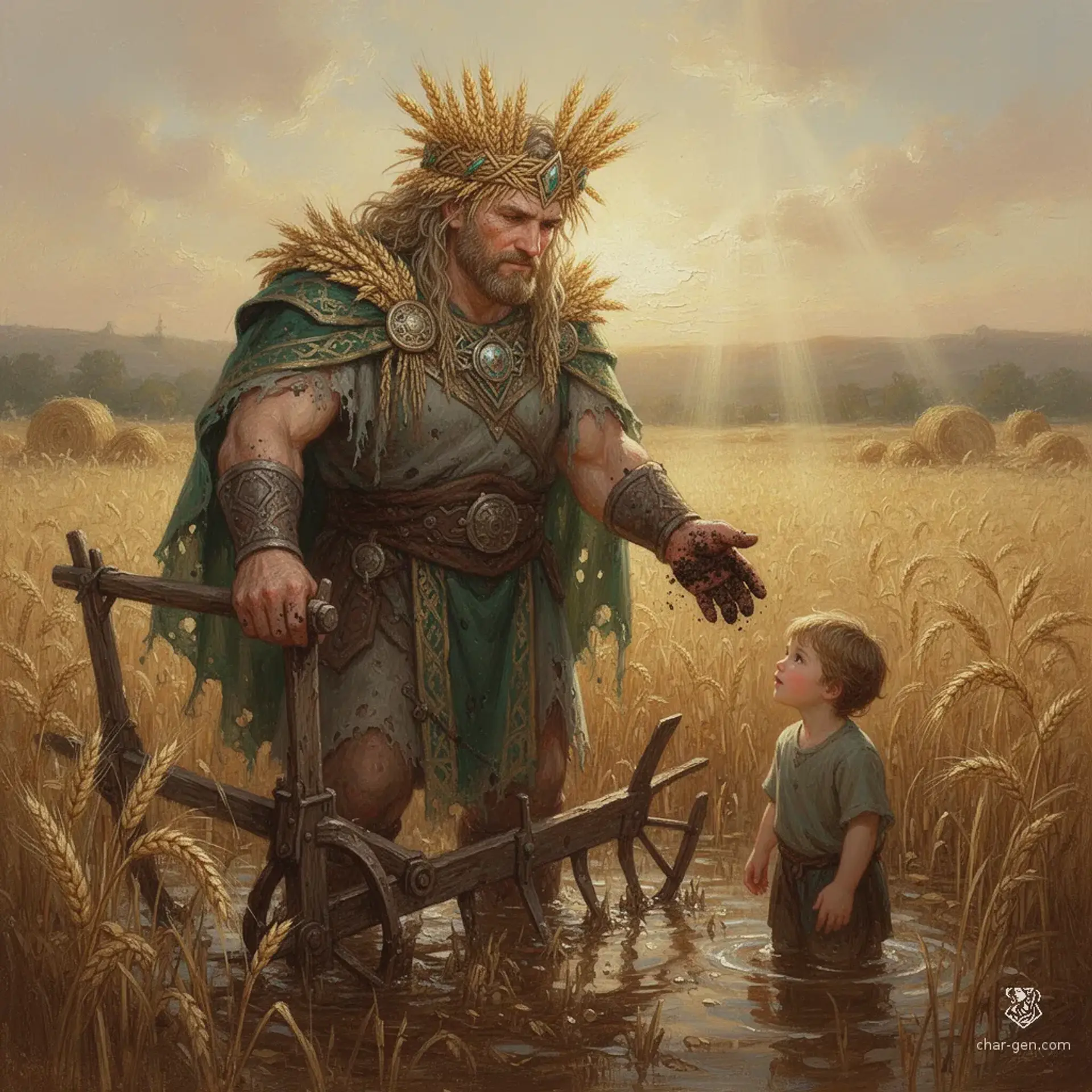
Unnamed pantheon
Origin
The pantheon arose in the oldest barley settlements of Greyharrow, when the first communities survived flood, hunger, and raiders by sharing labor and naming each essential task as sacred. In those early centuries the gods were equal companions: one who taught sowing, one who marked roads, one who counted, one who healed, one who kept the hearth, and so on. As the kingdom centralized, the nobility adopted polished foreign cults and let the old household powers fade, shrinking the pantheon's influence among the elites while leaving the common people as its final faithful.
Cosmology
The world is a broad mortal field ringed by the Old Boundary, a circle of hill, river, root, and stone held in place by the gods' joint labor. Above it lies the Dawn Loft, where Brightren Kest first kindled measure, and below it the Deep Furrow, where Marrow-Sister Vale stores the bones of every season. The gods do not sit apart from creation; they tend it like a shared estate. Each deity has a task, a toll, and a season. Their power rises when mortals repeat those tasks in ritual, and falls when the kingdom forgets the disciplines of work, hospitality, craft, and mourning.
Structure
A loose fellowship of interdependent gods rather than a rigid empire: two greater deities, several major local patrons, and a network of household, roadside, and worksite powers. Shrines are usually paired or clustered, such as hearth-and-healing, road-and-bridge, or harvest-and-accounting. Priests often serve multiple deities. The pantheon has no single pope; instead, village councils, temple matrons, and seasonal processions negotiate ritual order. The faith's authority comes from usefulness, shared memory, and the gods' intimate involvement in mortal survival, not from state power.
Mortal Relations
This religion is inseparable from the daily life of Greyharrow's farmers, millers, builders, servants, and craftsfolk. Nobles may publicly tolerate the gods as quaint provincial customs, but the pantheon survives through the prayers attached to labor: seed casting, bread baking, bridge mending, childbirth, burial, and honest counting. Priests are often village elders, healers, reeves, and itinerant blessers rather than an isolated temple class. The gods answer readily to practical devotion and are most present where mortals are doing difficult, necessary work together.
Afterlife
The dead of Greyharrow pass first through the Lantern Threshold, where the faithful are weighed by the small deeds of ordinary lives: bread shared, backs straightened, debts forgiven, harvests saved, and children raised. Those who honored the pantheon are guided into the Hall of Return, a warm, tilled plain where they labor by choice and feast at dusk beside the ancestors. The forgotten and oath-breakers drift toward the Hollow Fen, a cold marsh of unclaimed names. The gods themselves can reach the dead most easily through prayers made at field edges, millstones, hearths, and bridges, because this pantheon has always lived close to mortal hands.
Turn Unnamed pantheon into a sheet
A high-res, share-ready sheet you can post or print.