
The Court of Astrals
Origin
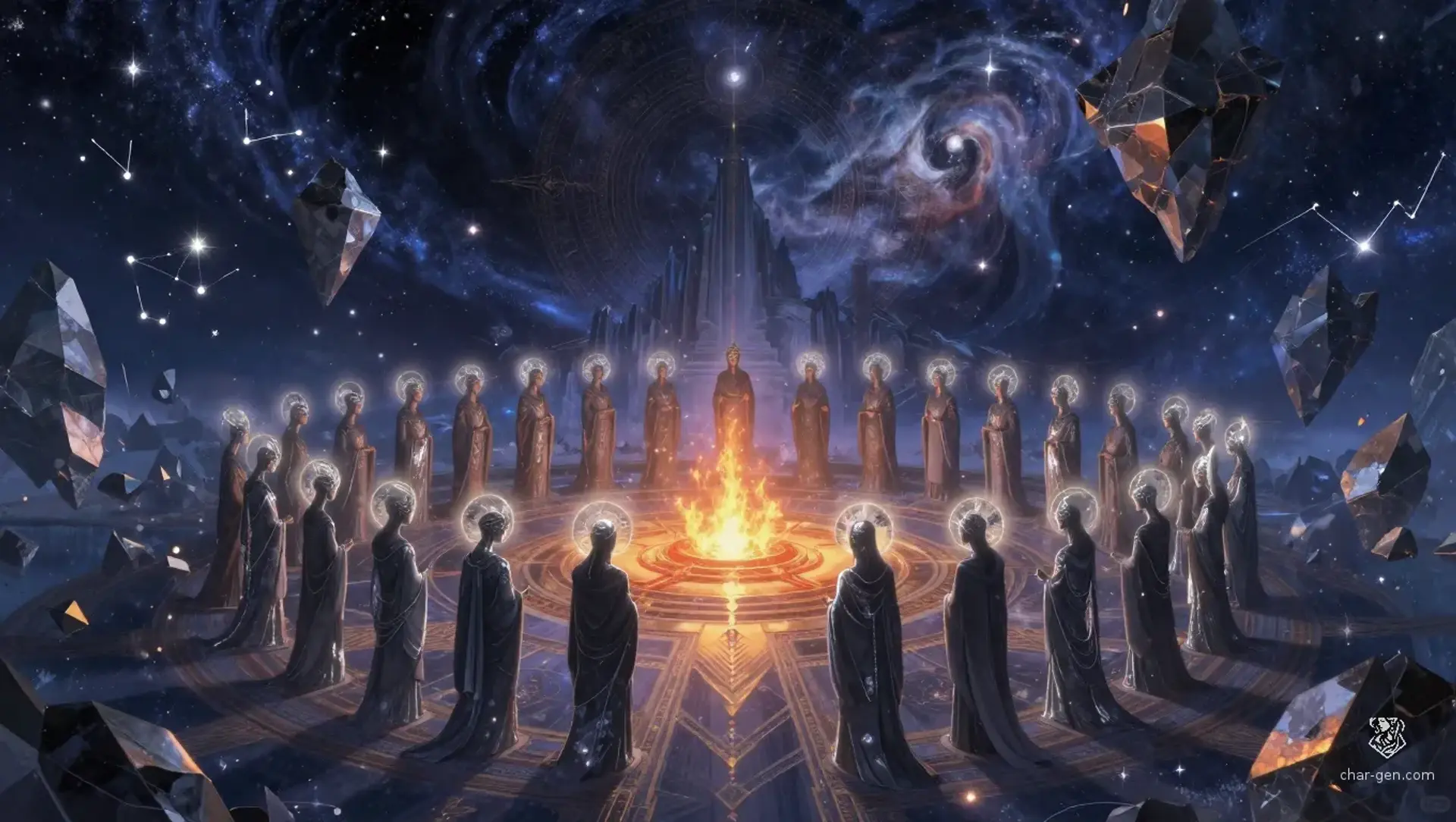
The Court was born when the oldest mortal empires learned to harness chaos as magic and then used that same power to banish the gods from the physical realm. The divine assembly survived by retreating into the Astral beyond the sky, where they rebuilt themselves as a court rather than a conquering throne. Their religion arose from the political truth that the gods are powerful, wounded, and dependent on mortal society, yet still capable of blessing, cursing, and teaching.
Cosmology
Reality is divided into the mortal plane, the Astral Court, and the seam of chaos from which magic arises. The gods do not create magic; they taught mortals how to open the wound where order and possibility meet, and that lesson made them vulnerable to the very people they empowered. The Astral Court floats beyond the sky as a citadel of star-stone islands, oath-bridges, memory seas, and locked gardens of lost seasons. From there the gods can only touch the world through dreams, omens, possessed relics, starfall, and the consent of worshippers. Mortals are not lesser in the cosmology; they are the species that proved it could seize divine knowledge and survive the consequences.
Structure
The religion is organized as a loose imperial court rather than a single church. Major temples are called Halls, and local shrines are often attached to civic institutions such as libraries, forges, hospitals, markets, and graveyards. Each deity has an elected or appointed mortal advocate called a Voice, and the highest clergy meet in seasonal conclaves to arbitrate disputes, share miracles, and negotiate worship quotas. There is no single orthodoxy; instead, doctrine is maintained through precedent, liturgy, and public debate. Heresies are common but usually political rather than purely theological.
Mortal Relations
The religion is intensely mortal-engaged: temples run schools, markets, infirmaries, forges, and courts, because the gods are understood as displaced rulers who still need mortal hands, prayers, and arguments to remain relevant. Clerics, bards, paladins, warlocks, and even skeptical civic officials participate in the faith for practical reasons—protection, legitimacy, spellcraft, healing, trade, funerals, and diplomacy. Worship is less about passive reverence and more about negotiated relationship; priests act as interpreters, contractors, and ambassadors between proud exiles and self-governing cities. Most common people respect the gods but do not fear them as absolute masters, and many churches openly teach that mortals have the right to question divine orders.
Afterlife
The dead do not pass into a distant paradise or inferno; they are drawn into the Astral Court, a silver-lit dominion beyond the sky where the banished gods convene in masked procession. Souls are weighed by memory, oath, and the use they made of magic, then assigned to quiet service, dream-labor, or one of the Court's endless galleries. Those who honored the gods may become petitioners, scribes, or attendants in the reflection-halls; those who abused chaos-magic are folded into storm-banks and shattered constellations that fuel the Court's wards.
Turn The Court of Astrals into a sheet
A high-res, share-ready sheet you can post or print.