
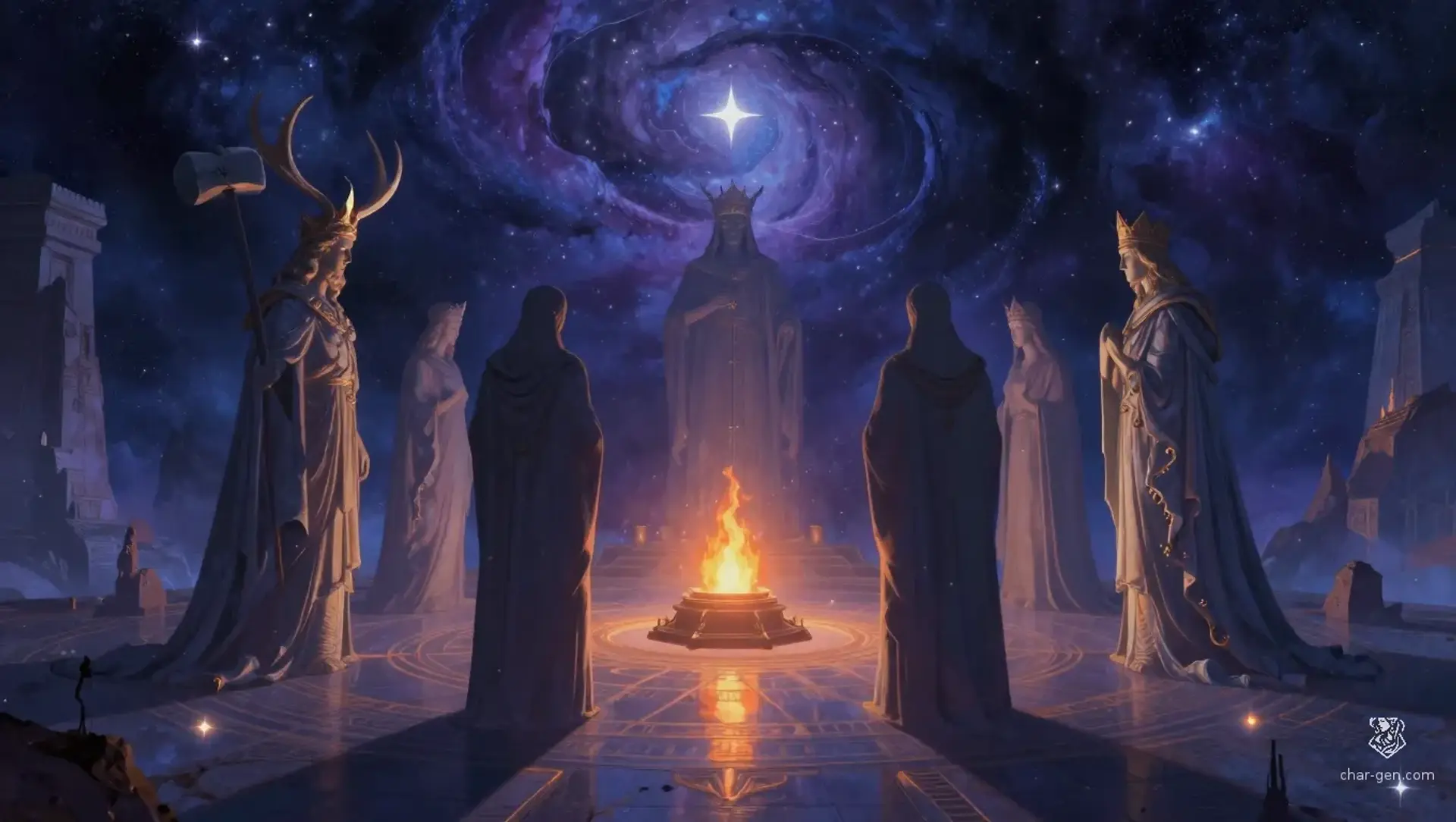
The Sixfold Hearth-Bond
Origin
According to the oldest songs, the six deities emerged when the first mortal peoples faced starvation, disorder, and forgetting. Veyra taught them to build; Rakal taught them to endure the wild; Sair taught them to keep promises; Oth taught them to meet across distance; Mera taught them to remember; and Marrow-Nine arose from the leftover rot of all failed kinship, becoming the warning that makes every blessing matter.
Cosmology
The gods are not distant creators but elder exemplars who first taught mortals how to become fully themselves: smiths learned from Veyra, hunters from Rakal, judges from Sair, wanderers from Brine-Kin Oth, and scholars from Whisper-Quill Mera. Each deity shapes a living current in the world, and mortals of the right class, clan, or species can attune to that current through vows, inheritance, and rite. The cosmos is imagined as a woven road: hearth, hunt, law, tide, memory, and plague all tug at the same cloth, and the pantheon is the loom that keeps it from unraveling.
Structure
A six-deity council centered on the sacred interplay of hearth, hunt, law, roads, memory, and decay. Veyra, Rakal, and Sair form the high triad of sustaining powers; Oth and Mera serve as connective powers; Marrow-Nine is the permitted wound in the system, feared but never fully erased. Temples are usually multi-shrined compounds where each deity has a distinct room, symbol, and rite, but shared festivals emphasize cooperation.
Mortal Relations
The gods are actively worshipped by households, clans, guilds, and species communities; they answer prayers through omens, blessings, taboos, and occasional direct avatars. Their priests serve as mediators, smith-blessers, trail-guides, and record-keepers, so religion is woven into politics, trade, inheritance, and survival rather than isolated from daily life.
Afterlife
The dead are sorted into six waiting halls that mirror the living clans' duties: the Halls of Ash for smiths and wardens, the Green Wake for growers and healers, the Sky-Court for messengers and judges, the Deep Feast for hunters and revelers, the Quiet Loom for ancestors and scholars, and the Far March for oathbreakers and exiles. Souls are not eternally trapped; they may petition for rebirth, service as household spirits, or promotion into ancestral attendants if their descendants keep the proper rites.
Turn The Sixfold Hearth-Bond into a sheet
A high-res, share-ready sheet you can post or print.