
DND Tavern Generator: Build Inns Players Remember
Use a dnd tavern generator to create fantasy inns with NPCs, menus, rumours, maps, and hooks that actually reach the table.
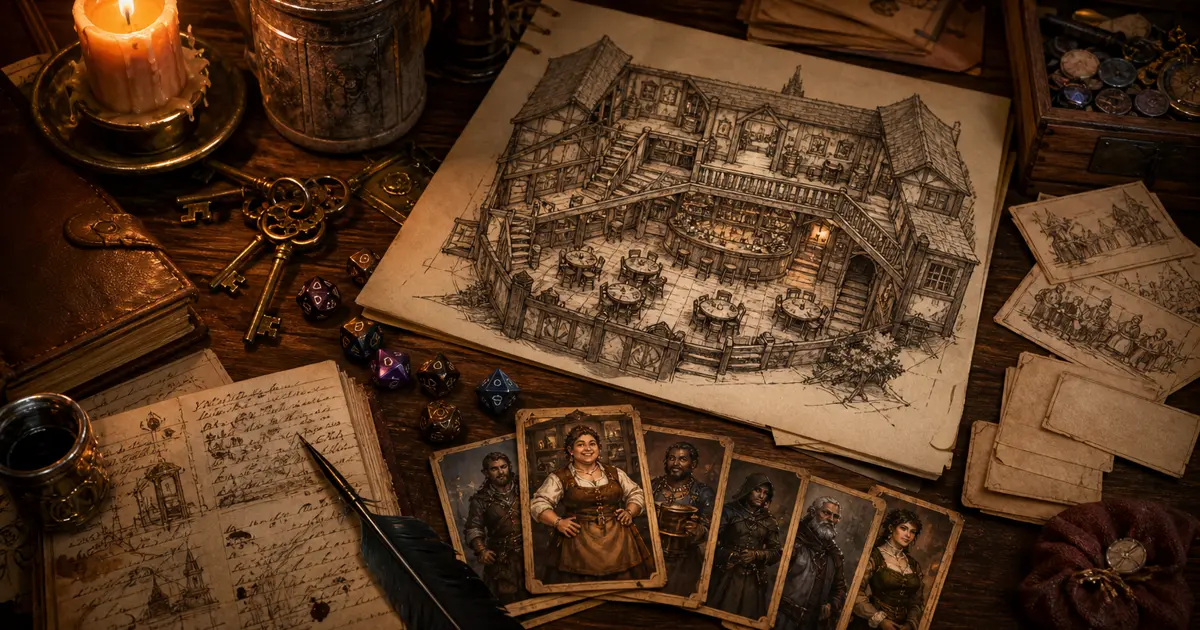
A good dnd tavern generator needs to do more than name a pub after an animal and a body part. I can invent The Drunken Stag before the kettle boils. The hard bit is making the place useful when players arrive, ask what smells good, accuse the innkeeper of lying, befriend a cardsharp, and decide the cellar is obviously hiding something because I paused for half a second.
Taverns are small locations with big table pressure. They are rest stops, rumour mills, job boards, safe houses, ambush sites, meeting rooms, social arenas, and sometimes the party's emotional support building. A weak tavern gives you a name, a barkeep, and maybe a stew. A good one gives you a reason for the party to stay long enough for something to happen.
CharGen's Tavern Generator is built for that second job. It creates a tavern name, tavernkeeper, regular patrons, atmosphere notes, menu items, rumours, plot hooks, quirks, amenities, and matching artwork. The page calls the empty state Your Tavern Awaits, and the main button is Generate a Tavern Now. That sounds simple, but it is exactly the shape I want when a travel session suddenly becomes a social session.
Right, so this is not a list of funny inn names. It is a practical way to turn a generated tavern into five to twenty minutes of actual play without writing a small hospitality novel.
If you are searching for an ai tavern generator dnd workflow, the useful question is not which tool can produce the longest description. It is which one gives you a tavern you can run before the party finishes debating room prices.
Why a dnd tavern generator needs table pressure
Most tavern prep fails because it stops at ambience. The note says warm hearth, pipe smoke, cheerful locals, and then the players ask who is arguing in the corner, what the house drink costs, who knows about the ruins, and whether they can rent the loft for a private meeting. Suddenly the cosy inn is a blank room with mugs.
The 2024 Dungeon Master's Guide on D&D Beyond puts social interaction in the same practical bucket as exploration and combat. That matters for taverns because an inn is rarely only scenery. It is where the party tests trust, spends money, picks up rumours, and chooses which local problems deserve attention.
Search results show the same split. Tool directories list old reliable generators like Donjon, menu-focused tools from The Thieves Guild, and bigger town generators from Kassoon. TTRPG Tools describes Donjon's random inn generator as producing names, menus, staff, patrons, and rumours, while The Thieves Guild focuses on tavern name, description, bartender profile, and food or drink menus. Those are useful jobs. The gap is what happens after the party decides to care.
I judge tavern tools by five questions:
| Question | Why it matters |
|---|---|
| Who runs the place? | The tavernkeeper is usually the first social anchor. |
| Who is already there? | Patrons turn a room into a scene. |
| What can the party buy? | Menus, lodging, stables, private rooms, and favours matter. |
| What local news leaks here? | Rumours connect the tavern to the wider campaign. |
| What changes if the party returns? | Recurring places need memory or they become vending machines. |
The last question is the big one. If a tavern can return three sessions later with changed staff, a new rumour, a missing patron, or a repaired sign after the barbarian incident, the players will treat it like part of the world. If it resets every visit, it is background colour.
What CharGen's tavern generator creates
CharGen's Fantasy RPG Tavern Generator is deliberately framed around DM prep. The page promises tavern names, NPCs, menus, lore, and story hooks, then backs that up with the pieces I actually need. It also sits inside the RPG Workshop, so I can move between Tavern, NPC, Shop, Loot, Settlement, Region, and Faction without rebuilding the whole session in another tab.
The current tavern page highlights four core outputs:
| Output | How I use it at the table |
|---|---|
| detailed tavern atmosphere | one read-aloud sentence, plus sensory notes I can reuse |
| unique patrons and staff | people to talk to, bribe, annoy, hire, or suspect |
| menu and drink specials | quick answers when players order food or buy rounds |
| rumours and plot hooks | ways to point the party towards trouble without forcing it |
The Tavern Type examples are useful too: Cozy Village Inn, Dockside Tavern, Noble's Rest, Adventurer's Haven, Mountain Lodge, Elven Wine House, Underground Den, and Roadside Inn. I like that spread because taverns are not all the same social room. A noble wine house should not feel like a dockside dive with better chairs.
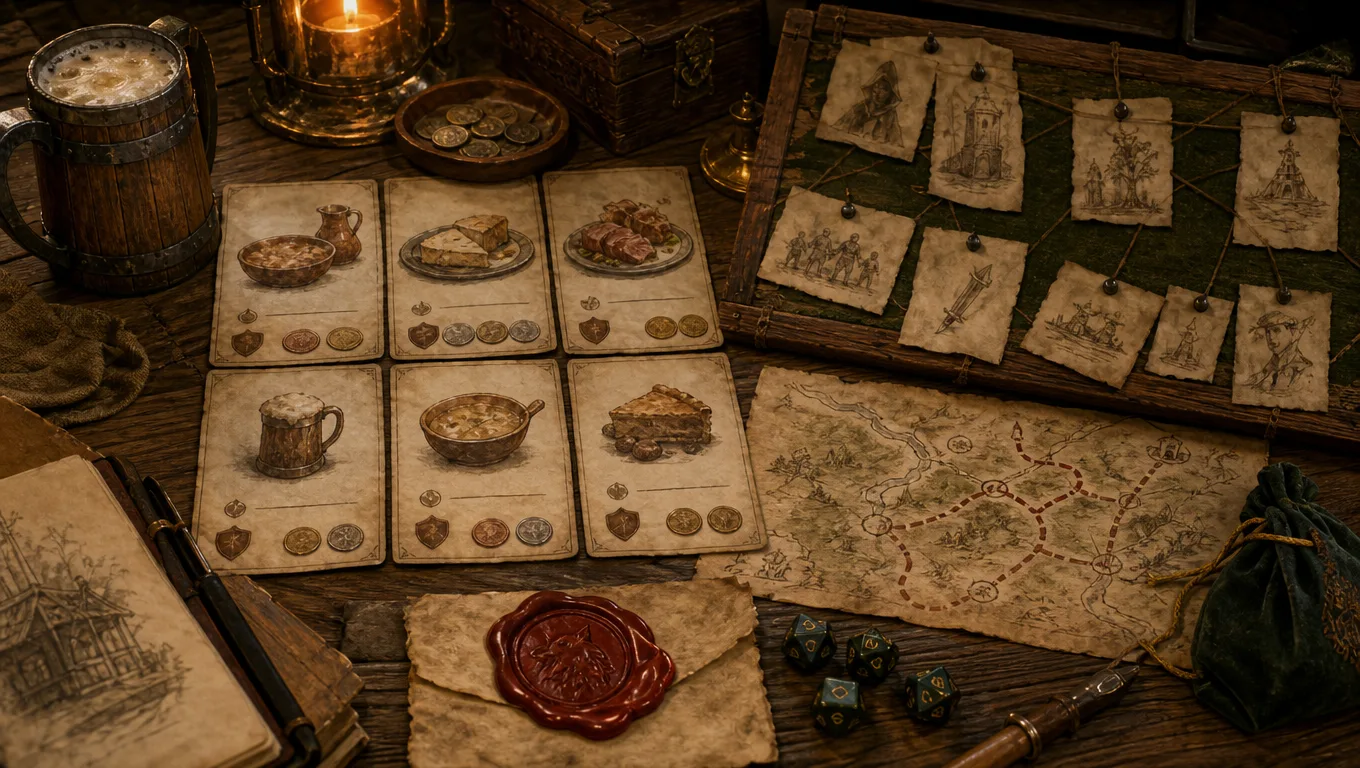
Here is how I would turn one generated tavern into table notes:
| Generated detail | Table version |
|---|---|
| tavern name | The Moth and Mallet |
| type | dockside tavern |
| tavernkeeper | Sella Brine, retired boatswain, hates unpaid tabs more than ghosts |
| menu | eel pie, black bread, hot cider, cheap crab broth |
| rumour | three ships paid extra to unload at night, then vanished from the harbour book |
| patron | a nervous clerk with ink on both cuffs and a sealed customs tag |
| hook | the cellar wall sweats salt water even at low tide |
That is a session seed. The party can buy a meal, follow the clerk, inspect the cellar, question the boatswain, or ignore all of it and still remember the place because it has a clear texture.
The five-minute tavern workflow I use
When I need a tavern fast, I do not start by naming it. I start by deciding what job it has in the session.
| Minute | Action | Output |
|---|---|---|
| 0-1 | choose the tavern's job | safe rest, rumour hub, trap, meeting place, social test, or recurring base |
| 1-2 | pick a tavern type | dockside, village, noble, road, mountain, underground, elven, adventurer |
| 2-3 | add one local pressure | missing caravan, guild feud, bad harvest, plague rumour, monster tax, secret auction |
| 3-4 | generate in CharGen | name, keeper, patrons, menu, rumours, hooks, quirks, artwork |
| 4-5 | cut to table notes | one face, one menu item, one rumour, one complication, one return detail |
My favourite prompt shape is plain:
Dockside tavern in a rain-heavy port district. Party level 5, D&D 5E. The innkeeper is hiding ledgers for a smuggling guild. Include a cheap menu, two suspicious regulars, one honest rumour, one false rumour, and a cellar clue connected to a missing ship.
That gives the generator a place, a system, a party level, a social secret, menu needs, and rumour structure. It also tells the tool that not every rumour should be true. Players love rumour tables, but they become too clean if every line points straight at the plot.
A shorter prompt works when I am improvising:
Roadside inn near a haunted milestone, cosy but worried, good for level 3 D&D characters, one patron knows too much.
I would use that when the party unexpectedly stops for the night. The result does not need to be perfect. It needs enough friction to stop me saying, "There is a bartender, he is normal, what do you do?"
Generate a Tavern FreeA fantasy inn creator should make people, not furniture
Furniture helps, but people make the tavern playable. A beautiful common room is still dead if nobody wants anything. I want a fantasy inn creator to give me at least three human-scale handles: someone who can help, someone who can cause trouble, and someone who knows more than they admit.
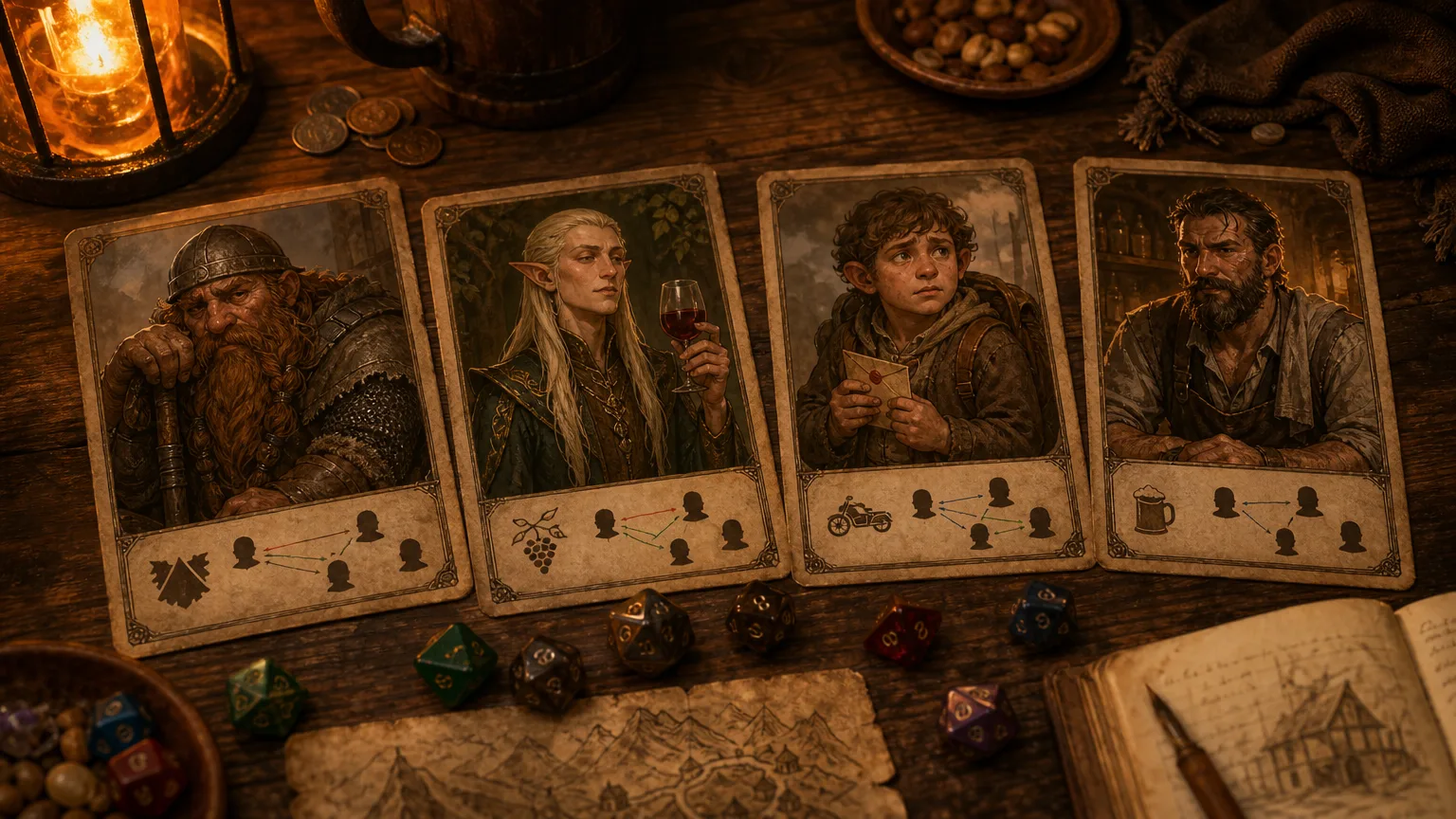
Here is a patron mix I use all the time:
| Role | Example | Table use |
|---|---|---|
| tavernkeeper | Sella Brine, retired boatswain | sets the house rules, controls gossip, knows who pays late |
| useful regular | Gerren Pike, mule handler | can guide the party, but wants protection on the road |
| problem guest | Lady Amryth, travelling noble | starts a social mess, hides a real fear under bad manners |
| local witness | Pell, halfling courier | saw something, does not know what it means |
| background texture | three fishers playing a bone dice game | makes the room feel occupied without stealing focus |
Worth mentioning though, I do not need five full biographies. I need one line each and a reason they might speak. The innkeeper can be deeper because the party will almost certainly talk to them. The regulars can stay lighter until players show interest.
My patron note format is:
Name, visible detail, want, secret or pressure.
For example:
| Patron note | Why it works |
|---|---|
Pell, mud on one boot, wants a private room, carrying a customs tag from a ship that has not arrived | immediate visual cue plus a mystery |
Lady Amryth, gloves never removed, wants silence, hiding a bite mark under a lace cuff | social tension plus possible danger |
Gerren Pike, patched cloak, wants escorts, owes money to the Moth and Mallet | hireling hook plus local debt |
That is enough to roleplay from. If a player asks for more, I can generate an NPC from the NPC Generator and link them later.
Menus matter more than DMs admit
Players ask about food because food is a safe way to poke the fiction. A menu tells them where they are, how rich the area is, what the climate is like, and whether the innkeeper has taste or problems. It also gives socially awkward tables something easy to do before the plot starts.
I want three menu tiers:
| Tier | Example | Use |
|---|---|---|
| cheap | crab broth, black bread, small ale | tells broke characters what the locals eat |
| house special | eel pie with peppered onions | gives the place identity |
| suspicious | red wine from a town nobody trades with anymore | points at trouble without a speech |
A fantasy menu creator that only makes funny drink names is fine for a quick laugh. A useful menu does more. It hints at trade routes, shortage, religion, class, and weird local habits. If a mountain lodge serves fresh citrus, that should mean something. If a village inn serves only thin oat stew and pickled turnip, the harvest probably went badly.
Here is how I would improve a generated menu before play:
| Generated item | Better table version |
|---|---|
fish stew | pepper-crab broth, too hot, 2 cp, served in chipped blue bowls |
house ale | black-malt ale, 4 cp, sour finish, brewed by the shrine sisters |
roast chicken | salt-baked river hen, 6 sp, only available if the road north is open |
fine wine | amber plum wine, 2 gp, from a noble house that officially denies selling it |
The prices do not have to be perfect. They need to feel consistent. I usually keep D&D food costs close to the Player's Handbook baseline, then adjust for poverty, isolation, war, or a noble district. A tavern in a besieged city can charge silly money for bread, and the players will understand the situation before anyone explains it.
Best tavern generator D&D 2026: quick picks
No single tool owns this category. I use different tools for different tavern jobs.
| Tool | Best for | What I like | Main limit |
|---|---|---|---|
| CharGen Tavern Generator | AI taverns with NPCs, menus, rumours, hooks, art, and campaign handoff | produces a playable location, not only a name or menu | you still need to cut details to fit the scene |
| Donjon Random Inn Generator | old-school quick random inns | fast, free, familiar, no account friction | less campaign context control |
| The Thieves Guild Tavern and Menu tools | detailed D&D 5E food, drink, and tavern flavour | good menu work and useful filters | weaker if you want linked NPCs, art, and campaign memory |
| Kassoon town tools | taverns inside a wider town result | good when you need shops, temples, streets, and a settlement at once | tavern detail can be secondary to the town |
| Fantasy Name Generators | names and signs | huge naming coverage | not a full tavern scene |
| Your notebook | important recurring home base | total control | slower when the players detour tonight |
My split is simple. If I only need a name, I use a name list. If I need a whole town, Kassoon or a settlement generator makes sense. If I need a dnd inn generator that turns the tavern into a session location with people, rumours, a menu, and visuals, I use CharGen.
The reason is not that AI is always better. It is that taverns connect several prep jobs at once. The barkeep might become an NPC token. The rumour might point to a Dungeon Generator output. The cellar clue might become a Puzzle Generator scene. The argument at table three might connect to a Faction Generator. A plain name generator cannot carry that chain.
That is also why I treat "best tavern generator dnd 2026" as a workflow search, not a single-feature search. A fantasy tavern generator should create the location, but a random tavern generator dnd tool is only half useful if I still have to make every patron, rumour, image, and follow-up note somewhere else.
Turning a generated tavern into a recurring campaign location
The first visit is easy. Recurring taverns need a different skill: continuity.
I keep a tiny return log:
| Visit | What changed |
|---|---|
| first visit | the Moth and Mallet is busy, Sella hides ledgers, Pell carries the customs tag |
| second visit | the side window is repaired, Pell is gone, Sella now trusts the cleric |
| third visit | a guild agent drinks in the back room, the house ale price doubles |
| fourth visit | the cellar is dry for the first time, which is worse |
That is all. Four lines can make a tavern feel alive. Players do not need a detailed economic model. They need proof that the place remembers them.
CharGen helps because generated taverns can live alongside other campaign entities in the World Codex. The tavern can link to a settlement, and NPCs inside it can become their own notes. After the session, RPG Session Notes can turn the tavern scene into clean recap notes, which is useful when the party returns weeks later and expects you to remember which chair exploded.
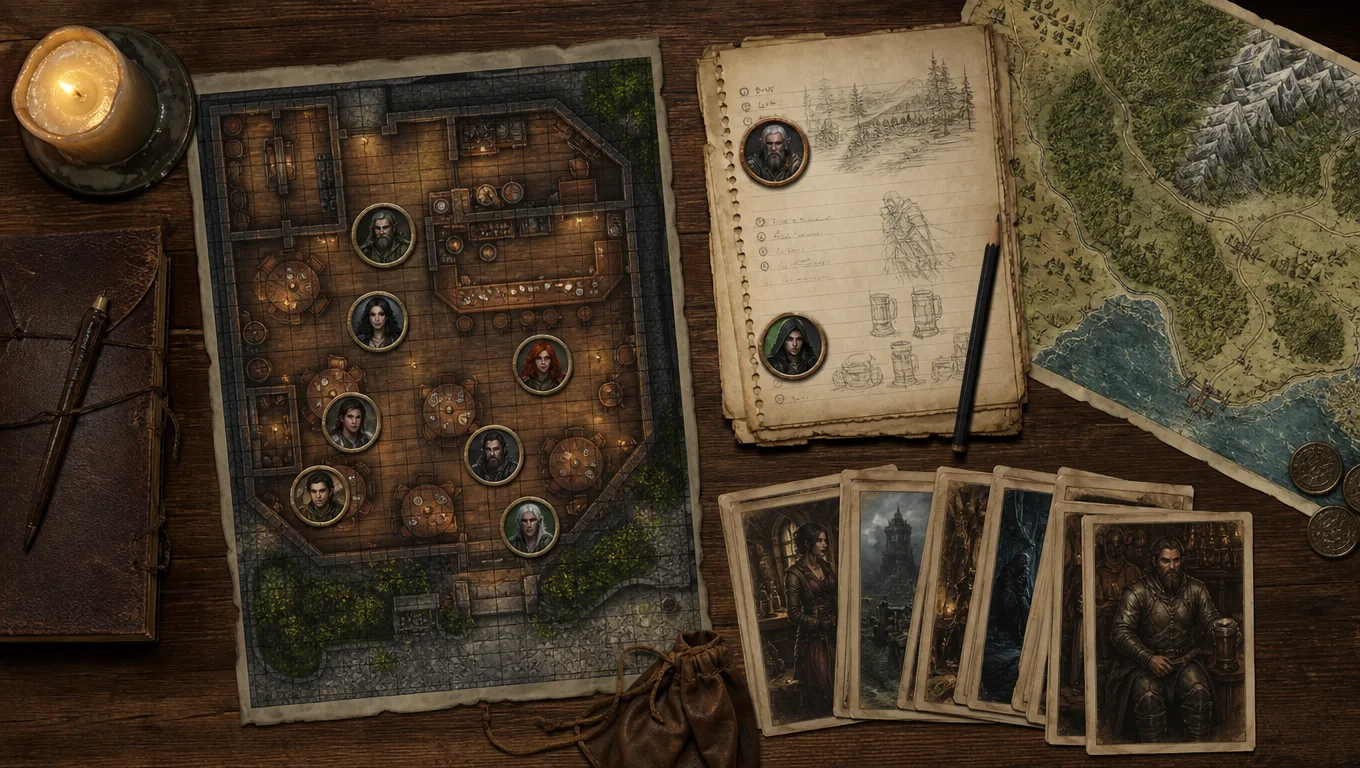
For VTT prep, I keep the handoff small:
| Asset | When I make it |
|---|---|
| exterior or interior art | if the tavern is a recurring place |
| top-down map or battlemap | only if a fight, chase, or secret room is likely |
| NPC tokens | only for named patrons likely to return |
| menu handout | if food, prices, or social cover matters |
| rumour card | if I want players to keep a clue |
Do not make twelve tokens for background drinkers. I have done it. It feels productive and then nobody cares. Make the innkeeper, the suspicious courier, the guild agent, and maybe the bodyguard. Leave the fishers as description unless the party adopts them, which they will do out of spite if you prepare nothing.
Tavern hooks that do not feel like quest boards
A quest board is fine. I still use them. But the best tavern hooks arrive through normal tavern behaviour.
| Tavern moment | Hidden hook |
|---|---|
| a regular refuses the house stew | the meat supplier changed after a monster attack |
| the innkeeper waters the ale | a guild debt is choking the business |
| a private room stays locked | a witness is hiding upstairs |
| the stable boy burns a saddle | he saw the rider return without a face |
| a noble pays in foreign coin | the coin is from a kingdom that closed its borders years ago |
| every mirror is covered | something in the tavern cannot be reflected safely |
I prefer hooks that start as details. Players feel clever when they notice them. If I need to be more direct, I let an NPC ask for help after the party has already interacted with the place.
Here is a full example from the Moth and Mallet:
| Detail | Hook |
|---|---|
| the cellar wall sweats salt water at low tide | a buried shrine below the tavern is opening |
| the cheap crab broth tastes metallic | the crabs have been feeding near a wreck full of alchemical cargo |
| Pell carries a customs tag from a missing ship | someone forged the harbour records before the ship vanished |
| Sella keeps every broken mug | each mug belongs to a sailor who never came back |
None of that needs a speech from a hooded stranger. It only needs players who ask normal questions.
Common mistakes to fix before running the tavern
Generated taverns still need DM judgement. I always check for these problems before the session.
| Mistake | Fix |
|---|---|
| too many patrons | keep three named people and make the rest background |
| menu with no local logic | tie one dish or drink to trade, climate, class, or shortage |
| rumours all point to the same answer | include one false rumour and one unrelated local truth |
| tavernkeeper has no desire | give them a want, debt, fear, loyalty, or rule |
| hook starts too loudly | hide it inside a normal tavern moment first |
| no return detail | decide what changes if the party comes back |
| no link to wider prep | connect the tavern to a settlement, NPC, faction, dungeon, or recap |
The biggest mistake is making the tavern too clever. Players came in to rest, gather news, and decide what to do next. If every mug, song, floorboard, and menu item screams secret plot, the place becomes exhausting. Pick two important details and let the rest be comfort.
I also avoid making the innkeeper the only useful person. That turns every tavern into a counter scene. Put one clue with a patron, one clue on the menu, one clue in the building, and one clue in local gossip. Players will approach the room in different ways, so the useful material should not all sit behind one conversation.
FAQ
What is the best dnd tavern generator?
For my table, CharGen is the best fit when I need a playable tavern with NPCs, menu items, rumours, hooks, and matching art. Donjon and The Thieves Guild are still useful for quick random inns or menu-first prep, but CharGen is stronger when the tavern needs to connect to a campaign.
Can I use CharGen's tavern generator for D&D 5E?
Yes. The tavern generator is designed for D&D 5E, Pathfinder, and other fantasy RPGs. I add the party level and the local situation, then use the generated NPCs, prices, rumours, and hooks as table notes.
What should every D&D tavern include?
Every useful tavern needs a name, a tavernkeeper, one memorable menu item, two or three patrons, one rumour, one complication, and one reason the party might return. Artwork and maps are helpful when the tavern is recurring or likely to become an encounter location.
How do I make tavern rumours feel natural?
Attach rumours to normal behaviour. A courier asks for a private room, a regular complains about the stew, the innkeeper refuses foreign coin, or a card game stops when a certain name is mentioned. Rumours feel better when they arrive as social texture rather than a list read aloud.
Should I make a battlemap for every tavern?
No. Make a battlemap if a fight, chase, secret room, or tactical scene is likely. For a quick rest stop, a strong image, a menu, and three NPC notes are usually enough. Save the map prep for taverns that matter.
My practical recommendation
Use a tavern generator for structure, then cut hard. Keep one face, one menu item, one rumour, one complication, and one return detail. That gives you enough material for players to interact with without burying the table under inn lore.
For a one-shot, generate a dockside tavern with one honest rumour and one false rumour. For a campaign, generate a recurring tavern, link it to a settlement, and add the innkeeper as a proper NPC. After the session, run the recap through CharGen so the tavern remembers what the party broke, bought, promised, and ignored. Start with CharGen's Tavern Generator, then only make the pieces your next session will actually use.
Image credits
All images in this post were generated for CharGen using WaveSpeed GPT Image 2 at medium quality, then resized and converted for web use.